This Week in Garde Manger – Sandwiches

This week in Garde Manger class they learned about making pickles, condiments and sandwiches. While most people know what a sandwich is, very few can actually make a ‘really good’ sandwich.

Sandwiches draw odd emotions from people. Some love them and some actually get angry at poor little sandwiches. There is a blog where the host actually uses the ‘f ‘ word regarding sandwiches. He seems quite hostile towards them. Amazing.

Really? Get angry at a sandwich?

Some have sworn them off for life, some get sick of them after eating sandwiches day after day after day. (Remember, we always have a choice.)

Some eat the same one always. For instance whenever I go into a Subway or Quiznos, I always order the BMT or Italian, toasted. Hands down, that is my favorite sandwich where ever I go. At home I make a wide variety, but not the Italian ones. I buy those out. Why? I don’t know, it is just the way I do it. My sandwich quirk.

I love a good sandwich. Here is what makes up “good”.

The four sandwich elements:

  • Bread –  sliced varieties, artisan, rolls, buns, wraps, look around, choose what you love or looks great
  • Spread – mustard, ketchup, chutney, relishes, aioli, mayonnaise, dressings , tapenade, taziki
  • Filling  – sliced meats, cheeses, vegetables, bound salads, fruit, cured meats, tinned fish, fried chicken, fish or vegetables
  • Garnish – lettuce, sliced tomatoes, caramelized onions, sliced apples or pears, arugula, spinach

All elements contribute to either a great sandwich eating experience or one that simple stops the growling in your stomach.

Choose great ingredients from each category and you will end up with a nice product. Shake it up and do something different.

Personally every time I eat, I want it to be an experience. Even if it is a snack. Since I have no desire to be fat, overweight or insolent, and considering how much I love food, there isn’t any time for poorly flavored or poorly prepared food.

Student assignments included: muffuletta, gyros (with grilled lamb leg), Italian hoagie, Maine lobster roll, Rubens, open face French radish and ham, Cubans and more.

We did an “Ultimate Dog and Burger Day” but I forgot my camera that day so no photos, sorry. If anyone sends me some of the Dog and Burger Day, I’ll add-on to this post.

Students made mustard, different ketchup styles: mushroom, yellow pepper and tomato – none like Heinz, pickles, aioli, and side things like vegetable chips and Greek fries.

Turkeys and prime ribs were roasted, cooled and sliced. Lamb legs were roasted and grilled. Whole pork loins, seasoned, marinated and roasted for the perfect Cuban sandwich with ham, mustard and pickles. Students made pita for the gyros. (The week after next they start making their own cheese.)

Our kitchens smelled so good!

Next week they start hors d’ oeuvres, canapes and carving skills. Wait till you see what happens to simple vegetables. They also have their first event: “Grazing with Student Chefs” with 125 guests showing up to graze. Come back next week and see what happens.

The students did a fantastic job this week. See the photos of their work and tell me what you think!

This slideshow requires JavaScript.

This Week in Garde Manger I

This was the first full week of classes for Garde Manger.

What is Garde Manger?

“Garde” as we call it, is the art of the cold kitchen. In this class we learn all about cold food preparation and presentation.

Garde covers everything from condiments, salads, sandwiches, vegetable carving, garnishes, pickles, chutney, confitures, jams, buffet and grand presentation displays.

Each week I will post a gallery of our lessons and the students work while classes are in session.

This week the lesson was “Salads“.

Students learned about grain, legume, pasta and green salads; appetizer and entrée portions and buffet or family style presentations.

In addition they learned about oil, vinegar, dressing styles and techniques.

Students learned the nuance of different of vinegar by tasting them over vanilla ice cream. They learned about the different flavors of oils by dipping bread. (The vanilla ice cream makes tasting 20+ vinegar styles so much easier on the stomach at 9 AM.)

Enjoy this visual presentation of students work from “Salad Week”

This slideshow requires JavaScript.

Images of Soup on Sunday 2012

This slideshow requires JavaScript.

Please enjoy these images from Soup on Sunday 2012

Food Safety

English: Template for Template:Food safety

Image via Wikipedia

Nearly every day we hear of  food safety related issues in the news: salmonella, Listeria, E coli, norovirus, hepatitis a,b,c, Shigella contamination and food recalls. While most people think these issues are concern only to the commercial food industry, the truth is these issues matter at home too.

Food safety is a passion of mine. We all expect restaurants to handle the food they prepare safely and not transmit any food borne illnesses. Protecting  public health through training and education is expected, encouraged and required by laws and regulations.

The general public has a notion of what they expect from a restaurant as far as sanitation standards are concerned but neglect to apply those same expectations to their home kitchens.

How well do we do at home?

Food borne illness outbreak investigations begin in the victims home. Often it is found we have made ourselves sick.

If we look at the top five areas the Center for Disease Control and Prevention (CDC) has identified as the most likely to produce a food borne illness, we can analyze how to do better at home.

1. Buying food from unsafe sources

2. Failing to cook food adequately

3. Holding food at incorrect temperatures

4. Unclean equipment and utensils

5. Poor personal hygiene

Let’s take a look at each area and see what we can do to improve the sanitation of our home kitchens. A little knowledge can save a lot of discomfort while preventing a food borne illness outbreak.

1. Buying food from unsafe sources

Know where your food comes from. If you buy from farmers, ask about their agricultural practices. Are they organic? Do they have documentation to prove it? Can you come visit the farm?

For grocers and other markets, look around and see how clean it is. Notice handling habits of employees and don’t be afraid to speak up when you see something you think should be corrected.

Transport your food from the store to home in cooler bags and properly put the food away as soon as you get home.

Use the rule of 2 hours or less out of refrigeration. This includes walking around the store, taking it home, unpacking and putting it away. Do it quickly. Don’t buy groceries and then just “run in for a minute” anywhere. Food has the priority over just about anything else short of a medical emergency.

Remember this rule: Any food that has been out of refrigeration for 4 hours or more has to be thrown away.

Color-enhanced scanning electron micrograph sh...

Image via Wikipedia Color-enhanced scanning electron micrograph showing Salmonella typhimurium (red) invading cultured human cells Credit: Rocky Mountain Laboratories, NIAID, NIH

2. Failing to cook food adequately

Cook poultry well done. That is at least 165°F (74°C) for 15 seconds. There should be no pink or red juices and no red or pink near the bones.

The inside of muscle meat is considered sterile until pierced. So don’t go poking your fork in the steaks for the grill if you want them on the rare side. Poke them only after the outside has been seared.

3. Holding food at incorrect temperatures

Hot food hot and cold food cold. The temperatures are 135°F (57°C) for hot food and 41°F (5°C) for cold foods. Anything in between is optimal for bacterial, viral and parasitic growth.

DO NOT thaw frozen proteins on the counter or in the sink. Thaw in the refrigerator, or under lightly running water that is 70°F (21°C) which means the water is cold, not warm or hot!

Always sanitize the counter, sinks, tools, towels, aprons etc. after handling proteins using a bleach solution of  1/8 tsp bleach to 1 quart of cold water.

4. Unclean equipment and utensils

After each use and before starting another one, all used equipment must be washed, rinsed and sanitized before starting another task. Run things through the dishwasher on the sanitizer cycle with heat dry.

When was the last time you cleaned out the refrigerator and washed all the drawers, walls and shelves? Do this task on a weekly basis and daily as spills occur.

None - This image is in the public domain and ...

Image via Wikipedia

5. Poor personal hygiene

Wash your hands, wash your hands, wash your hands. When handling food, you can’t wash your hands too much.

If you have a wound or injury that has broken flesh, cover the wound with a bandage and wear a glove.

Do not prepare food for other people when you are ill.

Sorting out your home refrigerator

If you know what order foods should be stored in, you can avoid the risk of causing a food borne illness in your home.

Here is a simple rule I call “Swim, Walk, Fly”

From the top down designate areas for:

    • Ready to Eat (vegetables, salads, cakes, fruit, drinks, cheese)
    • Things that swim (fish, shrimp, seafood – fresh and salt water)
    • Things that walk (Beef, pork, lamb roasts or steaks)
    • Walking things that are ground up (Ground beef, ground pork, ground lamb)
    • Things that fly (chicken, quail, turkey, duck, pheasant, squab, eggs)

All flying things are to be on the very bottom. Keeping items in this order will prevent any cross contamination. Teach your family how to properly store things in the refrigerator too.

Cover and label all food correctly.

Date when things go into the refrigerator and then throw them out after 7 days.

Cool food before placing them in the refrigerator. Remember to cool food quickly – four hours or less or else throw it out.

Use ice baths, cut into smaller portions, increase the surface area by spreading the food on a sheet pan are all methods to cool food quickly before storing.

Pack groceries carefully. Keep all proteins in separate plastic bags.

Do not mix muscle meats with ground meats; keep them separated.

Keep all poultry separate from everything.

If you use cloth bags for your groceries, be sure to wash them once a week or more often if they become soiled or stained.

Designate different bags for meat and bags for produce.

Food Safety is not just for professional food handlers. It is for everyone.

A little bit of knowledge can go a long way in preventing some pretty serious food borne illnesses.

Implement your own food safety program at home today.

If you need any help as to how to get started, let me know. I’ll be glad to help.

Sautéed Brussels Sprouts

Ahh! One of my favorite vegetables is Brussels sprouts. These little green cabbage looking things are wonderful as long as they aren’t over cooked.

Truth is you either love them or hate them. I stand firmly in the love category.

They grow on a large stalk and if you can find them on the stalk, buy them that way. The first time I found them on the stalk, I grabbed it, brought it home only to realize the stalk was way too big to fit into my refrigerator. Considering the size of the stalk, I must have been insane at the market when I thought it would definitely fit into the fridge.

Later I realized the stalk can sit on the counter in the kitchen for a few days, while they get eaten up in various dishes.

Brussels sprouts can be steamed, sautéed, baked or roasted, or pickled.  You can use them in soup, as a side dish and in salads. I adore them with Italian dressing and Parmesan cheese.

You can cook them whole, cut them in half or “shave” or shred them into thin slices. There are even Brussels Sprouts with chocolate. And of course, don’t forget, you can always add bacon.

My preference is to use fresh sprouts but if you can’t find fresh one and you absolutely need to have Brussels sprouts, frozen will do in a pinch, although not nearly as wonderful as fresh.

The following recipe is a simple delicious way of serving Brussels Sprouts.

Sautéed Brussels Sprouts with Pecans

  • 1 pound Brussels sprouts
  • 1 Tablespoon olive oil
  • 1 Tablespoon butter
  • 1 cup pecans – halves or pieces
  • 1/2 cup water
  • Salt and pepper to taste

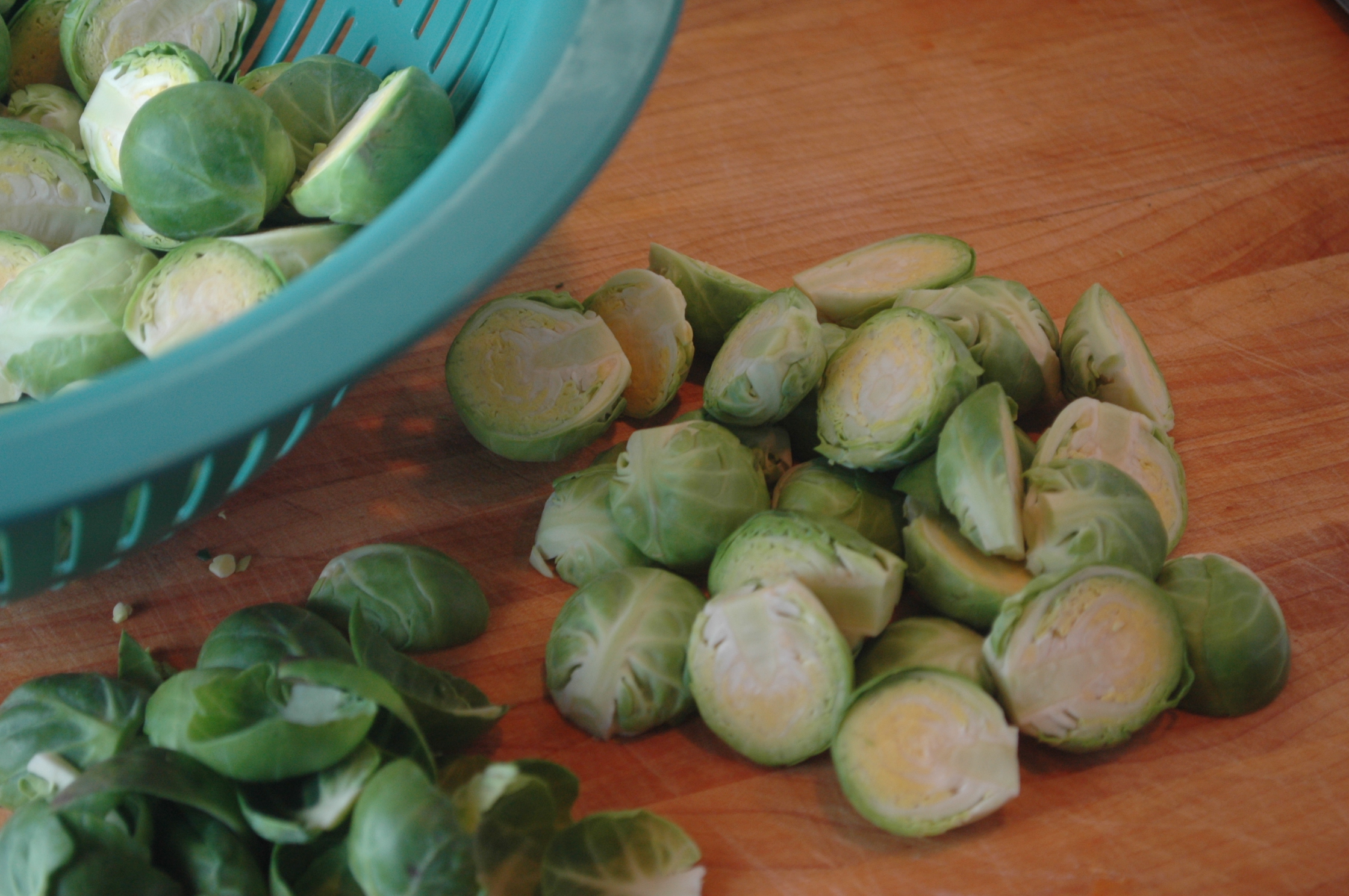
Trim sprouts and cut in half. Rinse under cool water.

Heat a saute pan, add oil. Place the sprouts cut side down in the pan. Allow the cut sides of the sprouts to become golden brown, not black and not pale green but a nice golden color.

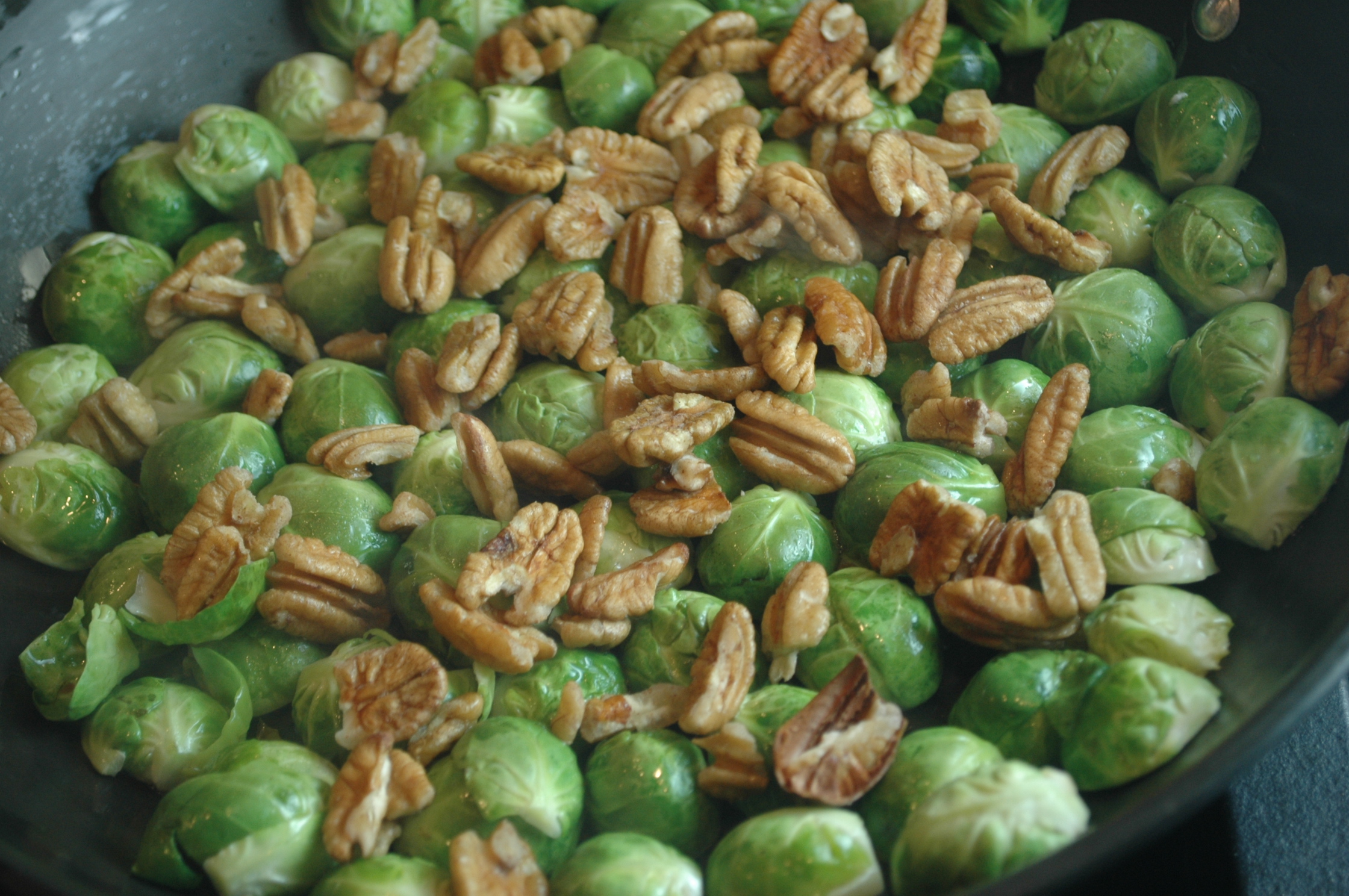
Place the pecans over the sprouts as they are browning. Once the sprouts have  developed the color, stir the pan and add the water to steam the sprouts.

Simmer until the water has evaporated; add butter and stir to glaze the nuts and Brussels sprouts.

Season with salt and pepper and serve.

Trim and wash the sprouts

Place cut side down in a hot saute pan

Put pecans on top

Add water and simmer until water is gone

Serve and enjoy!

Eat More Brussels Sprouts!

Basic Knowledge Every Cook Should Know: Part 1

These are some basic points of knowledge I believe every cook should know.

Knowing how to do these things can make your food more flavorful, easier, cheaper and lots of fun.

In no particular order:

Make your own creme fraiche, yogurt and sour cream

The procedure is basically the same for each.

Yield: 1 quart

1 quart heavy cream or half and half (for sour cream and creme fraiche) or milk (yogurt)

1/3 cup starter culture:

Creme fraiche – buttermilk

Sour cream –  sour cream

Yogurt –  yogurt, plain

Place the dairy product into a non-reactive pot and bring to 185°F. Remove from heat and cool to below 75°F.

For yogurt, add 1 cup dry milk powder and 1 tbsp honey or other liquid sweetener such as agave syrup or maple syrup while heating.

Add the starter cultures after cooling; stir it in well.

Cover and leave in a warm spot overnight or for 12-18 hours. The product is ready when it has thickened.

To make a Greek style yogurt, pour the thickened yogurt into a quadruple folded cheesecloth. Tie the corners so the yogurt can hang from a wooden spoon suspended over a bowl to catch the dripping whey. Overnight is usually sufficient to thicken the yogurt to  “Greek” style thickness.  The key to a thicker yogurt consistency is using dry milk powder.

Refrigerate and use within 2 weeks.

Learn to make Half Sour Pickles

These are considered a “fresh” pickle

Ingredients for half sour pickles

Yield: 1 quart

1 quart wide mouth canning jar with new 2-piece lid. Sterilize the jar in the dishwasher, NOT the 2-piece lid

2 pounds pickling cucumbers, cut into spears or leave whole if desired

Brine:

1/4 oz dill sprigs

2 cloves fresh garlic, smashed

1 bay leaf

1 quart water (32 ounces)

3 ounces salt

4 ounces white vinegar

Boil enough water to cover the 2-piece lid. Place the 2-piece canning lid in a mixing bowl. Pour boiling water over the canning lid.

Set aside until ready to use.

Place the dill, garlic and bay leaf into the bottom of a 1 quart wide mouth canning jar. Pack the cucumbers on top.

Bring the water, salt and vinegar to a boil and pour directly over cucumbers. Place the canning lid on the jar; turn upside down and cool. Refrigerate.

Allow pickles to steep 24 hours before eating.

They are good until they are gone, which won’t be long.

Make your own “signature” butter

1# butter (European style preferably)

1/4-1/2 cup of your favorite combination of high quality dried herbs. Using dried herbs, garlic and onions are essential here due to a food safety standpoint.

Mix the butter (soft, of course) and the herbs all together in a mixer. Begin with the lower amount and add more, adjusting to the taste level you like.

Form into a log using parchment paper. Wrap in cellophane or package into small plastic food storage containers and refrigerate.

Use the butter for saute, on bread, rolls, over vegetables, gnocchi, pasta, potatoes, steaks, seafood and so much more.

This alone will give your food character and a flavor profile that will identify you!

For food safety reasons, please use dried herbs and spices for this. However, you can use fresh citrus zest but keep the product cold!

Make your own Seasoning Salts

Seasoning Salts

Use 1 cup of salt. The kind of salt does matter. Do NOT use iodized table salt. That kind of salt should be used for driveways in the winter. There are so many better choices. Not sure about what kinds of salt there are? See my article on Salt.

To make your seasoning salt: Choose your favorite herbs, spices or citrus zest. Mince them fine and stir them into the salt. Allow to mellow a day before using. The salt will “dry out” the seasonings so it is alright to use fresh flavorings here, but not in your butter.

Use these seasoning salts as finishing salts, to top your loaves of bread or rolls, to season a crisp radish or to top a grilled steak or baked potato.

Simple, easy, and the flavor enhancement really goes a long way. Don’t spend the money on gourmet salt blends when you can make your own, have better quality and  all that is much more friendly on your wallet.

Make your own unique fresh ground pepper blends

Every serious cook has a pepper grinder to use for fresh pepper, right? If not, go get one. Fresh ground pepper is necessary.

Instead of just adding plain black peppercorns to your grinder, add whole allspice, white, green, pink and Szechuan  peppercorns. Add broken cinnamon sticks, a clove or 2 or 3, fennel seeds, whole cumin seeds, whole coriander seeds to the mix as well.

This will create a wonderful complex flavor enhancement whenever you crank a few rounds from your grinder.

Grow your own fresh herbs

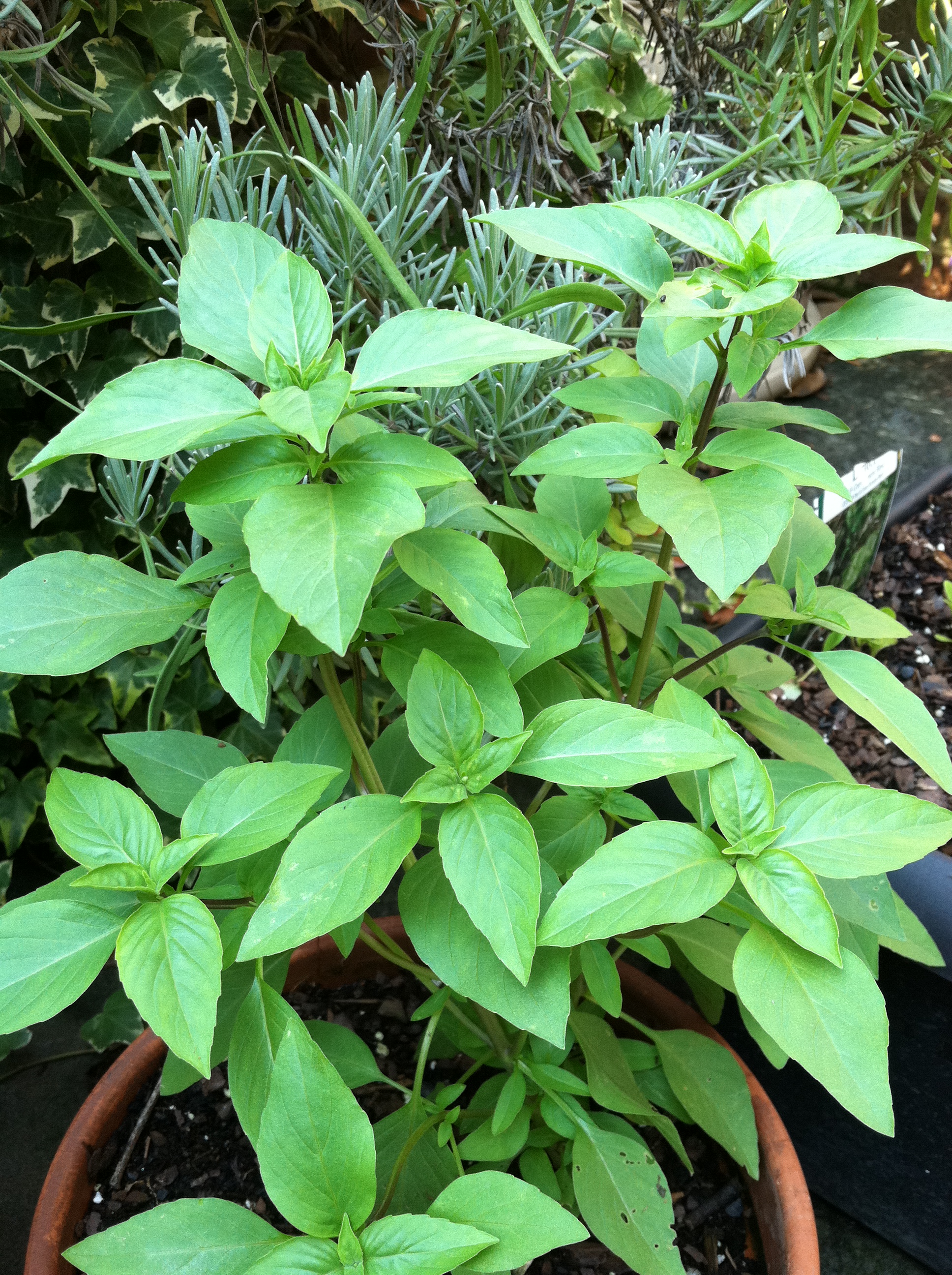
Thai basil

Having access to fresh herbs is not only wonderful, but a great time and money saver as well. See my article about growing your own herbs here. There is a lot of information and links to buying herbs and other products from trusted sites.

Make perpetual vanilla extract

I posted an article about how to do this recently. You can access “How To Make Vanilla Extract”here.

making vanilla extract

Doing this is so easy and the flavor of this extract is far better than anything you can buy, even the best vanilla extract out there.

Just be sure to start with quality ingredients and be patient for 6 months. You will then have a lifetime supply.

Coming in Basic Knowledge Part 2:

  • Learn to make a simple loaf of bread
  • Make flavored vinegar and infused oils
  • Create your own favorite Fresh Vinaigrette to use for salads, marinades, or dips

And much more.

Is there anything YOU want to learn about? Leave a comment and let me know.

Oven Fried Chicken Fingers and more

http://youtu.be/FgNmtuis3hI

Charlotte Cooks

Oven Fried Chicken with Fresh Cole Slaw, Mango Salsa and Salt and Vinegar Roasted Potatoes

Recipes

Oven Fried Chicken

  • 2 boneless chicken breasts, cut into fingers
  • 2 cups buttermilk + 2 additional cups, keep separated
  • 2 cups all-purpose flour
  • 2 cups panko
  • 2 Tablespoons Montreal Steak Seasoning
  • ¼ cup Olive oil

Preheat oven to 400°F

Cut the chicken into fingers.

Marinade 30 minutes in 2 cups buttermilk.

Remove from buttermilk and pat dry.

Lightly season the chicken with salt and pepper.

Set up a standard breading station.
3 containers:
#1 is flour
#2 is 2 cups buttermilk
#3 is seasoned panko (season the panko with Montréal steak seasoning)

Here’s the set up:

Pan #1: Flour, seasoned    Pan #2 Buttermilk    Pan #3 Seasoned Panko Breadcrumbs   Pan#4 Sheet pan for breaded chicken

Dredge each finger in flour, then buttermilk, then panko. Making sure each finger is well coated on all sides.

As each finger is coated, place on a parchment lined baking sheet.

Drizzle each finger with a small bit of olive oil.

Place sheet pan in oven and bake the chicken until golden brown; usually about 20 minutes.

Ovens vary so watch yours.

The internal temperature should reach 165°F on a food thermometer.

Keep warm in a 150° oven. Do not cover so the chicken remains crispy.

Coleslaw

  • 1 bunch scallions
  • 1 teaspoon celery seed
  • ¼ cup mayonnaise
  • 2 tablespoons seasoned rice wine vinegar
    • There are 2 kinds of rice vinegar; seasoned (with salt and sugar) and unseasoned. Read the labels and choose seasoned for this recipe.
  • 1 tablespoon sugar
  • 1 pound bag of tri-color coleslaw mix
    • Or thinly slice cabbage, carrots and some red cabbage for about 1 pound total weight.
    • Salt and pepper to taste

Choose a large bowl; Allow lots of stirring room.

Slice scallions, place into the bottom of the bowl.

Add the celery seed, mayonnaise, rice wine vinegar, sugar and whisk to smooth.

Slice the cabbages and carrots and add to the dressing.

Stir to coat.

Adjust flavors with salt and pepper if needed.

Allow to sit for at least one hour in the refrigerator before serving to allow flavors to meld.

Stir well before serving.

Mango Salsa

  • 1 pound mango slices, fresh or jarred mango, cut into medium dice
  • ½ sweet onion, small dice (like Vidalia)
  • 1 small diced jalapeno,
  • ½ cup sweet grape tomatoes, cut in half
  • 2 tablespoon seasoned rice wine vinegar
  • ½ bunch chopped cilantro
  • ½ bunch chopped scallions
  • Salt and pepper to taste

Cut all fruits and vegetables, combine everything in a bowl and serve.

Salt and Vinegar Roasted Potatoes

  • 3-4 small red potatoes per person
  • 1 tablespoon salt
  • ¼ cup Olive oil
  • 1 teaspoon Kosher salt

2 ounces Malt vinegar (you may use more or less depending upon your taste)

Place the potatoes into a saucepan, cover with cold water and bring to a boil.

Salt water once boiling begins.

Cook until done.

Drain and place on a clean kitchen towel.

Cover and whack each potato with a rolling pin to break it open but not smash it flat.

Place the smashed potatoes on a baking sheet, drizzle with olive oil.

Place in the 400° and bake about 35-40 minutes until the edges start to turn golden brown and the skins are crispy.

Remove from the oven, place in a serving bowl.

Sprinkle salt and malt vinegar over the potatoes and serve warm.