No Knead Bread

As far as bread making goes this if fast, tasty, chewy bread with a crispy crust. This method creates a wonderful artisan loaf.

Best of all, this no-knead method does not require the use of a cast iron dutch oven or 18 hours of proofing time!

Use this tool or a razor blade to slash the dough

For best results it is highly recommended you have a pizza stone  for baking your bread on and a pizza peel for getting the bread in and out of the oven. Also, you will need a broiler pan (something sturdy that won’t warp in high heat) for adding water to create the steam that makes the crust crispy and a razor blade or bakers peel for slashing the dough. You can find both the pizza stone and the peel for less than $20.00 total, even less if you are a clever shopper. (Hint: check out Target.)

Are you ready? Grab the flour and let’s get cooking!

No Knead Bread

      • 3 cups water 100°F
      • 1 tablespoon yeast
      • 1/2 cup sour dough starter (or 1 additional tablespoon of yeast for a total of 2  tablespoons)
      • 4 1/2 cups King Arthur AP or bread flour (use any brand you like)
      • 2 cups whole wheat flour
      • 2 tablespoons non-iodized salt (kosher, sea, etc)

Mix the starter and yeast with the water. Allow this to sit and bubble while you measure the remaining ingredients.

Measure the flours and salt into a large bowl.

Make a well in the center and pour in the yeast, starter and water mixture. Stir with a wooden spoon to mix it all together.

Cover the bowl with an oiled piece of plastic wrap and place in a warm place to rise for the next two hours. If your home is chilly, use the oven on a proof setting or set at 100°F. A gas oven with a pilot light is often enough warmth to proof the bread.

Risen Dough

The dough should double in size. Depending on how warm your proofing area is, this may take longer or shorter time than 2 hours.

Now here is where it gets tricky.

The dough is very wet and sticky. You do not want to handle it very much.

Heavily flour your working station and your hands.

Remove 1/2 of the dough from the proofing bowl and place on the flour.
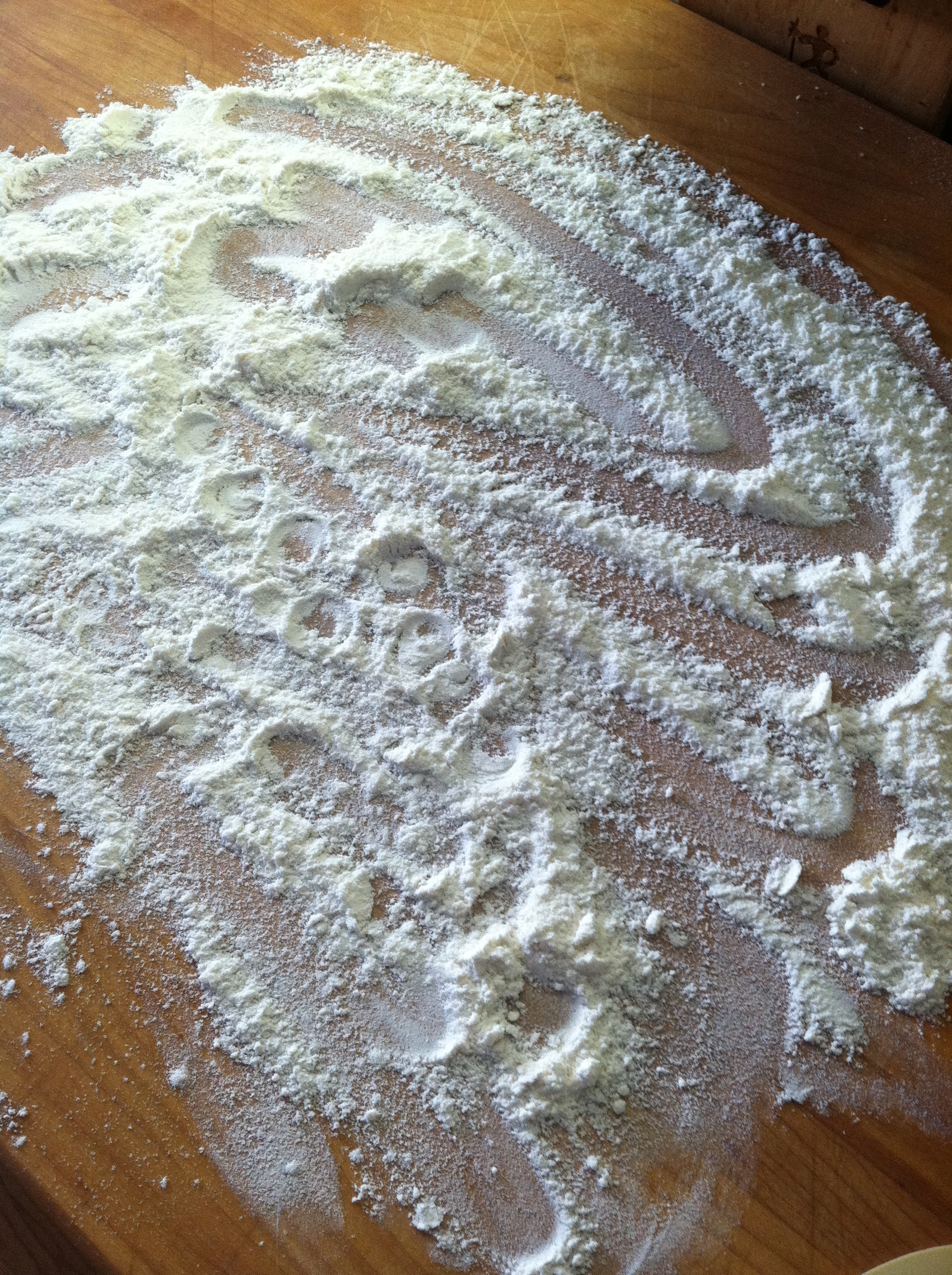
Flour the work station

Shaped Boule
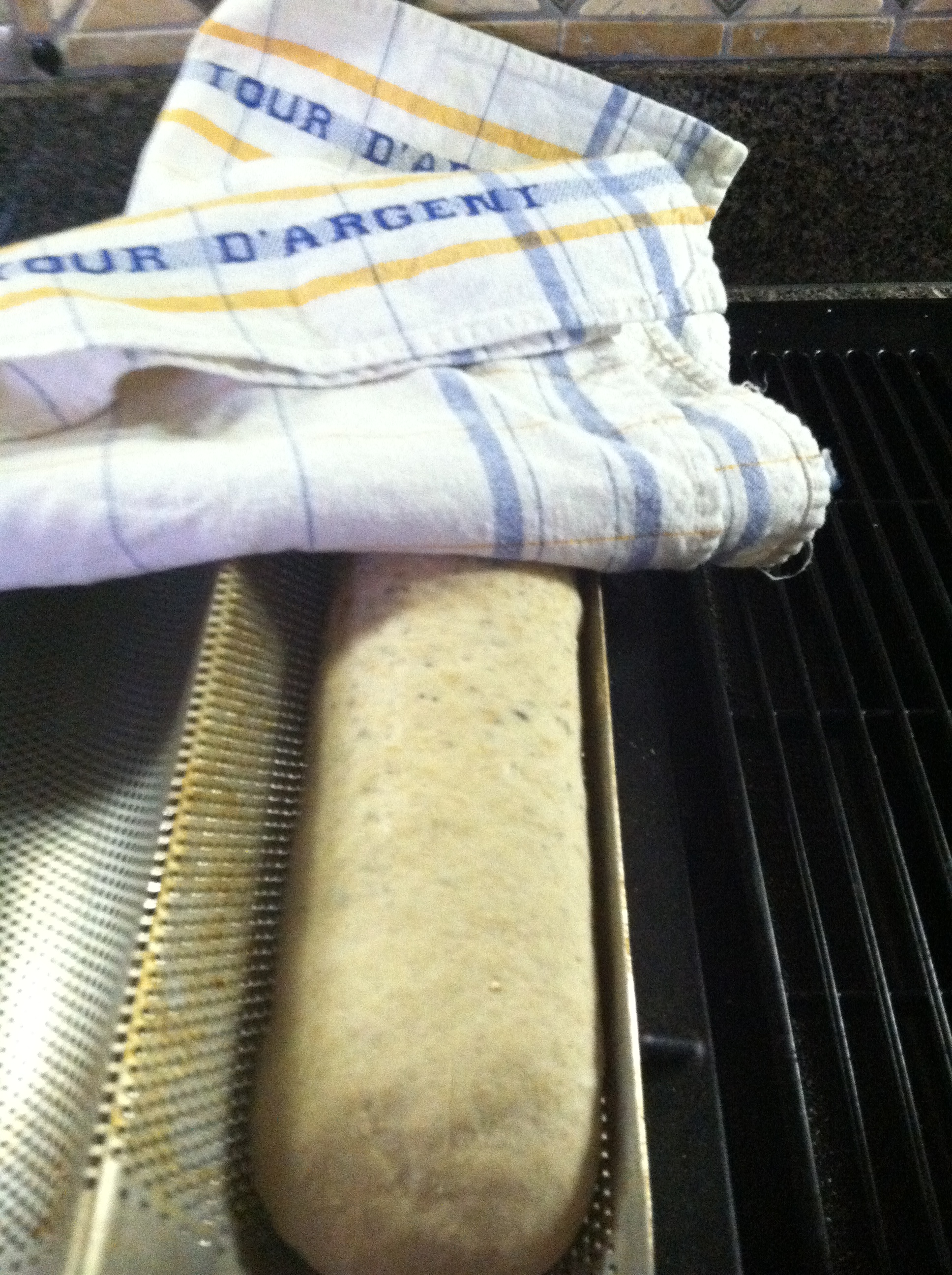
Shaped Loaf

Cover any sticky spots with flour so the surface feels smooth and not sticky. Using a well floured rolling-pin, work the dough into a rectangle about 1/2 inch thick.

Fold the left edge over 2/3’s of the bread, fold the right edge over the folded left side. You should have three layers. Turn the bread 1/4 turn, roll and repeat 4 times.

Lastly, roll into a rectangle. Take the edge closest to you and begin rolling the dough into a cylinder.

Peel with a good layer of cornmeal

Place a good layer of corn meal on the surface of the pizza peel; place the loaf on the peel, near the edge so the dough does not have a long way to slide when placing into the oven.
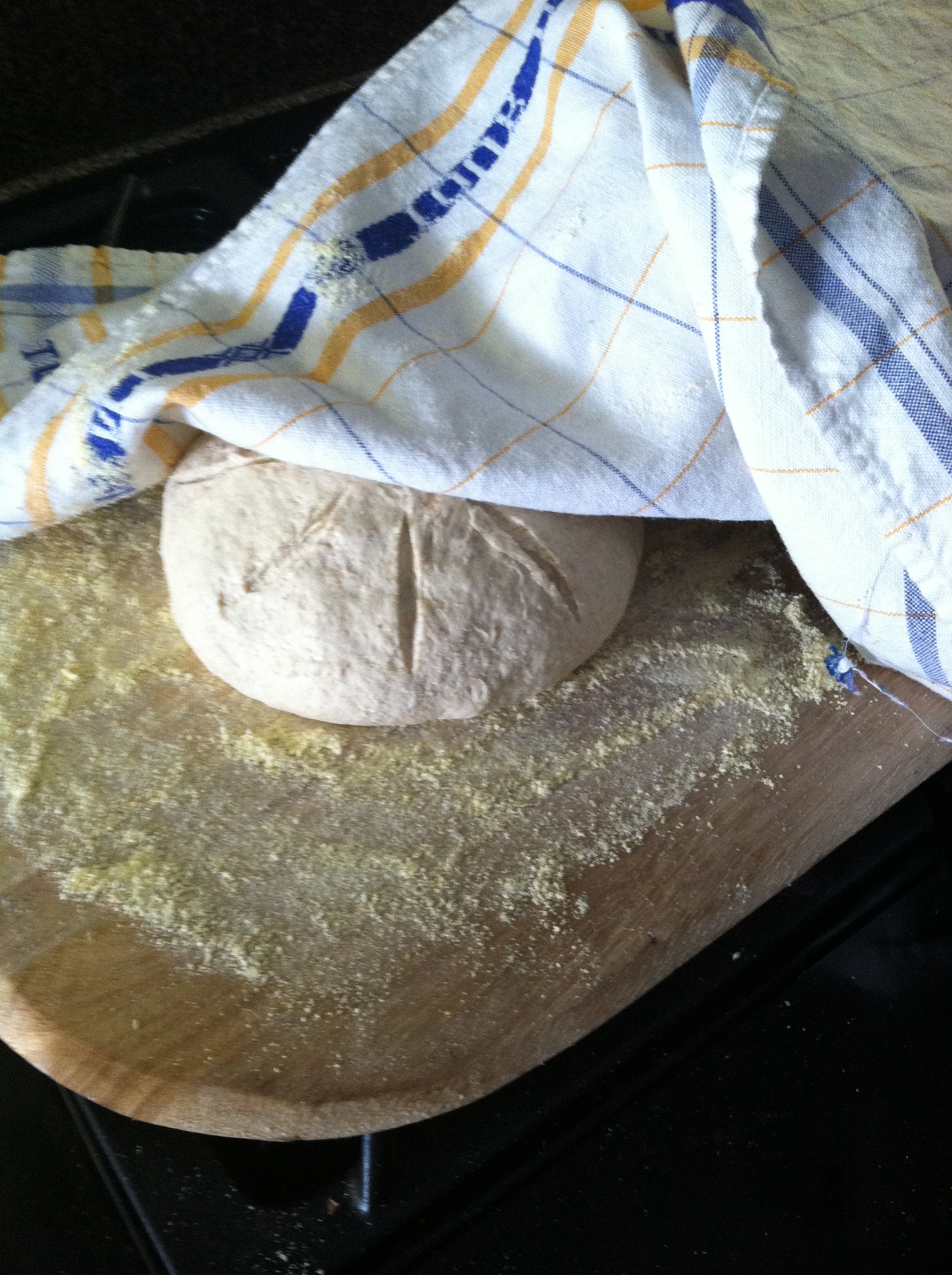
Shape and cover with towel to rise

Cover with a clean towel and allow to rise for about an hour.

In the meantime, while the oven is cold, place the pizza stone on the middle rack of the oven. Place the broiler pan on the bottom shelf and remove the top shelf. You want the bread to have plenty of room to rise!

Pre-heat the oven to 450°F. The oven needs to heat for 30 minutes at 450°F before baking. This ensures the temp is good and hot which is necessary for great ‘oven spring’.

Bring 4 cups of water to a boil in something it is easy to pour,  like a kettle.

Once the oven has heated for 30 minutes and the dough has been rising for an hour, and the water is boiling, it is time to bake the bread.

Now, you are going to look at it and say it is floppy and loose and not going to work. Trust me, just go through the process, be patient!

You have to work quickly here. Decide what you are going to do and do it!

Take the peel with the bread on it; remove the towel. Using a razor blade or bakers peel, make 3-4 deep slashes across the top of the bread. This prevents the bread from breaking while it expands in the oven.

Open the oven door and with a quick firm motion slide the bread to the baking stone from the peel. A quick forward back movement is all it takes as long as you have enough corn meal on the peel.

Hint: Once the bread hits the stone, don’t move it.

Quickly close the door.

Put oven mitts on your hands to prevent steam burns. Take the kettle of boiling water; open the oven door, pull the broiler pan out enough to easily pour the water into the pan. CAREFUL, it steams! Fill the bottom of the broiler pan by 1/2 inch. Quickly close the oven door so as not to let all the steam escape.

The steam is what creates the crispy crust. Commercial bread ovens have “with steam” options, home ovens do not.

There are several theories as to how to add steam in the home kitchen.

One will tell you to spray the bread with water while it is cooking.

Folks, if you spray cold or warm water on a 450°F light bulb in the oven, it will burst.
Same with your baking stone: CRACK! So this is not a good method.

Another is to brush the loaves with water just before putting them into the oven.

This dough is already wet. Additional moisture would hinder a smooth slide from the peel to the stone.
Besides the dough is so tender that brushing it at all would collapse whatever has risen.
Slashing is all it can take.

The broiler pan method is most useful.

It does not endanger the stone or bulb.
Just protect yourself from a nasty steam burn.

After you have added the water and started to create the steam, close the door quickly then set the timer for 15 minutes.

Make sure you have more boiling water at the 15 minute mark; open the door and add more water for more steam.

Note the color and the rise on the bread! The amount the bread rises once it hits the heat is referred to as “oven spring” and this bread formula has great oven spring. Yay!

In about 10 more minutes, remove the bread from the oven and take its temperature.  When the bread reaches 190°F the bread is done. Remove from the oven and cool on a rack until it is cool.

Slice and enjoy!

Loaves and Boules No Knead Bread

No Knead Loaf

Related articles

Basic Knowledge Every Cook Should Know: Part 1

These are some basic points of knowledge I believe every cook should know.

Knowing how to do these things can make your food more flavorful, easier, cheaper and lots of fun.

In no particular order:

Make your own creme fraiche, yogurt and sour cream

The procedure is basically the same for each.

Yield: 1 quart

1 quart heavy cream or half and half (for sour cream and creme fraiche) or milk (yogurt)

1/3 cup starter culture:

Creme fraiche – buttermilk

Sour cream –  sour cream

Yogurt –  yogurt, plain

Place the dairy product into a non-reactive pot and bring to 185°F. Remove from heat and cool to below 75°F.

For yogurt, add 1 cup dry milk powder and 1 tbsp honey or other liquid sweetener such as agave syrup or maple syrup while heating.

Add the starter cultures after cooling; stir it in well.

Cover and leave in a warm spot overnight or for 12-18 hours. The product is ready when it has thickened.

To make a Greek style yogurt, pour the thickened yogurt into a quadruple folded cheesecloth. Tie the corners so the yogurt can hang from a wooden spoon suspended over a bowl to catch the dripping whey. Overnight is usually sufficient to thicken the yogurt to  “Greek” style thickness.  The key to a thicker yogurt consistency is using dry milk powder.

Refrigerate and use within 2 weeks.

Learn to make Half Sour Pickles

These are considered a “fresh” pickle

Ingredients for half sour pickles

Yield: 1 quart

1 quart wide mouth canning jar with new 2-piece lid. Sterilize the jar in the dishwasher, NOT the 2-piece lid

2 pounds pickling cucumbers, cut into spears or leave whole if desired

Brine:

1/4 oz dill sprigs

2 cloves fresh garlic, smashed

1 bay leaf

1 quart water (32 ounces)

3 ounces salt

4 ounces white vinegar

Boil enough water to cover the 2-piece lid. Place the 2-piece canning lid in a mixing bowl. Pour boiling water over the canning lid.

Set aside until ready to use.

Place the dill, garlic and bay leaf into the bottom of a 1 quart wide mouth canning jar. Pack the cucumbers on top.

Bring the water, salt and vinegar to a boil and pour directly over cucumbers. Place the canning lid on the jar; turn upside down and cool. Refrigerate.

Allow pickles to steep 24 hours before eating.

They are good until they are gone, which won’t be long.

Make your own “signature” butter

1# butter (European style preferably)

1/4-1/2 cup of your favorite combination of high quality dried herbs. Using dried herbs, garlic and onions are essential here due to a food safety standpoint.

Mix the butter (soft, of course) and the herbs all together in a mixer. Begin with the lower amount and add more, adjusting to the taste level you like.

Form into a log using parchment paper. Wrap in cellophane or package into small plastic food storage containers and refrigerate.

Use the butter for saute, on bread, rolls, over vegetables, gnocchi, pasta, potatoes, steaks, seafood and so much more.

This alone will give your food character and a flavor profile that will identify you!

For food safety reasons, please use dried herbs and spices for this. However, you can use fresh citrus zest but keep the product cold!

Make your own Seasoning Salts

Seasoning Salts

Use 1 cup of salt. The kind of salt does matter. Do NOT use iodized table salt. That kind of salt should be used for driveways in the winter. There are so many better choices. Not sure about what kinds of salt there are? See my article on Salt.

To make your seasoning salt: Choose your favorite herbs, spices or citrus zest. Mince them fine and stir them into the salt. Allow to mellow a day before using. The salt will “dry out” the seasonings so it is alright to use fresh flavorings here, but not in your butter.

Use these seasoning salts as finishing salts, to top your loaves of bread or rolls, to season a crisp radish or to top a grilled steak or baked potato.

Simple, easy, and the flavor enhancement really goes a long way. Don’t spend the money on gourmet salt blends when you can make your own, have better quality and  all that is much more friendly on your wallet.

Make your own unique fresh ground pepper blends

Every serious cook has a pepper grinder to use for fresh pepper, right? If not, go get one. Fresh ground pepper is necessary.

Instead of just adding plain black peppercorns to your grinder, add whole allspice, white, green, pink and Szechuan  peppercorns. Add broken cinnamon sticks, a clove or 2 or 3, fennel seeds, whole cumin seeds, whole coriander seeds to the mix as well.

This will create a wonderful complex flavor enhancement whenever you crank a few rounds from your grinder.

Grow your own fresh herbs

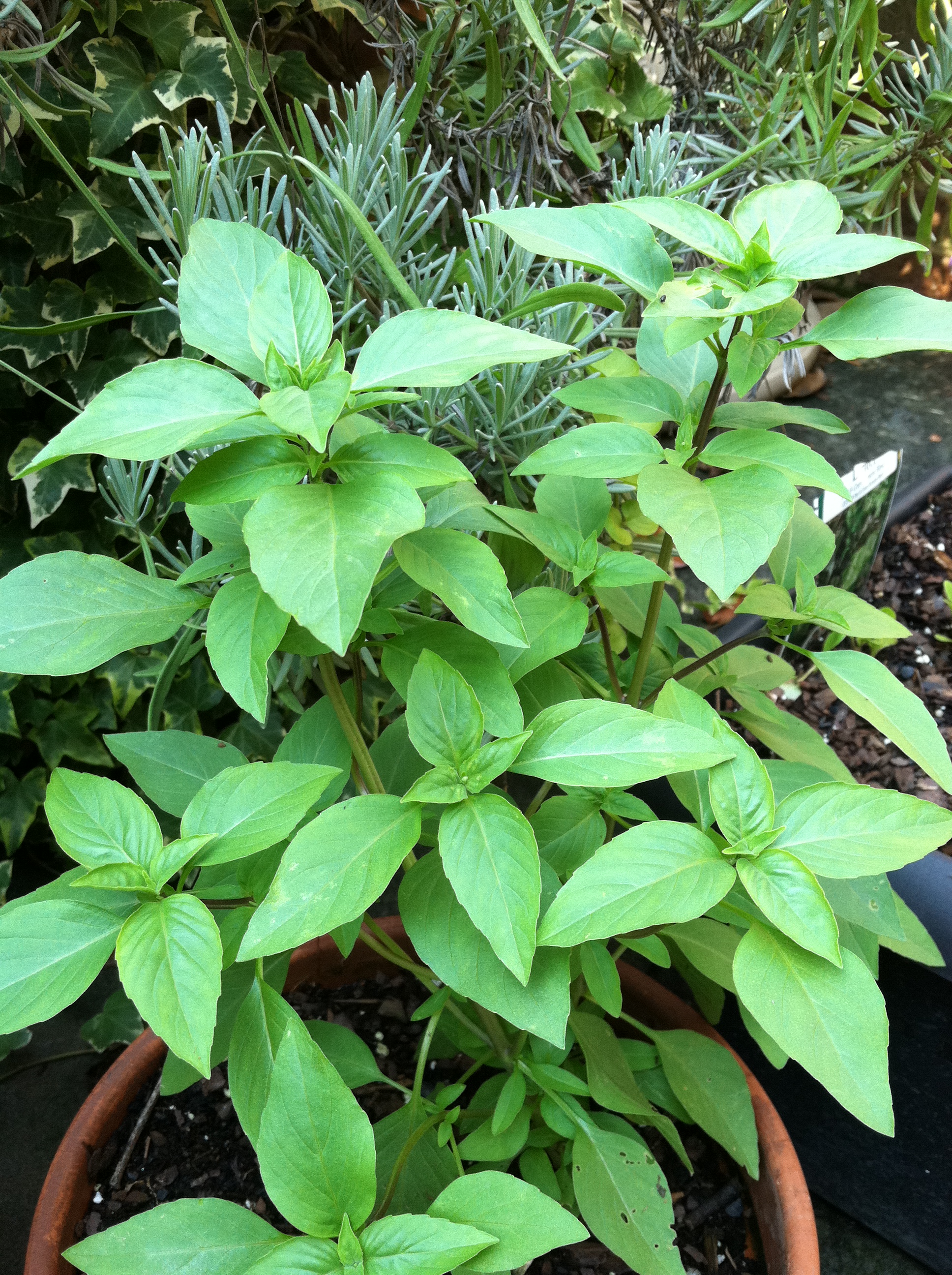
Thai basil

Having access to fresh herbs is not only wonderful, but a great time and money saver as well. See my article about growing your own herbs here. There is a lot of information and links to buying herbs and other products from trusted sites.

Make perpetual vanilla extract

I posted an article about how to do this recently. You can access “How To Make Vanilla Extract”here.

making vanilla extract

Doing this is so easy and the flavor of this extract is far better than anything you can buy, even the best vanilla extract out there.

Just be sure to start with quality ingredients and be patient for 6 months. You will then have a lifetime supply.

Coming in Basic Knowledge Part 2:

  • Learn to make a simple loaf of bread
  • Make flavored vinegar and infused oils
  • Create your own favorite Fresh Vinaigrette to use for salads, marinades, or dips

And much more.

Is there anything YOU want to learn about? Leave a comment and let me know.

Farmers Market

Local, sustainable, organic, the buzz words of foodies everywhere. Do we really know where our food comes from? How does it end up on our plates? Who are the people that actually grow our food?

I decided to do to the big farmer’s market here in Charlotte to find out. Charlotte has many small markets that pop up all over town on different days of the week.

There is a popular one just a few blocks down the street from the house and then there is another HUGE one out by the airport. That’s where I went; The Charlotte Regional Farmers Market on Yorkmont Road.

The market opens at dawn on Saturdays. Every time I was there before, there were always treasures. Today was no different.

I bought a bounty of goodies. French red sparkler radishes, aromatic peaches, crisp rainbow Swiss chard, pink lady apples, yummy corn relish and more.

Scuppernong Grapes

The air was filled with the heady scent of scuppernong and muscadine grapes. I think they are like eating eyeballs, but of course much more flavorful. You bite the skin open and squeeze the grape’s insides into your mouth then discard the skin and the single seed inside. The flavor is sweet, rich, full and totally unique to these grapes. Everyone should try them sometime.

I met a delightful, energetic lady who keeps herself quite busy with all the tempting relishes, pickles and treats she makes and sells at the market. Miss Virginia has been selling her wares at this market for over 8 years. I will have to visit Virginia again for another of her creations as well as to get her information. Be sure to buy yourself something when you visit Virginia at the market.

Her corn relish was great with the grilled chicken we had for dinner. . .  wait until you hear about our dinner!

She told me about her grape leaf dill pickles, which she claims is her best seller. I asked about the grape leaf and Virginia says it makes the pickles really crispy. Virginia has written her most popular and favorite recipes in a cookbook which she sells at her booth in the market. I enjoyed talking to someone who obviously enjoys the condiment world as much as I do. In fact she inspired me to buy some pickling cucumbers to put up some more before the season is gone. I’ll be making the half sour pickles.

Virginia and Grape Leaf Dill Pickles

I talked to a gentleman who grew the most beautiful radishes. We spoke about the many ways to cook them and agreed the best was was to simply dip them salt and scarf them raw. His display reminded me of the markets in France in that he used these small chalk boards to write his items and prices and laid the boards amongst the leaves.

I bought these radishes, YUM!

There was one farmer who had a very nice hand made book he was collecting e mail addresses in. It was made from leaves and found objects and fabulous hand made paper and a small bit from a palm tree decorating the spine.

The farmers were excited about the fall growing season. After a hot summer, they are glad for more hospitable growing conditions. Hopefully, as long as the frosts don’t come, there will be lots of bounty to come.

There were organic chickens, eggs, beef, lamb, pork, goat (sold out), quail, Cornish hens, bacon, country hams, sausages and more. I looked for Arcana chicken eggs but didn’t see any. These eggs are naturally laid colors: pink, green, blue, yellow with bright orange yolks. Either the hens aren’t laying or they sold out early.

I brought home an arm load of goodies. We had to cook the chard because it was too big to fit into the refrigerator. For dinner we grilled an organic chicken, sweet onions, peaches with thyme and honey, sauteed Swiss rainbow chard, Virginia’s corn relish (so good!), Lundberg Farms Brown Rice Medley, grilled French bread with olive oil and rosemary.

I think I need to stretch my belly. Here are some pictures I took today.

Apples on display

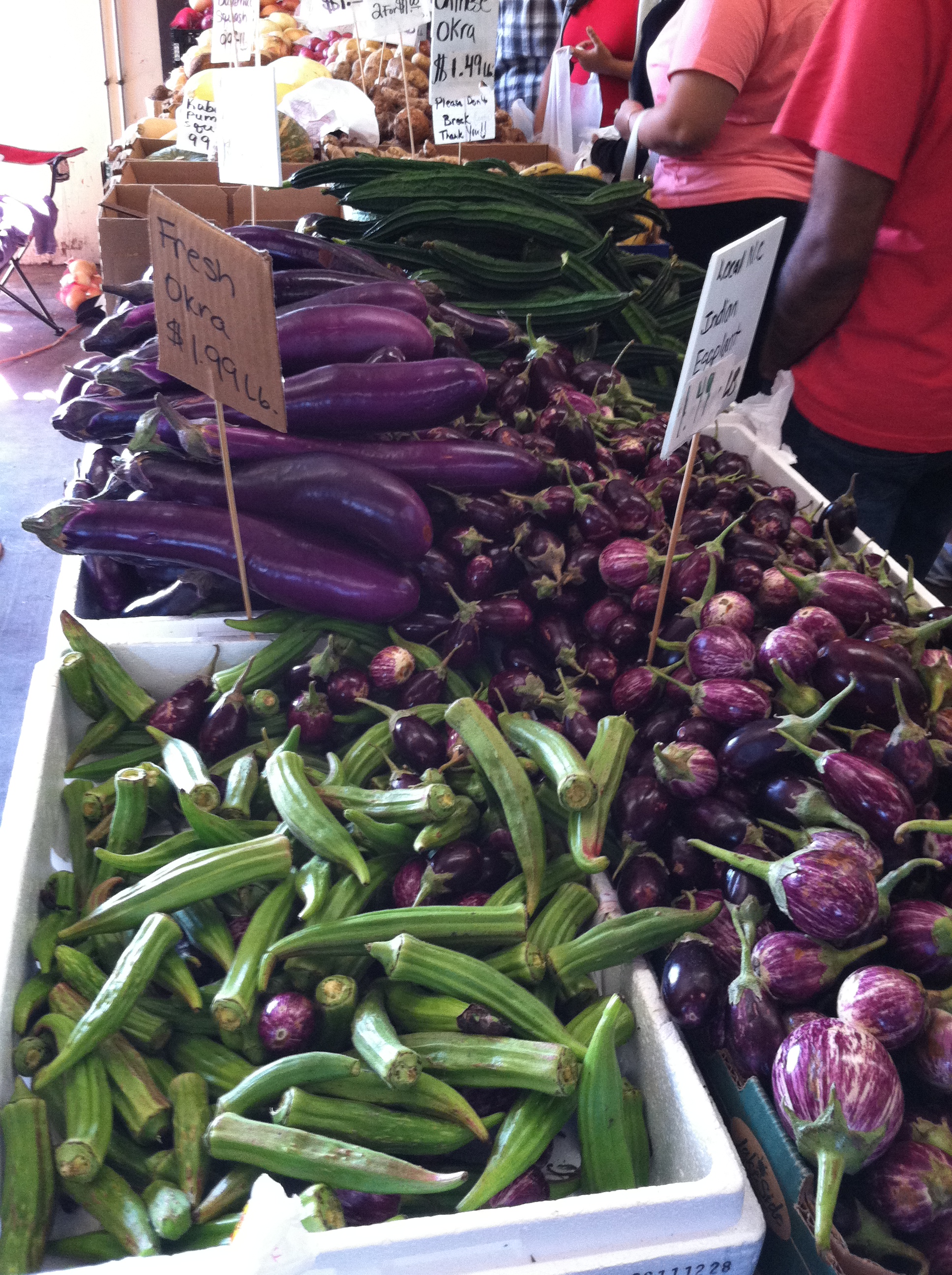
Eggplant varieties

Multi colored Carrots (I bought these!)

I bought this rainbow chard too

Well stocked

I bought all this and more

If you haven’t been to a farmers market lately, go. These people are the heart of our country, they grow YOUR food!

Go meet them, talk to them, learn what is in season, ask how they cook it if you don’t know how.

Get on their e mail lists and they will tell you what they have an how much. Reserve what you want before it gets sold out. I do this with Cornish hens. Your food comes from somewhere other than the grocery store. Go discover where your food is grown, meet the farmers and feel good about using local and sustainable resources. Supporting local will improve local economies, but that is another post.

Let me know what you find at your farmer’s market! Click Farmers Market here for a listing of markets in the Charlotte area.

Spatchcocked

This technique tends to draw giggles and silly voices from people who don’t know what it is. This technique is quite simple and brings great results. I prefer it over trussing and roasting.

All you have to do to spatchcock a bird is to remove the backbone and the sternum and lay the bird out flat.

Simply said, now how?

Take a good pair of poultry shears and a whole bird. On either side of the triangle bit at the end of the spine, start cutting along the backbone. Be careful not to cut into the thigh or breast meat. The hip joints will be the hardest but cut between the joints rather than cutting the actual bone. Although the bones are hollow and easy to cut, be careful. If you are doing a turkey, you will need some strength as simply by being larger, they take more muscle that say a quail.

One the backbone has been removed, open the bird up and lay it flat, inside up, skin side down. Now you are looking at the inside of the bird. Using a good sharp boning knife or chef’s knife, make a slit in the cartilage between the breasts. Try to bend the bird backwards and the breastbone will literally pop loose. Then all you do is pull it out.

There will still be rib bones attached but you want those to still be there. Rinse the bird, lay it out flat. With the backbone gone and the breast bone removed, the bird should lay out nice and flat.

Season the inside of the bird, flip it over. Pat the skin dry, rub a small amount of oil over the skin and then rub it well with seasonings. My favorite seasonings are salt, pepper, Montreal steak or chicken seasoning, and paprika. Paprika will help make the skin crispy.

The seasoned bird can now be cooked either on a grill or roasted in the oven on a rack over mirepoix (50% diced onions, 25% diced carrots, 25% diced celery) at 375 Degrees F.

If grilling you will want to use the indirect method and keep the heat between 350-375 degrees F and no direct flames under the bird. Grill it skin side up for about 2 hours, keep checking so the bird does not burn.

Either in the oven or on the grill, cook until the internal temperature reaches 165 degrees F. So yes, you will need a real food thermometer that is correctly calibrated.

The bird is easily carved after it is cooked. Let the bird rest for about 20 minutes after removing it from the grill or the oven. Use a sharp knife to separate the leg and thigh and then to cut the breasts in half unless you want to leave them whole.

During this time, if you roasted the bird in the oven you can make some pan gravy from the mirepoix and drippings. If you grilled it, have some nice condiments

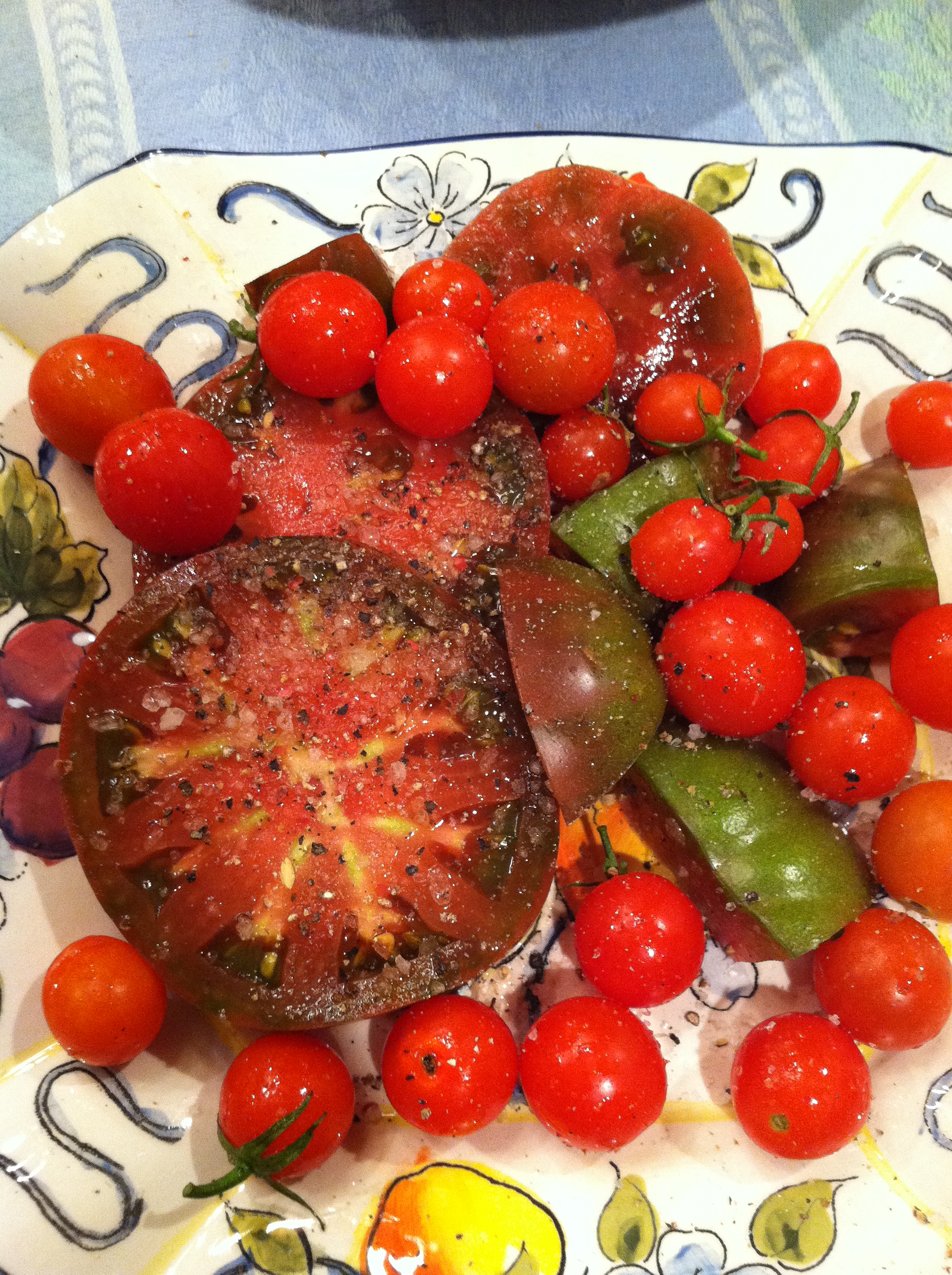
Heirloom Tomato Salad

or salsas to serve with the bird.

The spatchcocking technique can be used with anything that flies; squab, quail, partridge, grouse, duck, chicken, Cornish hens or even turkey if you are strong enough to wrestle with removing the breastbone and laying the bird out flat. (Yes, I know turkeys do not fly but hopefully you get the idea.)

This 18th century technique probably prompted giggles from the first time it was named. I have no idea where the name came from but the technique is a rather nice way to cook a bird.

Try it, let me know how it works out for you!