How to: Egg White Omelet

Dear Tyler,

You asked: How do you separate eggs to make an egg white omelet?

There are two ways to do it manually and one way to do it while shopping.

Shopping: buy egg whites in a carton like you do milk. What? You don’t buy milk? Then just buy the whites that come in a carton package just like cream or half and half does. You won’t need to separate or waste the yolks.

To do it manually, follow these directions.

To separate yolks from whites, you will need:

  • A raw egg or two or three etc.
  • A bowl to catch the whites
  • A bowl to put the yolks in
  • Trash for the shells

Step 1:

Crack the egg on a flat surface.

Why a flat surface? Between the shell and the actual egg is a membrane that protects the egg. It is attached to the shell. When you crack the egg on a flat surface, the membrane merely splits yet remains attached to the shell.

When the egg is cracked on the edge of something like a bowl or counter edge, the membrane gets torn and separates from the shell allowing shell fragments to get into the eggs.

If this happens, use a large piece of egg-shell to scoop out the fragments of shell.

Crack the egg, separate the shell . . .

Catch the yolk between your fingers.
Allow the whites to fall into the bowl below.

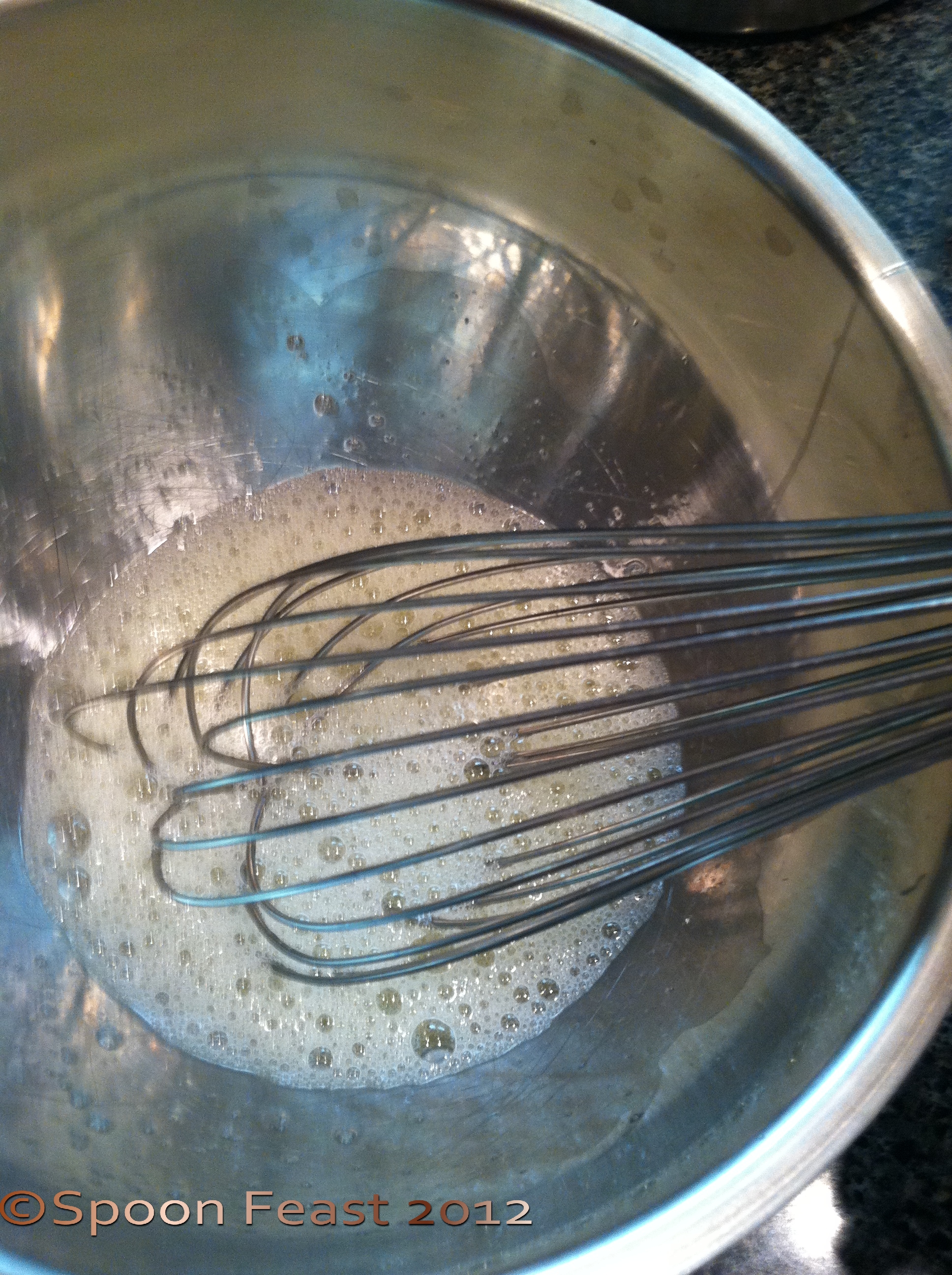
Whip the egg whites for 2-3 minutes. Build some volume to create a fluffy omelet.

The whites should be frothy. Season with salt, pepper, herbs or what ever you prefer. I always used “herbs de Provence”, salt and pepper.

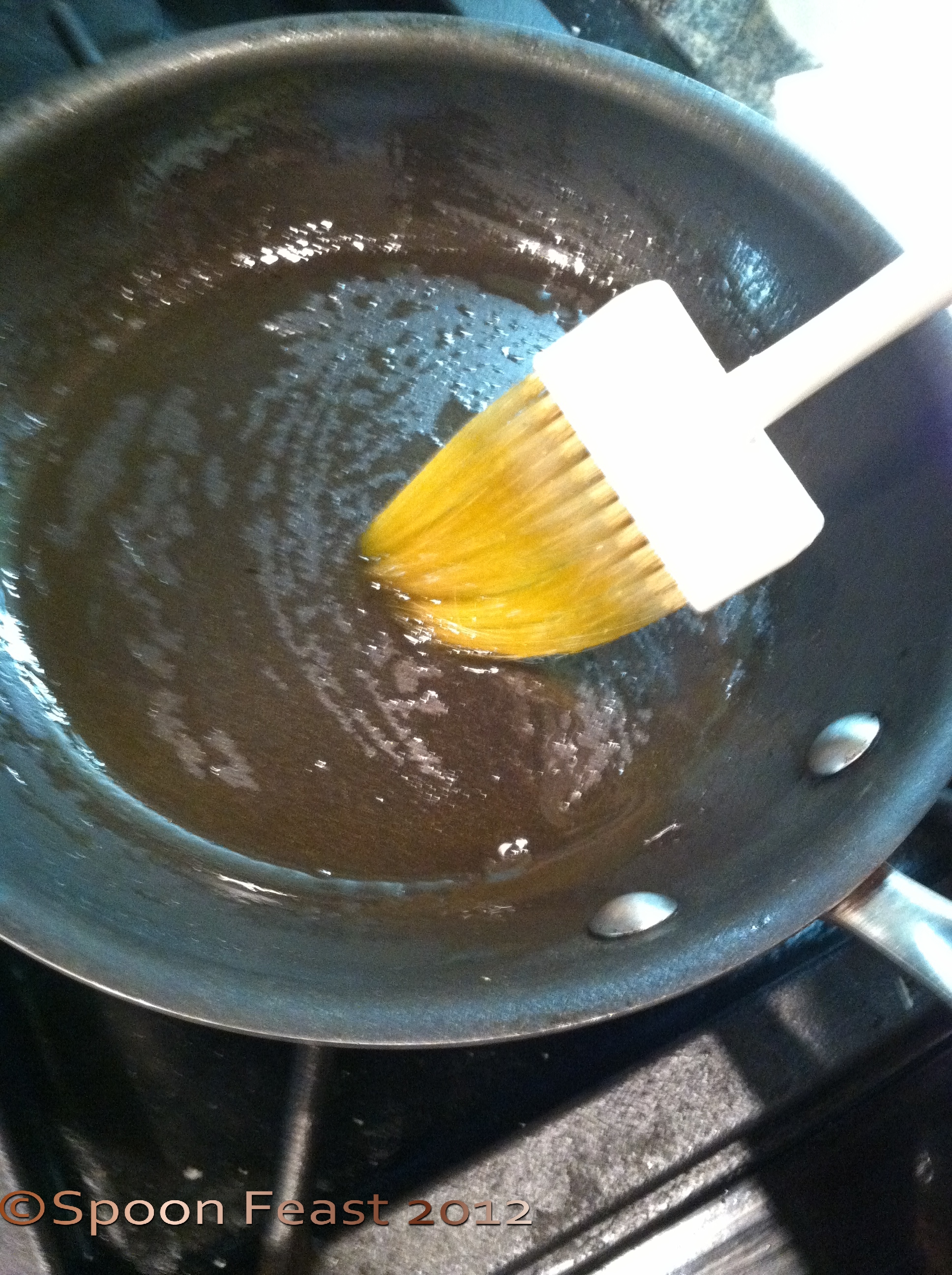
Brush a non-stick pan with oil to leave a thin coating on the bottom and the sides

Pour the frothed and seasoned egg whites into a warm, oiled pan.
When you oil the pan, set the heat to medium. The pan should be warm before you add the seasoned egg whites.
Do not use a hot pan! Medium heat is all you need.

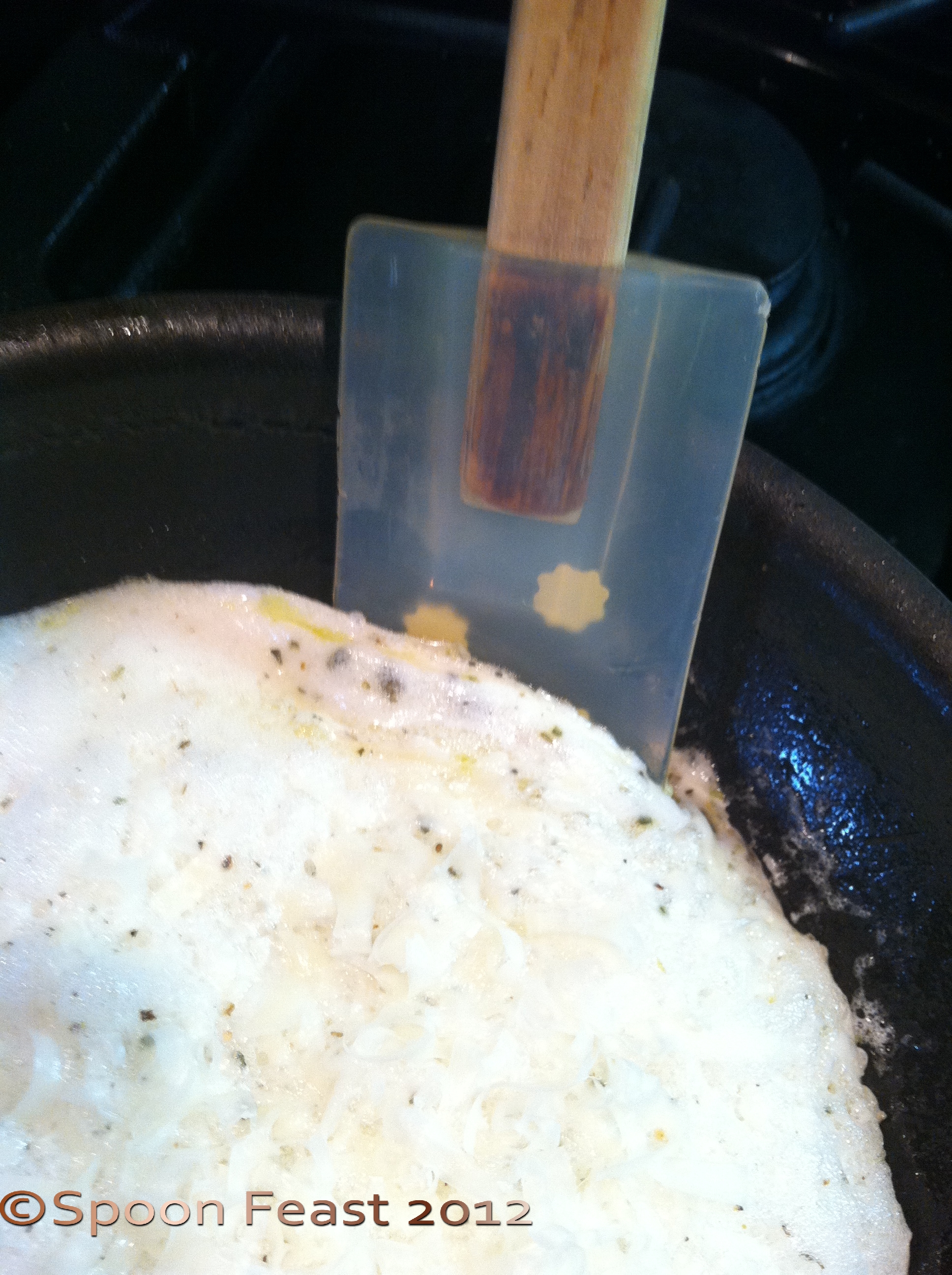
While the eggs are ‘setting’, shred some cheese or desired fillings over the egg whites.

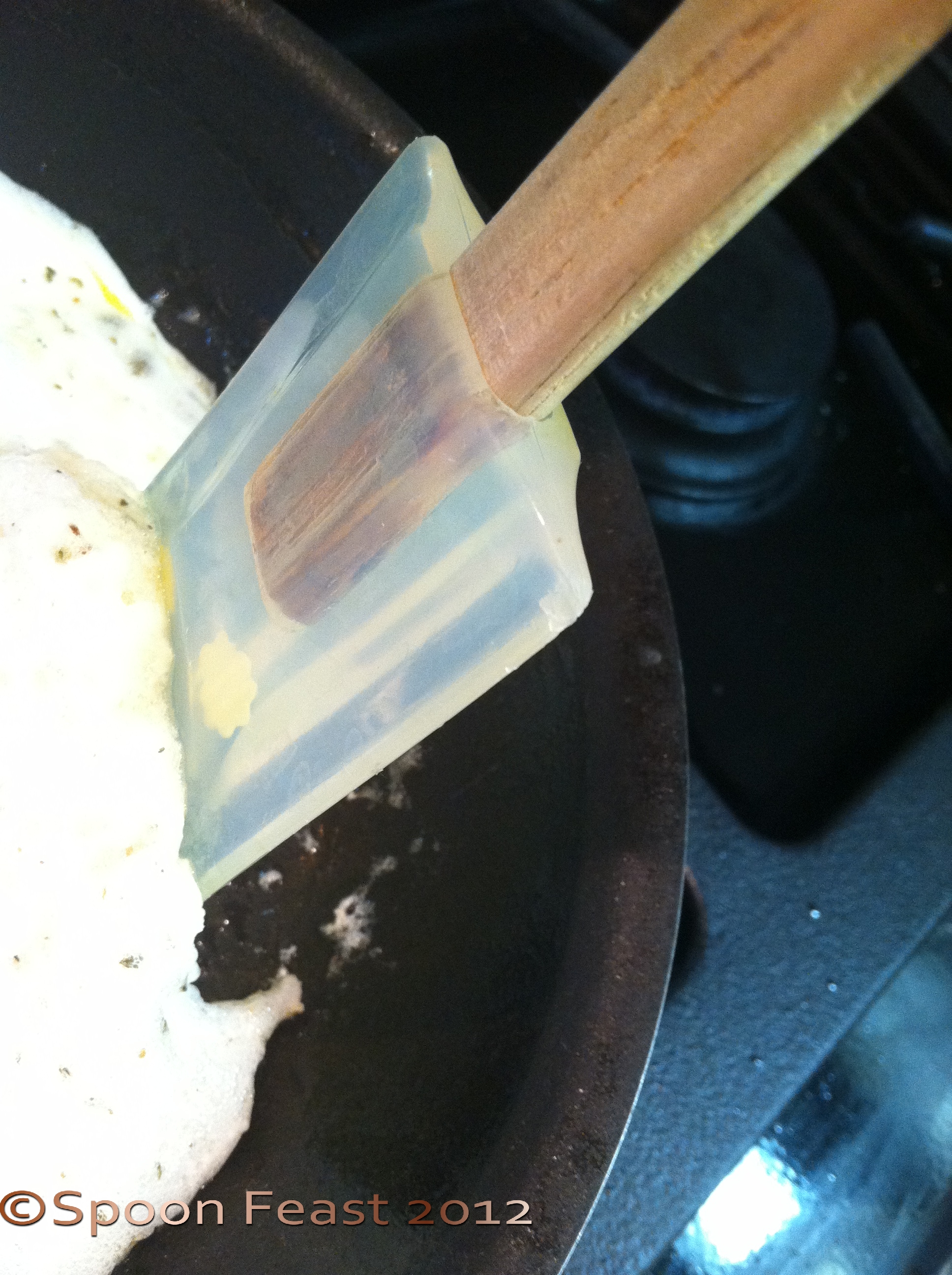
As the whites begin to set, use a heat-resistant spatula to lift the edge of the omelet all the way around the pan.

The omelet should lift easy from the pan. Use your spatula to see if it lifts. If not let it cook a bit longer.
Remember Low to Medium Heat!

Life one side and fold it over the other

Fold it in half and serve right away.
If you let it sit around too long, it will “fall”.
Sure, it will taste as good, just not look the best.

Bon Appétit!

It may take some practice but once you get the hang of it, you will be able to whip out an omelet in no time!

The fillings can be anything you want or have on hand. Just be sure it is fully cooked.

The heat of cooking an omelet is just enough to melt cheese. So keep that in mind.

No raw meats, seafood etc. Cook it first, which is why left overs are great omelet fillings.

Let me know how it works out for you!

Love,

Mom

Food Safety In the Refrigerator

Everyone needs reminders of how to handle food safely. As a professional who teaches food safety, I believe you can’t hear it enough. Small reminders and a bit of education can help save a lot of grief in preventing a multitude of food borne illnesses for anyone who handles food.

Do you know how to keep food safe in the refrigerator?

Current Contents of Refrigerator

Current Contents of Refrigerator (Photo credit: Natalie Maynor)

This post will outline the basic concept of refrigerator storage to reduce the chance of cross contamination.

The top of the fridge should be home to all ready to eat foods. Sandwich meats, cheese, leftovers get stored above raw products.

Some refrigerators have 2 bottom drawers. Designate one for raw meats and one for fresh produce. If you only have one large drawer, buy plastic storage bin that will fit on one side and designate that for meat storage. Keep all poultry separate from meat.

Raw meats should be stored in the following order

  1. Things that swim
  2. Things that walk
  3. Things that are ground-up walking around
  4. Things that fly or come from things that fly

This is called “The Swim, Walk, Fly System” of refrigerated storage.

To describe each category:

  1. Things that swim

    English: Sushi is a dish made of vinegared ric...

    Raw seafood (Photo credit: Wikipedia)

Raw fresh water and salt water fish, whole or fillets, shell-fish, shrimp, lobster, crab, mussels, oysters, etc.

If it is pre-cooked, it goes with the ready-to-eat category.

2. Things that walk

English: Veal shank used for ossobuco. Dansk: ...

English: Veal shank used for osso buco.  (Photo credit: Wikipedia)

Raw beef, pork, veal, lamb, venison, boar, buffalo

     3. Things that are ground-up walking around

Raw Ground beef

Raw Ground beef (Photo credit: Wikipedia)

Any raw ground beef, veal, pork, venison, buffalo: if it is ground up it goes below whole muscle meats.

      4. Things that fly or come from things that fly

Raw chicken fillet

Raw chicken fillet (Photo credit: Wikipedia)

All raw birds: chicken, quail, turkey, pheasant, squab, duck, and even though it does not fly, ostrich belongs in this category.

Raw eggs belong on the bottom shelf too. If one breaks, it won’t have the chance of dripping all over other things in the refrigerator.

Here is an interesting experiment to try with a raw egg:

English: The white eggshell has been removed b...

English: The white eggshell has been removed by soaking a normal chicken egg into vinegar for 48 hours. (Photo credit: Wikipedia)

Of course don’t eat the egg after.

Make it a habit to wash the drawers and shelves when they get soiled or sticky.

An open box of baking soda will help absorb strong odors.

After handling raw meats, poultry and seafood, be sure to wash and sanitize the knives, cutting boards, sinks and counter tops to prevent cross contamination.

Clorox Clean-up spray does a great job of this. Use gloves when handling to protect your skin.

That’s it for now.

I’m going to go soak an egg.

How to Boil Rice

Dear Tyler,

There are many kinds of rice to choose and methods of how to cook; this post is about how to boil rice. This is the most simple and least complicated method.

You just need to pay attention while it is cooking.

Let’s talk about the forms of rice that are out there. I am not going to go into all the varieties, this is just to tell you how to boil basic rice.

You don’t always have to cook rice.

You already know about the pre-cooked rice packets you can buy either shelf stable or frozen in vacuum sealed packets. These area great to have on hand when you don’t feel like cooking.

Trader Joe’s frozen Brown Rice is so nice and easy! Nuke and eat.

But you pay a price for that convenience. These products are ‘expensive’ in the relative terms of how much rice actually cost.

Rice on its own is cheap. It is a meal staple in many parts of the world for good reason.

I love the taste of rice, white, basmati, brown, mahogany, black or red. I love the texture, the way it carries sauces and serves as a flavor base for lots of dishes.
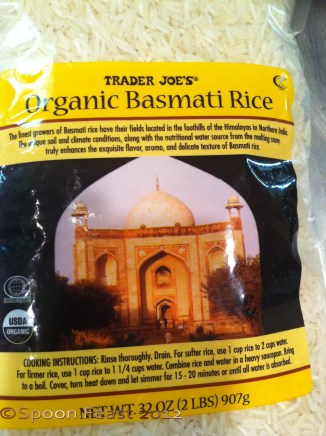
You were brought up on Basmati Rice. White and brown. When you go to the store to buy rice, don’t cheap out and buy the cheapest rice out there.

Choose Basmati or Texmati rice. Basmati rice comes from India and Texmati is the same variety grown in Texas. Honestly, the cost difference isn’t much between cheap rice and a quality rice and the taste is much more pronounced. Tastes more like rice should.

Rice has become so polished and processed that most of what passes for rice these days has very little flavor or nutrients. This kind of rice provides little nutritional value beyond carbs.

Avoid instant rice at all costs. It has horrible flavor, it tastes processed.

Avoid ‘converted or par boiled ‘ rice as well.

We get enough nutrients from our diets to have to worry about the delivery of Thiamine. If we were starving, it would be another issue.

Basmati and Texmati rice is flavorful and nutritious and goes great with lots of dishes. It is not sticky rice so it will have that fall-apart quality desired in fluffy rice.

Here is the key for How to Boil Rice:

Main ratio: 2:1

2 parts water to 1 part rice

So if you use your shoe as a measure, measure two shoes of liquid and one shoe of rice. The point being what ever you measure with, use 2:1. If you use your shoe, sanitize it first.

Whatever measure you are using, make it 2:1

Measure the liquid (so you know how much rice you need), put into a pot with a tight-fitting lid.

Bring water to a boil. It’s boiling when the bubbles break the surface.

Add salt after water boils

Add salt and then rice

Return to a boil.
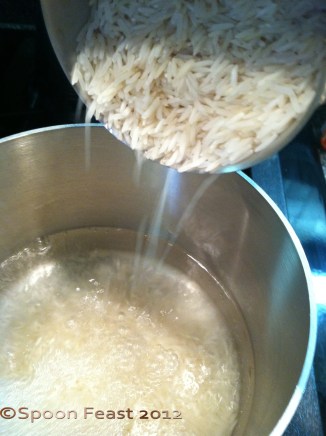
Then add rice; return to a boil
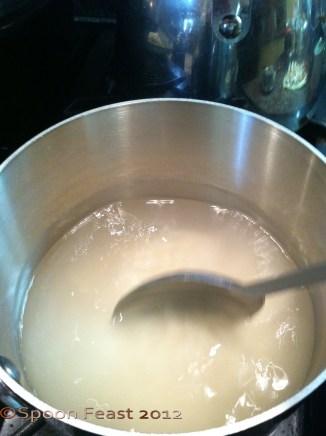
Stir the rice after adding it to the water to ensure nothing is sticking to the bottom of the pot. Put a lid on it and let it simmer.

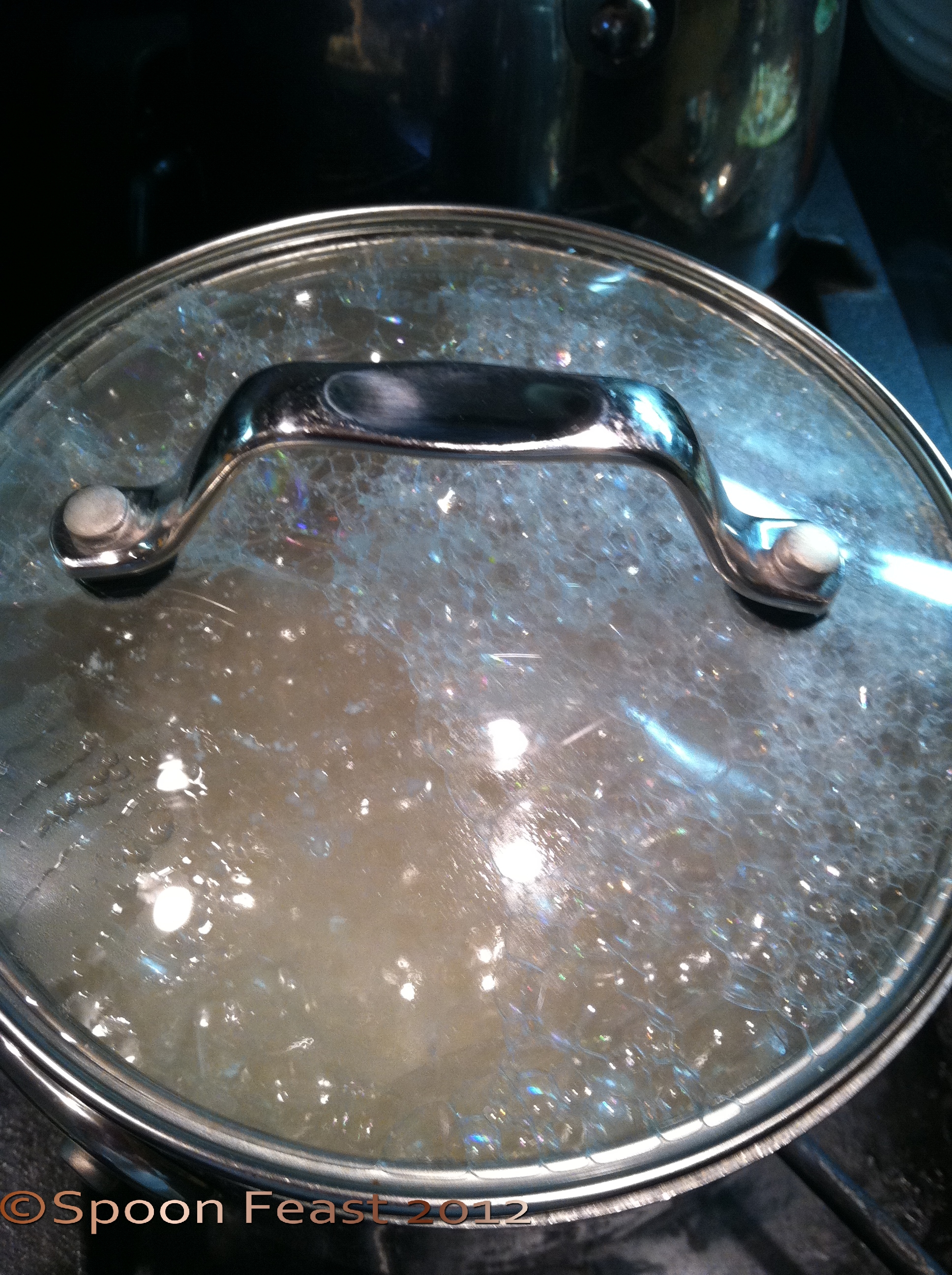
Put a lid on it. Simmer for 15-20 minutes. If you use a glass lid, you can see what is happening while it cooks.

When it looks like this, it is probably done.
Try not to life the lid until you are SURE the rice is done. Time 15-20 minutes before peeking.

Take a large kitchen spoon and see if all liquid has been absorbed. If it has, the rice is done.

Brown and darker rice will need to cook for at least 1 hour with monitoring of the liquid to doneness; adding more liquid if necessary.

Keep your eye on it until you know how your stove works. (Does it run hot or really low on the lowest settings? Adjust your cooking accordingly. All stoves behave differently. Learn how the one you have works by observation while you cook and adjust accordingly. )

Hints to successful rice:

Do not lift the lid once it returns to a boil.

Cover and reduce the heat. Let it go until the liquid is gone.

If you do lift the lid to check, your rice will become gummy and yucky.  It’s like the curse of gummy rice. Don’t lift the lid to peek unless absolutely necessary.

Learn your stove and adjust cooking times. Start noticing how it is doing at 15 minutes cooking.

How?

  • Listen, is it crackling? (Done)
  • Is it boiling still? (Let it keep going)
  • Can you smell smoldering? (May be burnt)

This is where glass lids are really handy. You can peek without lifting the lid.

The surface of done rice will look like this:

When it looks like this, it is probably done.
Try not to life the lid until you are SURE the rice is done.

Tilt the pot to the side, use a spoon to check that the liquid has been absorbed.

If it burns on the bottom, scoop from the surface. The surface rice may not taste burnt. If it does, oh well, it is cheap. Try again tomorrow.

Figure out why it may have burned:

Burner runs hot, forgot the timer, watching TV or playing games

Remember kitchen rules! Make them habits for safety’s sake.

Most of the time when I have burned things it is because I left the room and was distracted.  Please trust kitchen rules.

Once the rice is cooked, fluff it with a fork and serve. There are so many things to serve over rice.
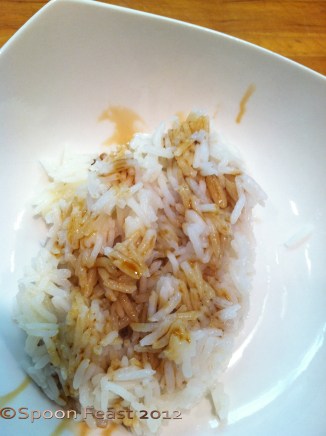
Comfort food! Sometimes I love just a bowl of rice with soy sauce just like this. In fact I ate this one. 😉

Sometimes when my tummy is upset, nothing makes it feel better more than a bowl of rice with a small bit of soy sauce.

Add Ins:

Enhance the rice by adding vegetables, meat, herbs and spices to the cooking liquid to flavor the rice.

My favorite is to add dried onion or vegetable soup mix or fresh thyme, garlic and shallots. Don’t be afraid to season the water the rice is cooked in. The rice will take on whatever flavor is added.

I like to finish the rice with a tablespoon of fresh butter. It really does something to the flavor that I adore.

Best way to clean pots used to cook rice:

As soon as you are done cooking rice and have removed the contents of the pot to another dish, fill the rice pot with COLD water. Let it sit for 20 minutes or so. Add a squirt of detergent if you want. It makes clean-up easier.

All the rice goop will release and rinse away and final clean-up is much easier.

To Serve and store:

Steam some broccoli and serve it over some rice.

Left over rice must be cooled and stored in the refrigerator. You can easily reheat rice in the microwave. Add a small spoon of water, cover and nuke for 30 seconds, stir and do it again. The rice should absorb the water, so don’t use too much, just a hint.

Next is how to make Tonkatsu using the standard breading procedure. (Yeah, I know you love it!)

~Can you get Tonkatsu Sauce? Check your grocery where they sell soy sauce products. It is made by Kikkoman.

Love,

Mom

Safety Rules for the Kitchen

Dear Tyler,

Before you get cooking, there are some extremely important safety rules you MUST follow.

If you don’t, the chance for injury to yourself or property could result.

As you start cooking, make these rules part of what you do automatically.

1) Never leave the kitchen when there is a pot or pan on the stove with a burner on.

If you have to leave the kitchen, turn off the burner.

Leaving things on the stove unattended is one of the leading causes of house/apartment fires.

Find something to do in the kitchen, wash some dishes, wipe down counters or refrigerator shelves, sweep the floor etc. just stay in the kitchen while pots and pans are on the stove.

If you are heating oil, you have to stay right there with it to avoid over heating and catching fire.

To extinguish a grease fire:

Keep a box of kosher salt or a large box of baking soda handy to throw on to a grease fire. Try to cover the pan with the lid to smother the flames.

Throw the baking soda or salt onto the flames to put out the fire if you cannot cover the pan.

NEVER! Never, ever try to put out a grease fire with water! The water will spread the fire and it will ‘explode’ all over you resulting in some pretty nasty burns.

You might want to get a small fire extinguisher to keep in the kitchen, under the sink.

2) Always leave a sign on hot pots or pans to indicate it is hot.

Nothing hurts like grabbing onto a hot handle and burning the palm of your hand! Youch! (An immediate treatment for burns is ice. It cool down the burned tissues.)

A clever way of putting ice on burned finger tips

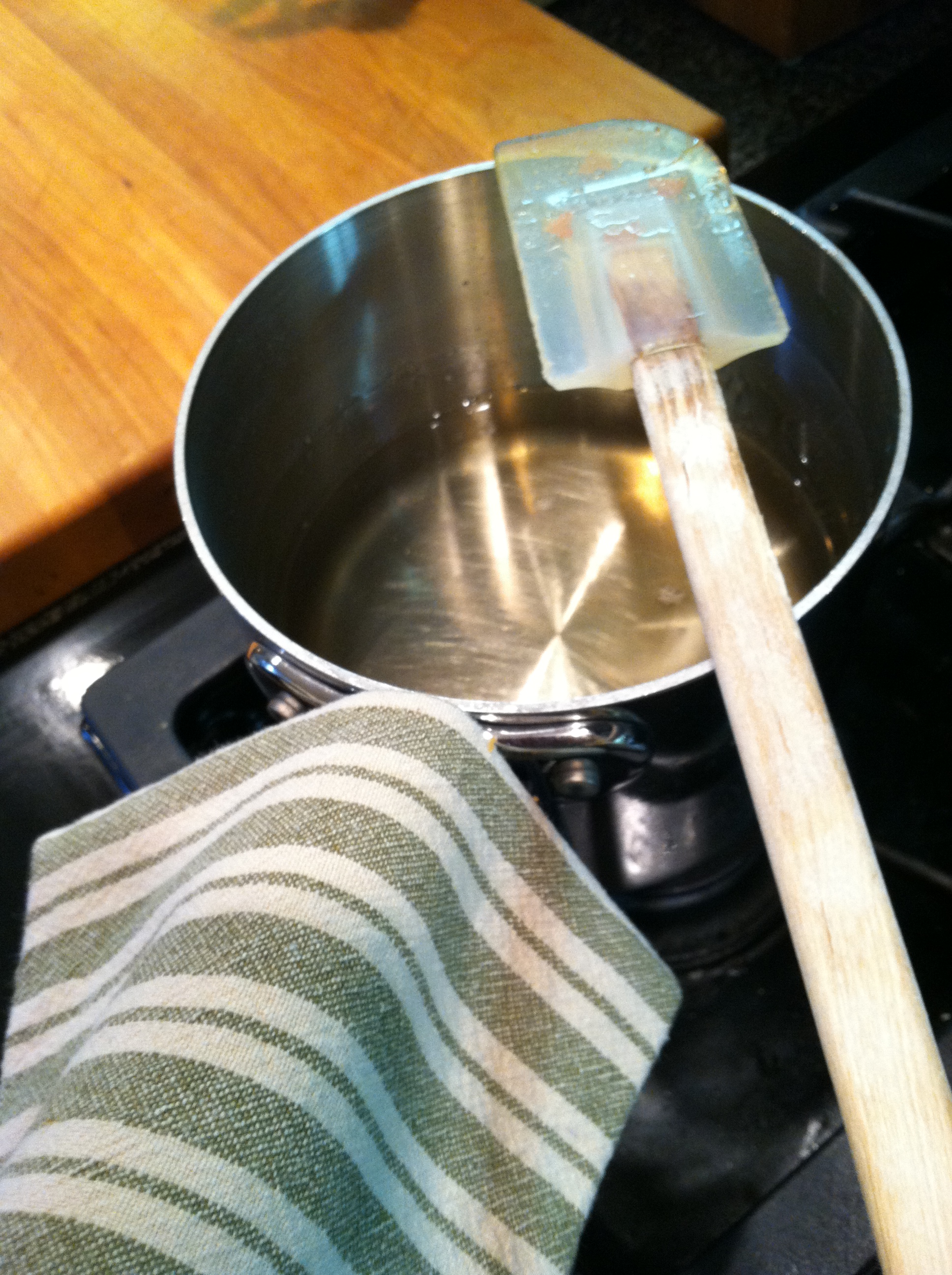
Signal the pan is hot by placing a towel on the handle or on the edge of a pan.

Leaving a clean kitchen towel on the handle or along the side of a sheet pan signals the item it hot.

You can forget when a handle or pan is hot while cooking.

Protect yourself and others from burns by using the towel signal.

3) Probably the most important of all: NEVER, ever catch a falling knife.

Jump back out-of-the-way and let it fall.

So what if it nicks the blade. You will still have your fingers.

Knives are replaceable, your fingers are not.

There will be a post on knife safety soon.

4) Keep all handles and pans so they do not hang over any edges of ranges, counters etc.

Nothing hangs over the edge, the sheet pan and the pot handle should be moved so they don’t hang over the edge.

Turn them so they cannot be accidentally tipped over.
Nothing should be hanging over an edge, turn things so they do not.

Turn items so they aren’t hanging over the edge

Use towels to grab hot handles and hot lids.
Things have been on the stove so they will probably be hot

Always assume handles will be hot and use a folded towel to grab them.

5) Do not allow electrical cords to drape across the counter or any other place.

Put electric units close to the plug.

Unplug when not in use.

This practice prevents tripping over cords and pulling hot pots over onto yourself  or others, resulting in horrible burns.

These are best practices for learning your way around the kitchen.

Kitchens can be dangerous places so please use these safety tips.

Save yourself and others the agony of burns and cuts.

I know you are First Aid trained. Make sure you keep it up.

Have a kit handy to treat simple cuts and minor burns.

Your training will be called upon eventually either for yourself or someone else.

Most important, be able to recognize when you need to seek medical attention and do not hesitate; act quickly.

Natural-path Treatment for Burns:

Whipped egg whites, applied to cover the burn, once the whites dry, apply another layer. Leave on as long as possible.

Seek medical attention if the burn is severe.

Protect the burn from exposure to air.

Never ‘pop’ a blister.

In my work teaching culinary school, I see and tend to many kitchen injuries that can easily be prevented.

Food Safety is something you need to know about too. Read this post and organize your fridge.

I will write more about food safety in another post. For now, be sure to keep all meats cold and on the bottom shelves so they don’t drip on other foods. Keep all left overs cold unless you are eating them.

Get some cellophane wrap (Saran Wrap like) and use it to cover your food in the refrigerator.

If you need to make a sign with the safety rules to post in the kitchen, print them from your computer. Safety reminders are always a good idea.

Reminders help roommates and friends remember too.

The Worlds Best Olive Oil and a Give Away!

On a weekend outing recently I had the honor to meet an inspiring , charming Greek man whose family owns olive groves in Greece.

The family produces some of the best olive oil I have ever tasted. Pure, green, fruity, this oil is unlike anything you have ever tried.

The olive tree, one of the bases of Greek agri...

The oil is extra virgin, undiluted. This means this oil is from the first cold pressing of ripe olives. The category of extra virgin olive oil is required to have an acidity of .o8%. Theros  Undiluted Extra Virgin Olive Oil is .045%.

If you are lucky, you will get a bit of the denser oil that filters to the bottom of the barrels. There is a very small amount of this because most of the oil is drained off and bottled in the clear state. Because the oil is undiluted, more of the ‘solids’ will fall to the bottom of your bottle. Shake it up if you like or save it for an ultimate treat near the end of your oil.

Theros also produces and sells unfiltered olive oil.

When we were children, we lived in Seville, Spain for a few years. My mom would slather us kids in olive oil and tell us to go play outside for a while. After we would come in, bathe and go to bed. Our skin and hair were so smooth and lovely. I remember the distinct aroma of the rich olive oil on my skin. I loved it.

When I smelled Theros oil, my memories of Spain came flooding back, the rich ripe aroma of olive oil. I wanted to slather it and go play. Amazing, we were brown as berries but we never worried about sunscreen then, and didn’t get sunburned. Mostly anyway.

The trend lately is to know where your food comes from, buying local, sustainable, etc.  I find it limiting  to say “we only use food from 100 miles of where we are.”

Why be so limited when the world has become so accessible?

Here is a way to extend the boundaries of local to include the world. In this case Greece. Who can say no to Greece?

Taken by Nick Fraser in 2005. The fruit of an ...

Taken by Nick Fraser in 2005. The fruit of an Olive Tree (Photo credit: Wikipedia)

The Greek economy is in pretty bad shape now. In a small way, buying olive oil helps support the families who grow and harvest the olives. In small ways, each purchase can help the Greek economy. Small yes, but it is something.

By using our purchasing power, and choosing to buy authentic Greek olive oil, authentic Greek Feta cheese, and authentic Greek Yogurt is our own small ways we can contribute positively to support Greek economy so they can begin the recovery they need as the break away from the European Union and the Euro takes place. (In my opinion, it is a matter of when, not if.)

The Italians have had such a world-wide demand on their olive oil, most of what you find in common supermarkets can no longer be trusted to be quality olive oil of any grade.

Italy exports so much olive oil the country itself is left to buy olive oil from Spain and Greece to grace their tables. If you are buying olive oil in a market in the US, chances are rare you will see

Simple meze of feta cheese and olives: charact...

Simple meze of feta cheese and olives: characteristic Greek flavours. (Photo credit: Wikipedia)

olive oil from anywhere else but Italy.

However, with the olive oil awareness and a more sophisticated demand by consumers, your chances are improving that you will find other countries of origin.

A few days ago I tested this theory in my local grocery and was pleasantly surprised to find 1 brand of Greek olive oil and 1 brand of Spanish – the rest were Italian.

Greece is ranked second in the European Union for their production of olives – 147,500 tonnes in 2010. I do not know how much was pressed into varying grades of olive oil vs being brined to eat as olives.

It would be extremely interesting to take a sabbatical from work and go harvest olives in Greece, take the olives to be pressed and learn about brining olives to make them palatable. Then to France to harvest grapes.

What a fall that would be!

Give Away Time!

Theros Olive Oil has agreed to give away 6 bottles of

Theros Undiluted Extra Virgin Olive Oil

To win one here’s what you have to do:

  1. Follow Spoon Feast on WordPress
  2. Like Theros Olive oil on Face Book and check out the amazing photos of the process
  3. Leave a comment on their Facebook page about why you like olive oil and ways you use it
  4. Leave a comment on this Spoon Feast post about why you like olive oil and ways you use it

6 winners will be chosen based upon meeting all 4 criteria above.

We will choose the most creative and delicious ways you use olive oil.

Winners will be chosen by a panel of Spoon Feast advisers.

All domestic and international shipping arrangements will be made directly with Theros Olive Oil.

You will have until Friday, June 15th to participate!

Winners will be announced on Sunday, June 17th.

Treat yourself, Check out Theros Greek Extra Virgin Olive Oil!

English: Olives in olive oil.

Olives in olive oil. (Photo credit: Wikipedia)

All About Potatoes – What is the difference?

In this post, I will attempt to explain all about potatoes, explain the varieties available and when to choose one over another.

What is the difference between potatoes?

Red skin and Russet Potatoes

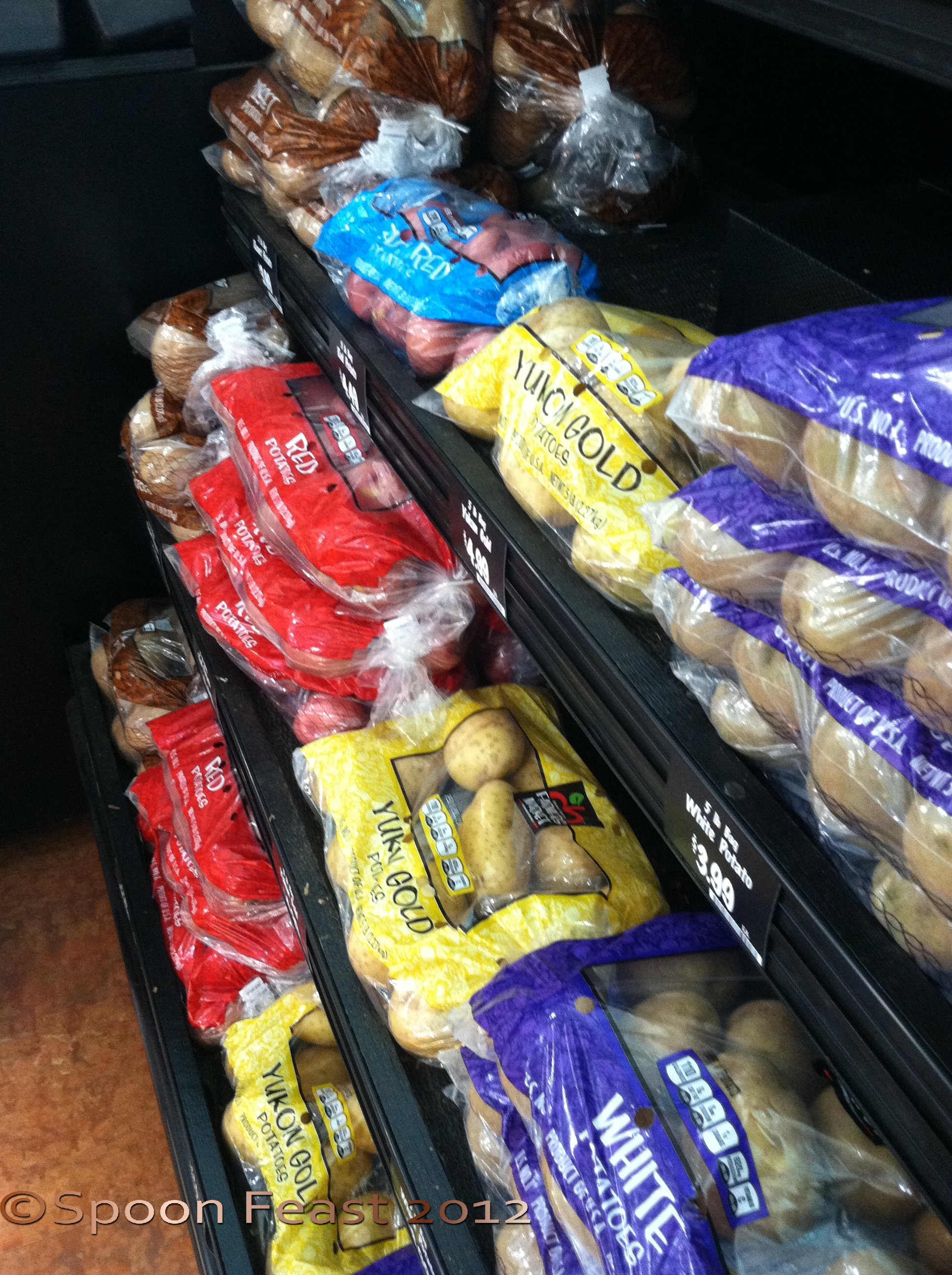
Next time you go shopping for potatoes, you will have a lot more knowledge about them after reading this post.

Have you ever:

  • Tried to make french fries from scratch only to have them turn out limp and soggy?

  • Tried to make potato salad or put nicely diced potatoes in a soup only to have the potatoes all fall apart?

  • Ever had your mashed potatoes turn out like glue?

  •         Had a baked potato explode on you in the oven? (Technique rather than variety is the secret)

It all has more to do with the potato you chose to make the dish with than your culinary skills, which I am sure are impeccable.

There are few categories in the potato world. Basically there are low-moisture, high-starch varieties and high-moisture, low-starch varieties.

The high starch varieties will fall apart if cooked in liquid but create light and fluffy mashed potatoes, crisp french fries and crispy chips.

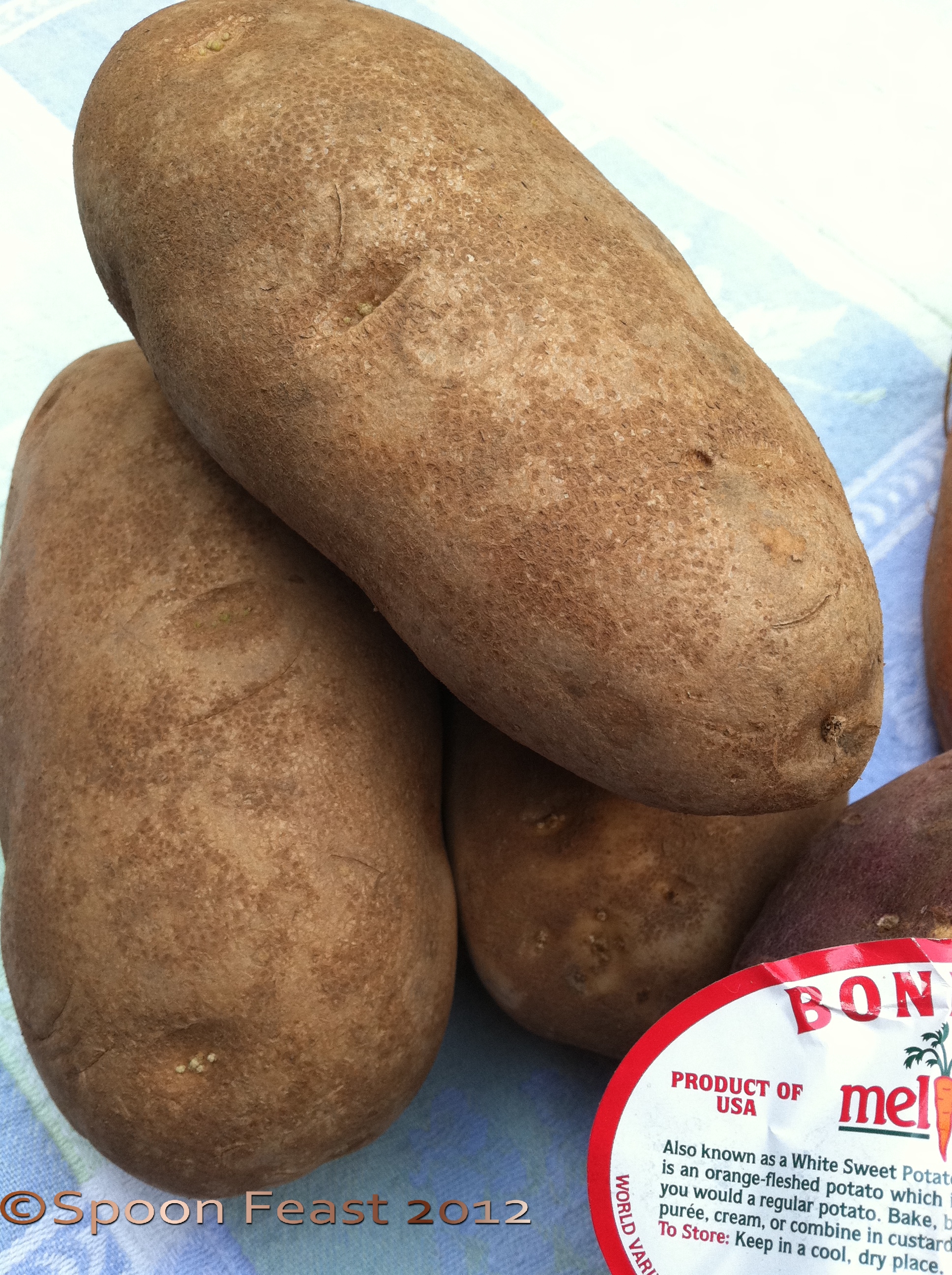
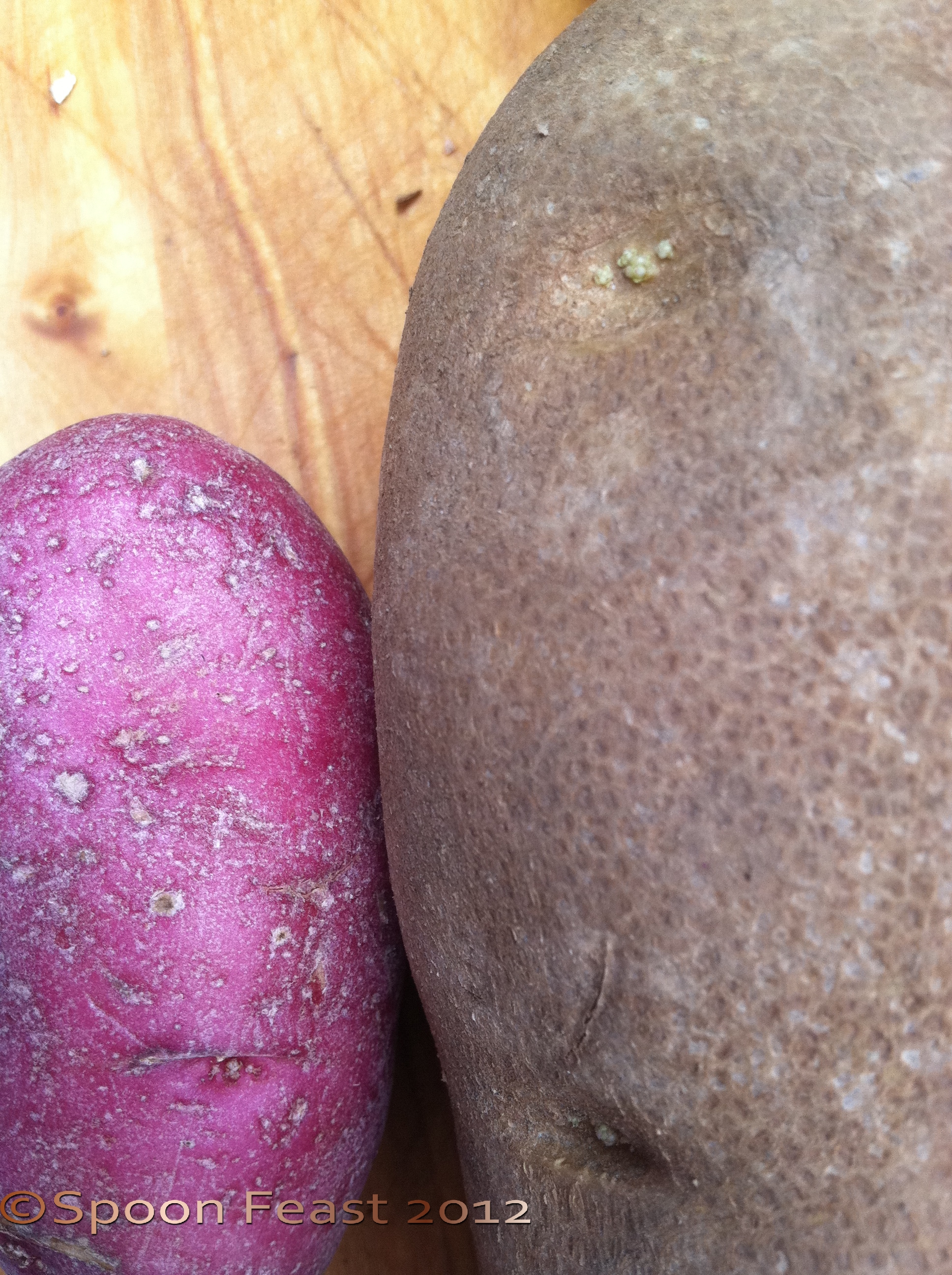
Russet Potatoes – notice the dark, thick skin. Compare this to a new potato which has a thin tender skin.

The russet is the king of the low moisture-high starch category. These potatoes have thick dark skins as opposed to the thin tender skin of new potatoes.

Yukon Gold: thin skin, shallow eyes and golden flesh

The low starch – high moisture category belongs to red potatoes, Yukon gold, new potatoes. All potatoes with a tender thin skin will be high moisture, low starch potatoes.

These potatoes hold their shape in soups, casseroles and salads. Their tender skins are often deep-fried and used a receptacles for dips, spreads, chili and salsa.

Go to the store and buy some of each variety and compare them. Cut them, notice the textures. Cook some of both using a variety of cooking methods and compare results. Make notes so you can remember what you discover during this experiment.

Then we have sweet potatoes and yams.

Yams are not as high is sugar as sweet potatoes are but they taste just a good. Be careful with large varieties of these potatoes as they can get very stringy. Choose smaller, even sized, good color and smooth skins when selecting these potatoes for purchase.

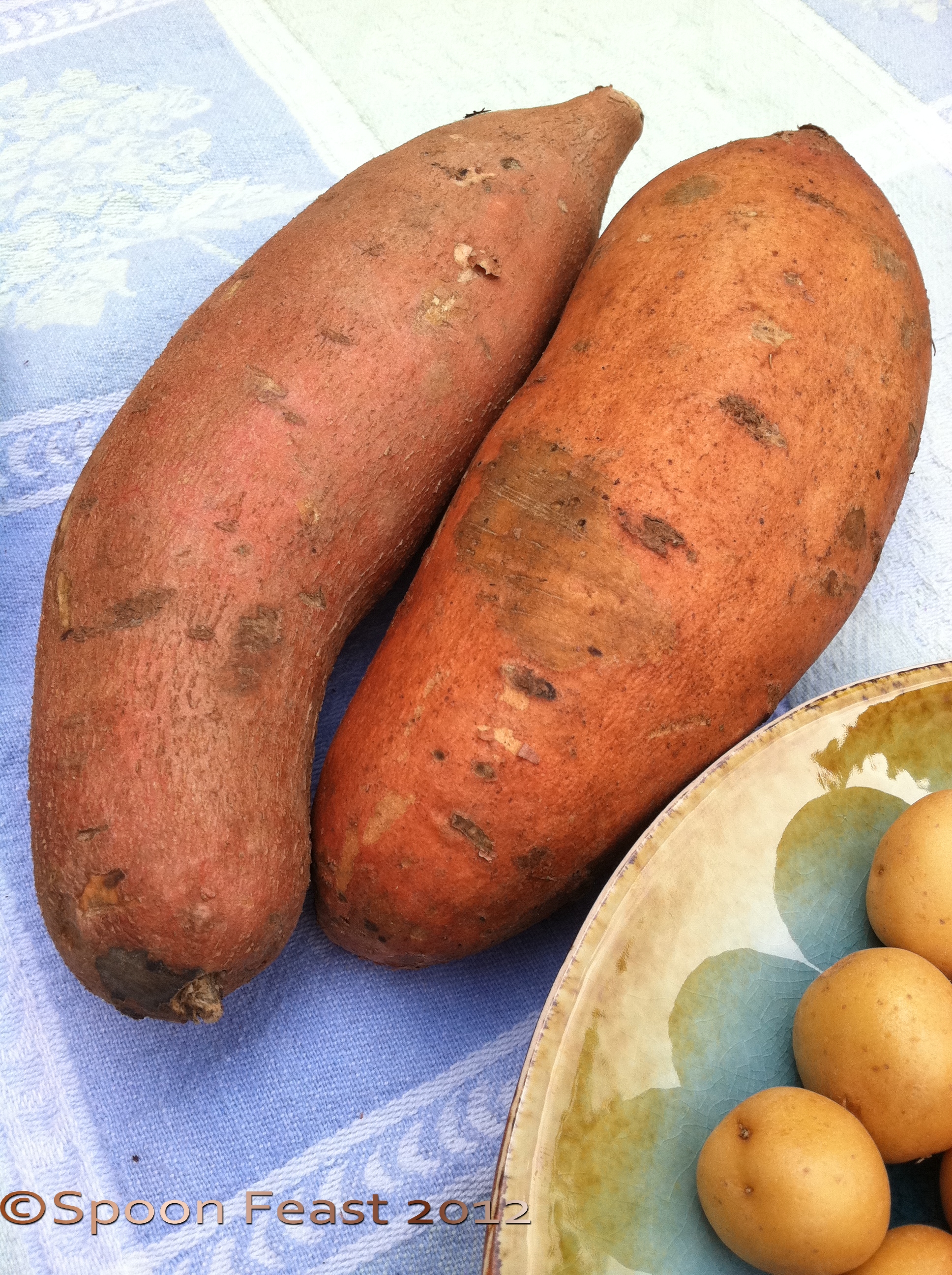
Typically, sweet potatoes and yams can be used interchangeably and can be applied to a many cooking methods. The skins are not edible. Colors vary from pale yellow to deep orange and now there are garnet and purple varieties too.

Tiny new potatoes, fingerling potatoes, “potato gems” are all varieties that belong in the low starch, high moisture variety. their size and shape make them special in that you can cook them without peeling or cutting them if you wanted.

Fingerling potatoes

Some of this variety are so moist and tasty, you never miss the butter.

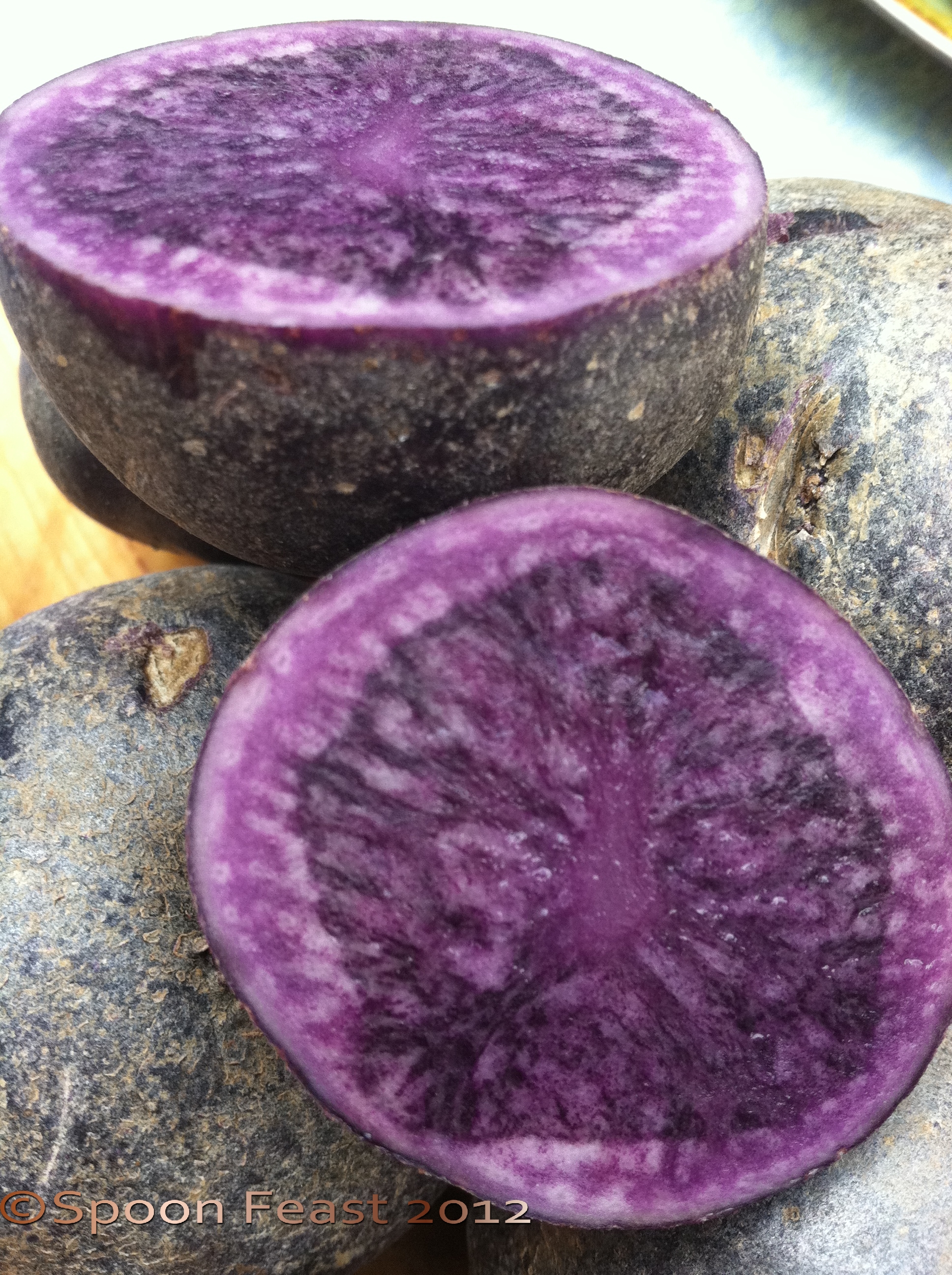
Have you ever seen a blue or purple potato? They really are blue or purple throughout. And they stay that way when cooked.

When you have purple asparagus or purple carrots, they lose the purple color when cooked.

Purple potatoes do not! For the most part, you can use them as a high moisture low starch potato, but they do mash well without turning into glue or paste.

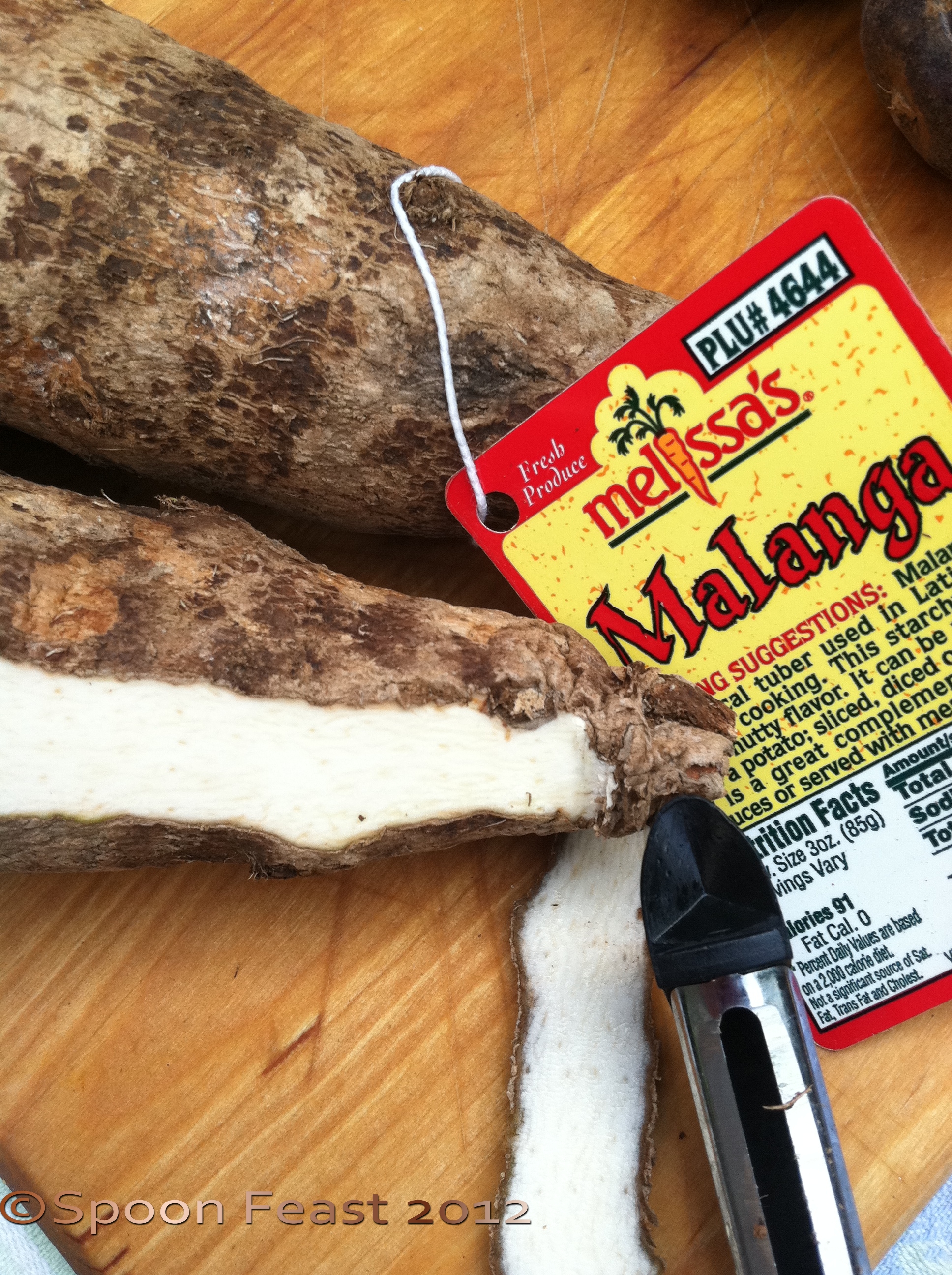
Additional varieties from the potato world include Malanga, Boniato which take to any cooking method potatoes do.

Boniato, inside flesh is white. Use these as you would sweet potatoes.

Malanga

Here in the US, Melissa’s Brands offer several unusual varieties not only of potatoes but of all unusual, hard to find produce items.

Be adventurous and try a different kind of potato next time you go shopping.

When choosing what potato you want, if you want a potato to hold its shape as in soup, choose a high moisture low starch.

For fluffy mashed potatoes, select russets and run cooked potatoes through a ricer, not a mixer. perfect mashed potatoes is another post soon.

For great french fries you need a low moisture potato with high starch. Again russets are your best choice but you can also use “All-purpose potatoes” or “chef’s potatoes”. These labels indicate a moderate amount of starch and moisture and can be used in any potato recipe.

This is why sweet potato fries are mostly limp, they have too much moisture to get fluffy like russets do. Sweet potatoes also break down your frying oil faster due to the amount of natural sugar in the potato.

Quick run down:

Fluffy baked potatoes, mashed potatoes and french fries use russet potatoes

To hold the shape as in soup, potato salads, use red or white skin potatoes, you can also find blue ones in this category.

Never store potatoes in the refrigerator. The cold converts the starch to sugar.

Always store potatoes in the dark, in a dry place. I keep mine in a cabinet that isn’t used much.

If potatoes area stored in light, they will develop a green skin which is a toxic substance known as “solanin”

It would take a boatload of solanin consumption to have an effect, but it is an intestinal irritant. You choose.

There will be doing a series of posts of cooking potatoes and selecting the right one for the recipe in the next few weeks.

In the meantime, choose something different and play!

Inside of a purple potato; notice the color of the skin in the background.

Inside a baked garnet sweet potato; isn’t that a great color?!

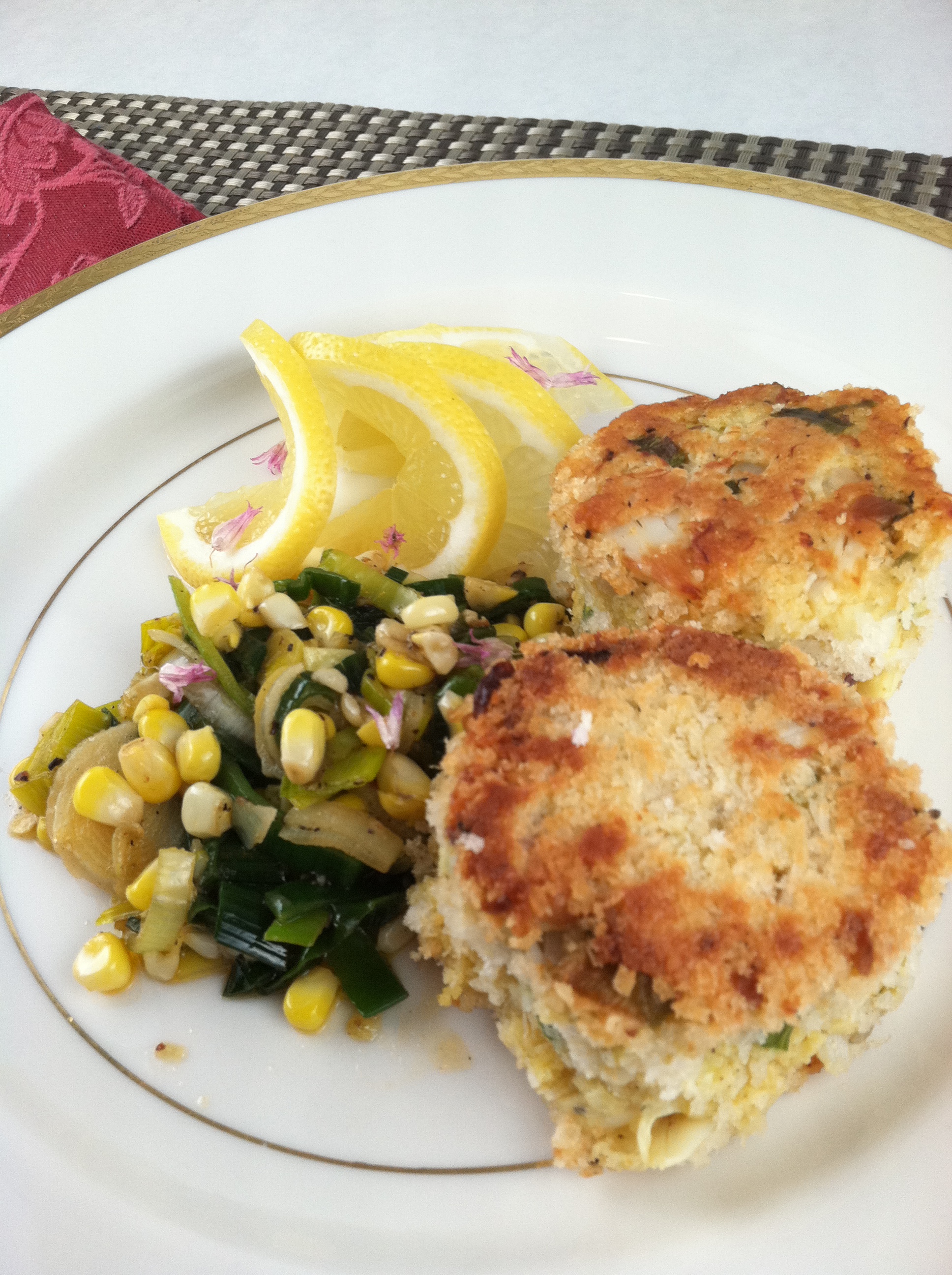
Crab Cakes with Leeks and Corn

Crab Cakes with Leeks and Corn

Crab Cakes get so abused. Tender sweet succulent crab; why do so many ruin the delicate flavor by adding red or green peppers to the mix?

When I think of crab cakes, I think of the delicious flavor of crab, not a nasal hit of red or green peppers. While I love peppers, they do have their place. In my opinion, that place is not in a crab cake.

What is the star of your dish? Is it the crab? How much did you pay for the crab? Usually a lot of money or labor if you cleaned your own crabs. Why would you want to hide the star of your dish with the pungent flavor of red or green pepper?

Peppers have a dominate flavor, they overpower everything. Which is why they are the stars in the dishes they are featured. Stuffed peppers, sausage and peppers, red pepper hummus, roasted pepper salads, great dishes with strong dominate flavors.

If you didn’t guess already, adding peppers to delicate crab meat is a pet peeve of mine. I feel strongly about it. If you like peppers in your crab cakes, fine, I’d ask you though if you really know what crab tastes like.

Enough of that rant, on to the crab cakes!

Crab, any kind of crab, has a delicate flavor. Enhance the flavor with a dab of smooth Dijon mustard, sautéed shallot, roasted garlic and sliced scallions or chives and lemon zest. Hold the mix together with an egg and coat the outside of each formed crab cake with a layer of panko bread crumbs and you have an amazing cake for either an appetizer, entrée or salad. How to and the recipe are below.

Crab comes in many forms. You can purchase live blue crabs  or king or queen crab legs and boil your  own for a great outdoor dinner party.

Colossal size crab meat from Blue Swimming Cra...

Colossal size crab meat from Blue Swimming Crab. Courtesy of Newport International. (Photo credit: Wikipedia)

Crab comes in canned or pasteurized form in addition to fresh. Here is the translation as to what kind of crab you are getting according to classification:

  • Colossal Lump: Very large white, unbroken pieces of crab.
  • Jumbo Lump:  largest white pieces of crab meat from the body portion adjacent to the back fin appendage. may contain broken pieces.
  • Back fin: A blend of large lump pieces and special meat.
  • Special: Flake white meat from the body portion of the crab.
  • Claw: This meat is from the crab claws. It is darker in color but sweeter in flavor.
  • Cocktail Claws: Claw meat intact on the claw with the outer shell removed.

Colossal Lump is typically the most expensive. If you think of the labor that goes into cleaning a crab, you would understand why.

Cocktail Claw crab meat from Blue Swimming Crab.

Cocktail Claw crab meat from Blue Swimming Crab. (Photo credit: Wikipedia)

The other night there was a pasteurized can of jumbo lump in my fridge. We had crab in salads and make crab cakes.

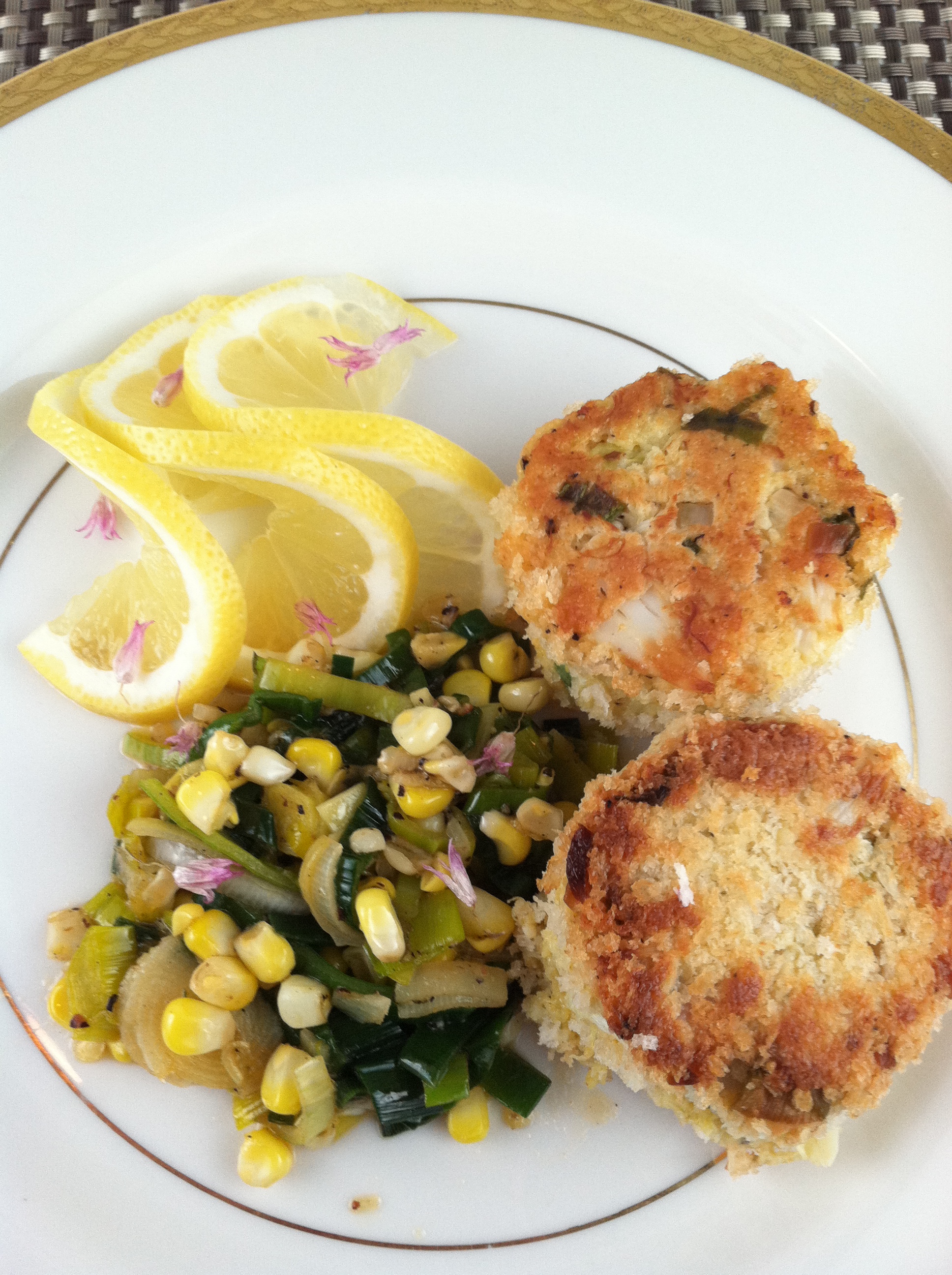
There were leeks and corn in the fridge too so I sautéed a nice side to go with the crab cakes.

Leek and Corn Saute

2 tablespoons vegetable or olive oil

1 shallot, sliced

1 clove garlic, minced fine

1 leek, washed and sliced thin

1 cup frozen corn or cut fresh corn from 2 ears

1/2 cup dry white wine or chicken stock

Salt and pepper to taste

Heat a saute pan over medium heat, add oil, shallot and garlic, stir.

Saute leeks and corn

Add rinsed leeks and corn, saute 2-3 minutes, add white wine and simmer until the pan is nearly dry. Taste and season with salt and pepper. Set aside and keep warm.

Crab Cakes

1/2 pound jumbo lump crab meat (or any market form you like but cocktail claws)

1 egg

1/2 cup panko bread crumbs

1 tablespoon fresh lemon zest and juice from 1 lemon

1 tablespoon minced shallots

2 scallions thinly sliced, white and green part

1 teaspoon minced roasted garlic

1 teaspoon old Bay Seasoning

Salt and pepper to taste

Optional: 1 tablespoon capers

To remove any cartilage that may still be in the crab meat, place the meat on a parchment lined sheet pan, place it in a 350°F oven for 2-3 minutes. Any cartilage will turn bright white or red and can easily be picked out.

Working in a restaurant, the sheet pan method is used to quickly identify any unwanted cartilage. This method also preserves the shape of the meat if using precious lump meat. High volumes of crab meat can be processed quickly this way.

Combine everything in a large bowl except the crab,  add the crab meat last so it does not get broken up too much.

Carefully, take a small handful and shape the crab cake between your thumb and forefinger as if you are making a hand gesture to say OK. This makes the sides and size consistent.

Roll each cake carefully in breadcrumbs.

Heat a saute pan with 2 tablespoons of oil. Cook the crab cakes until golden brown on each side. If you move them very little while cooking they won’t fall apart.

Serve with lemon, sautéed leeks and corn on the side.

Crab cakes with leek and corn

Potatoes Au Gratin

I have been on a comfort food kick the past few days; Potatoes au Gratin are one of my favorite creamy delicious side dishes.

We always had them as a kid sometimes from scratch and sometimes from a box. The box variety always fascinated me.

The clear plastic looking chips, the powdered sauces, pour over boiling water and bake. Voila! Potatoes au gratin or Scalloped Potatoes all from a box. It was amazing stuff.

Making the same potatoes from scratch is far more satisfying, both nutritionally and esthetically.

First you have to get some good starchy potatoes – russets are the best as they are a ‘high-starch, low moisture’ category of potato.

Peeling is your option, but be sure to scrub them clean.

Have everything ready to go before you start slicing the potatoes so they don’t turn colors on you.

If you don’t know what I mean about potatoes turning color, take a slice and just let it sit out on the counter or on a plate. Look at it again in 5 minutes. It is oxidizing with exposure to air. Process potatoes quickly to avoid this color change happening.

“Green” on the potatoes is called “Solanin” and it is a sign of a potato that has been stored incorrectly with an exposure to light.  To avoid green potatoes, always store potatoes in a cool, dark place.

While it would take quite a bit of solanin to cause severe damage, it is an intestinal irritant. Simply cut away the green with your peeler. It isn’t very deep.

Do not store potatoes in the refrigerator, the cold converts the starch to sugar. Restoring to room temperature, over a few days will convert back to starch.

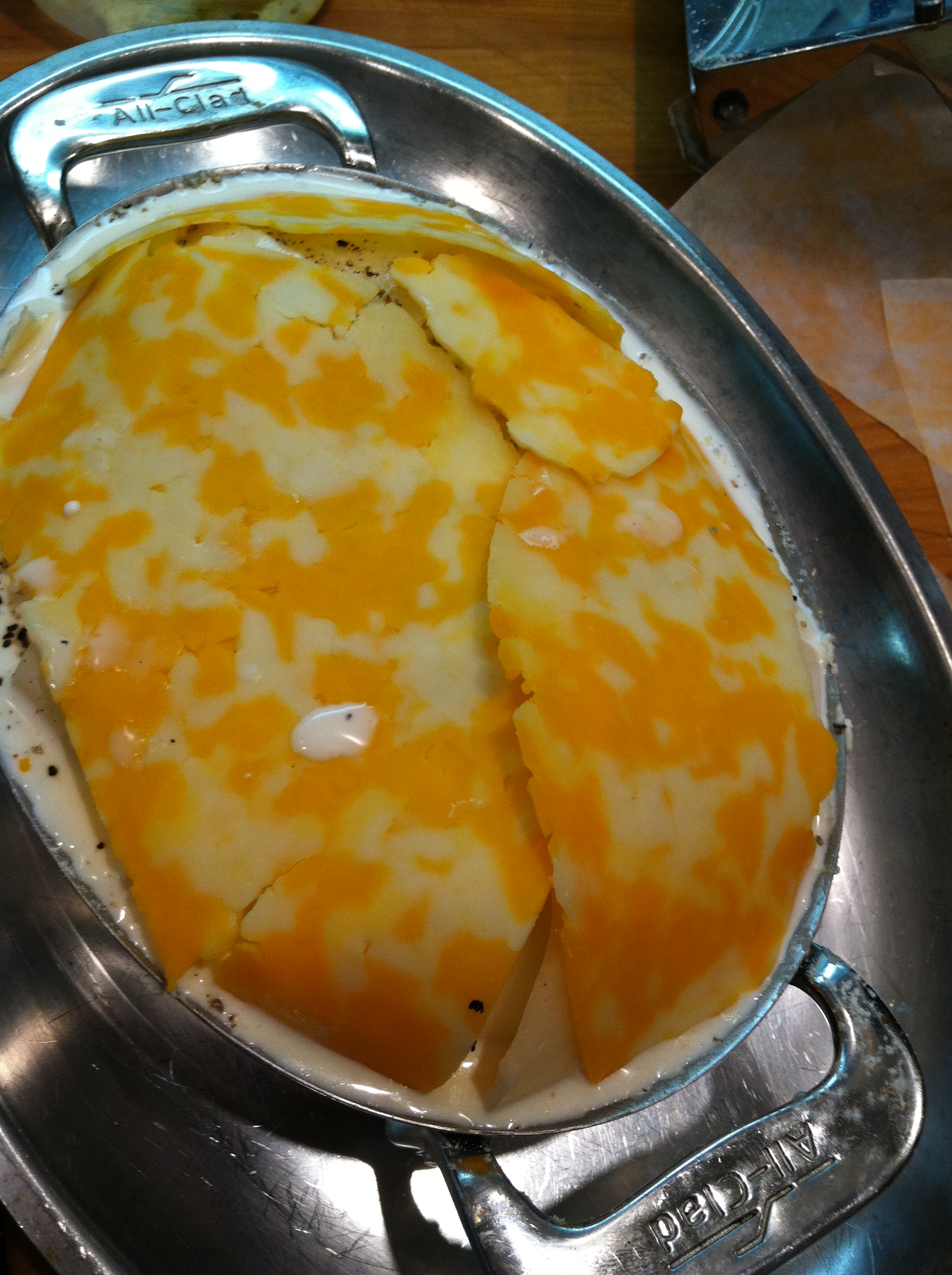
I made this dish for Robert and me but it would easily feed four. I used an All-Clad oval stainless baker pan, you can use any oven-proof dish you want. Adjust the quantities if using a large pan.

Potatoes Au Gratin

Serves 2-4

  • 1 or 2 large russet potato, peeled and sliced thinly
  • 4 whole large shallots, peeled and sliced thinly
  • 1/2 container Herbs and Garlic Boursin cheese (or 1/2 cup any shredded cheese of your choice)
  • 1 cup heavy cream, brought to a boil
  • 2 tablespoons flour
  • Salt and pepper
  • Optional: Monterrey Jack cheese to top and get all golden brown

Method:

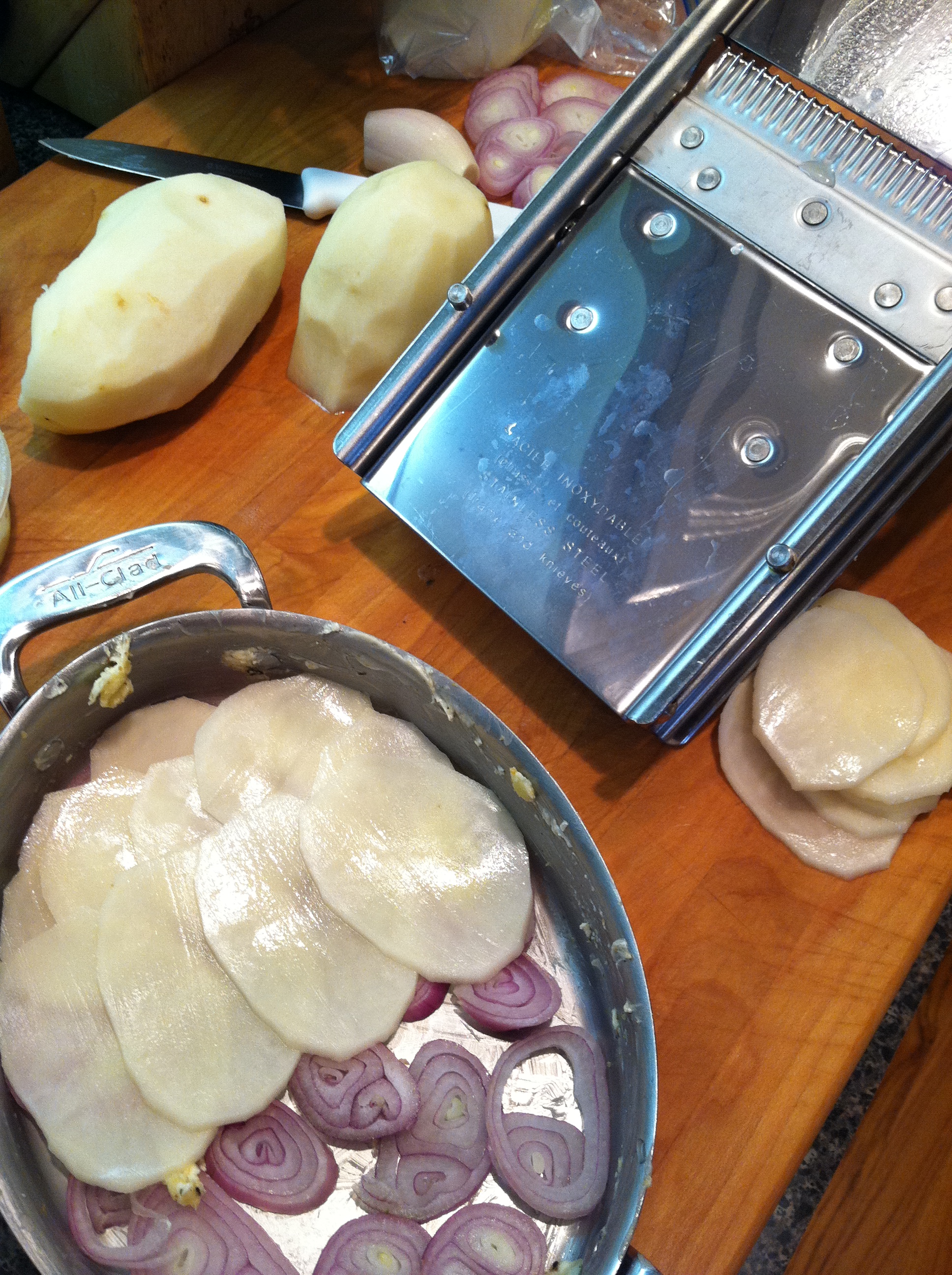
Thinly slice potatoes and shallots by hand or use a mandolin.

Be careful when slicing on a mandolin! Slicing on the mandolin ensures even slices so they cook at the same rate.
HINT: Slice shallots by hand.

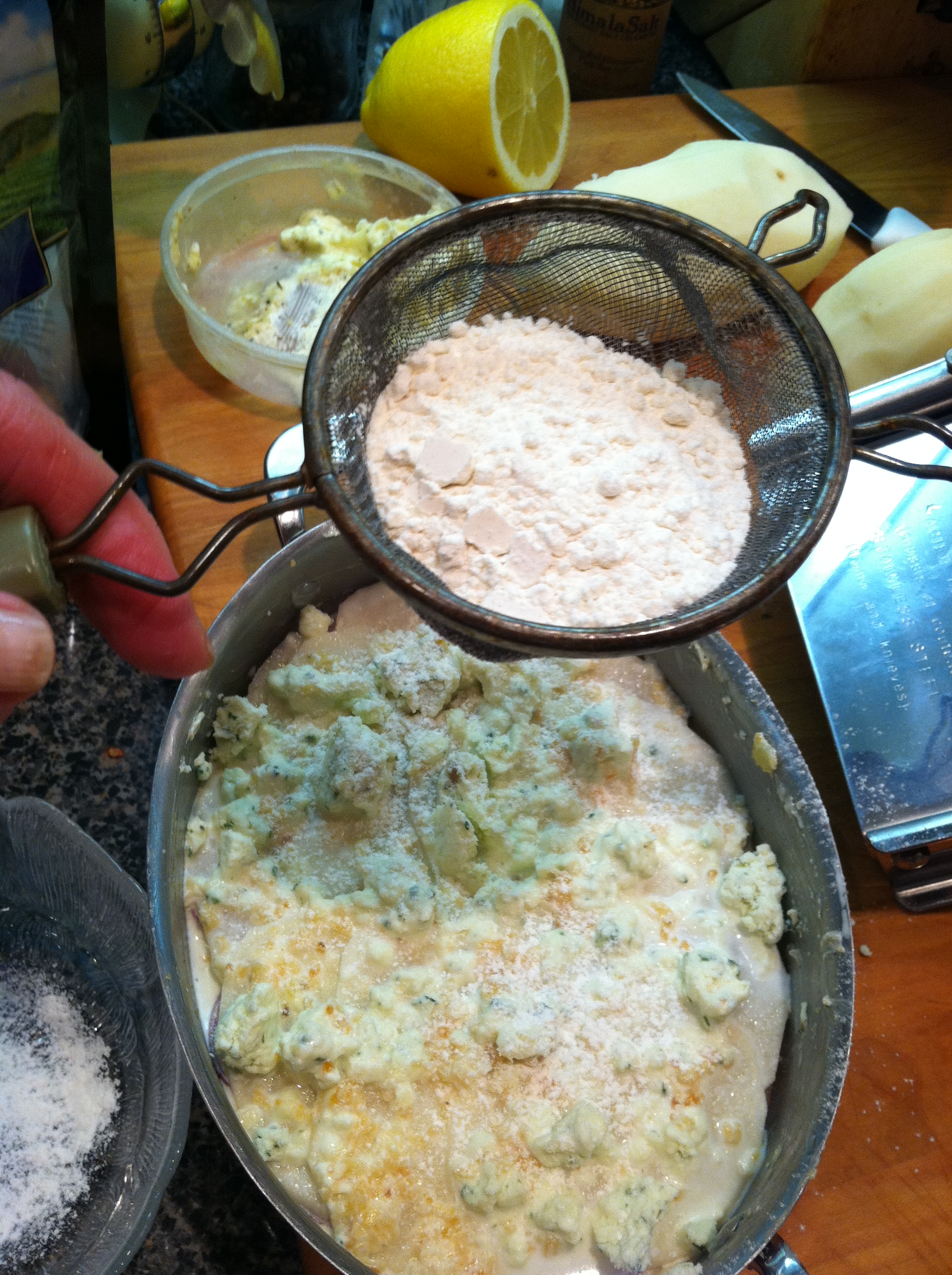
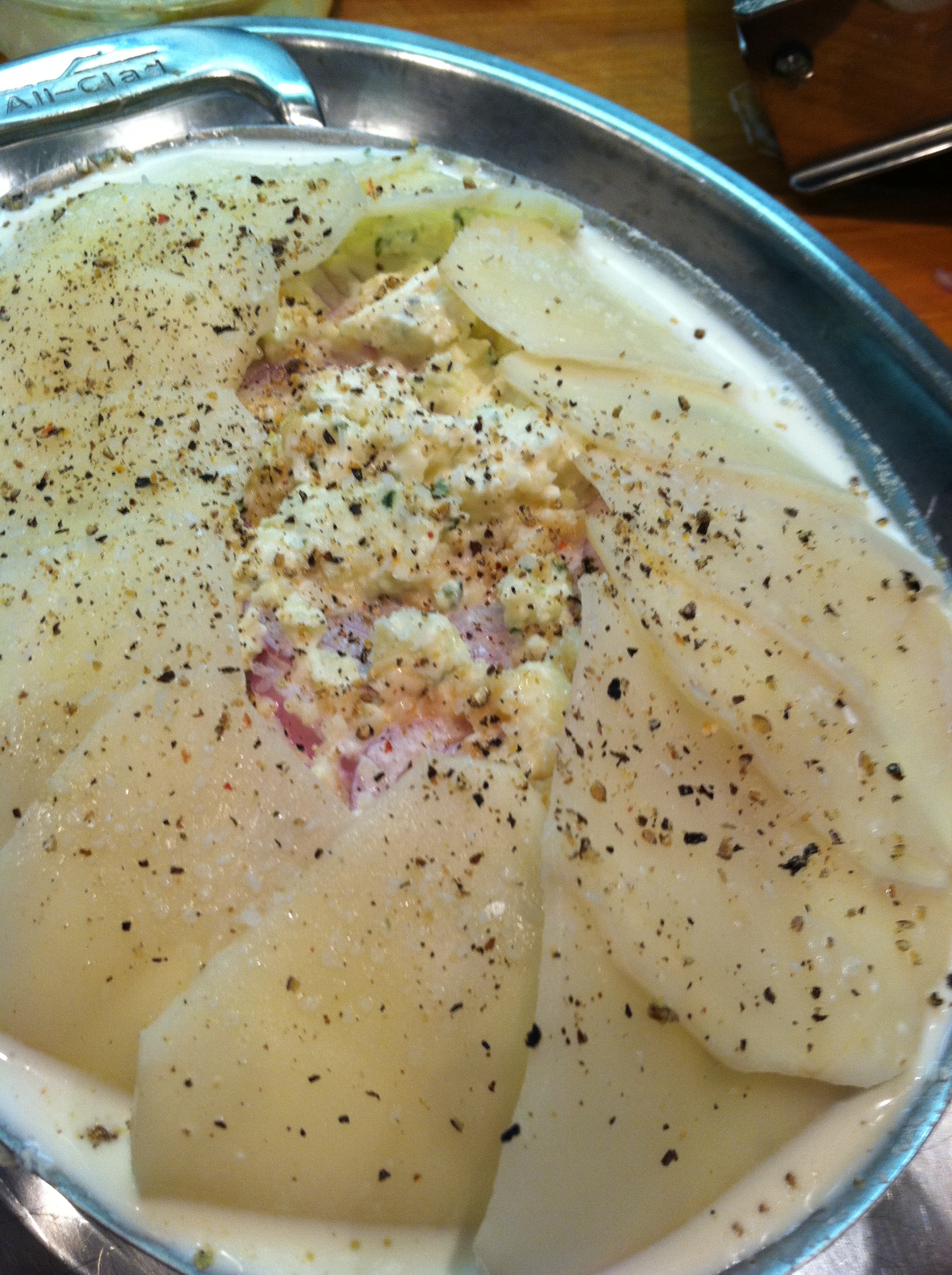
Butter the dish, place a single layer of sliced shallots on the bottom of the pan, top with potatoes laid in a single layer, top with shredded cheese, spoon 1/4 cup of warm cream, sprinkle with salt and pepper, drizzle a light sprinkling of flour and repeat layering until the dish is full. The top layer should be cheese.

Here is the layering sequence again:

  1. sliced shallots
  2. sliced potatoes
  3. cream
  4. salt and pepper
  5. flour
  6. cheese
  7. repeat leaving cheese as the top layer

Butter the dish, layer shallots then potatoes

Notice how the potatoes are shingled into a layer

Sprinkle flour over the cheese and potato layers

Keep alternating layers to the top

Top with cheese and bake

Place the filled dish on a parchment paper lined baking sheet to catch all spills. Place in a 400°F oven for 1 hour or until the dish is bubbling and golden brown on top.

We usually gobble these up pretty quickly but if you have any leftover, cut them into shapes and reheat either in the microwave or the oven until nice and warm in the center.

Variations on the theme:

  • Scalloped Potatoes: Leave out the cheese and make sure enough cream covers the top slightly. Top with breadcrumbs; Bake the same way.
  • Add your favorite herbs for an herbal variety.
  • Use different cheese: Goat cheese, Havarti, Asiago, fontina, add some bleu to the mix.
  • Use cheese that you know will melt nicely. If you want to make this with cheddar, please add some hoop cheese to it for melting purposes. Cheddar does not melt well all on its own.

I’m sure your family will enjoy this as much as mine does. Your home will smell wonderful as they cook. Since they are in the oven for so long, it is a good time to plan a baked chicken or pork chop to go along with the potatoes.

Sometimes I’ll have a plate of just potatoes au gratin for lunch, if there is any left over.

Plated Potatoes au Gratin

How to Roast a Chicken

Here is another basic skills post about how to roast a chicken. The same principle applies to most birds, large or small. Ducks are just a bit different due to the amount of fat on them.

To select a whole chicken, carefully look at the wing tips, they should not be brown in any way. Slightly red is OK but no brown. Look at the neck area, same thing. These areas show age on market chickens. If they are fresh, they will be ‘chicken color’ and possibly red tips on the wings. No brown, green or purple.

The chicken should also not have any odor. Give it a sniff. Pass it by if you smell anything.

Sometimes the inside of the bird contains a small bag of the heart, liver, neck and gizzard. Remove this from the inside of the bird. Throw it away unless you eat heart, liver, neck and gizzard. My father made wonderful sauce from these parts. Sometimes I saute the hearts and livers but there is only one inside each bird so they become the cooks treat. YAY!

Thoroughly rinse the bird inside and out. Pat the bird dry.

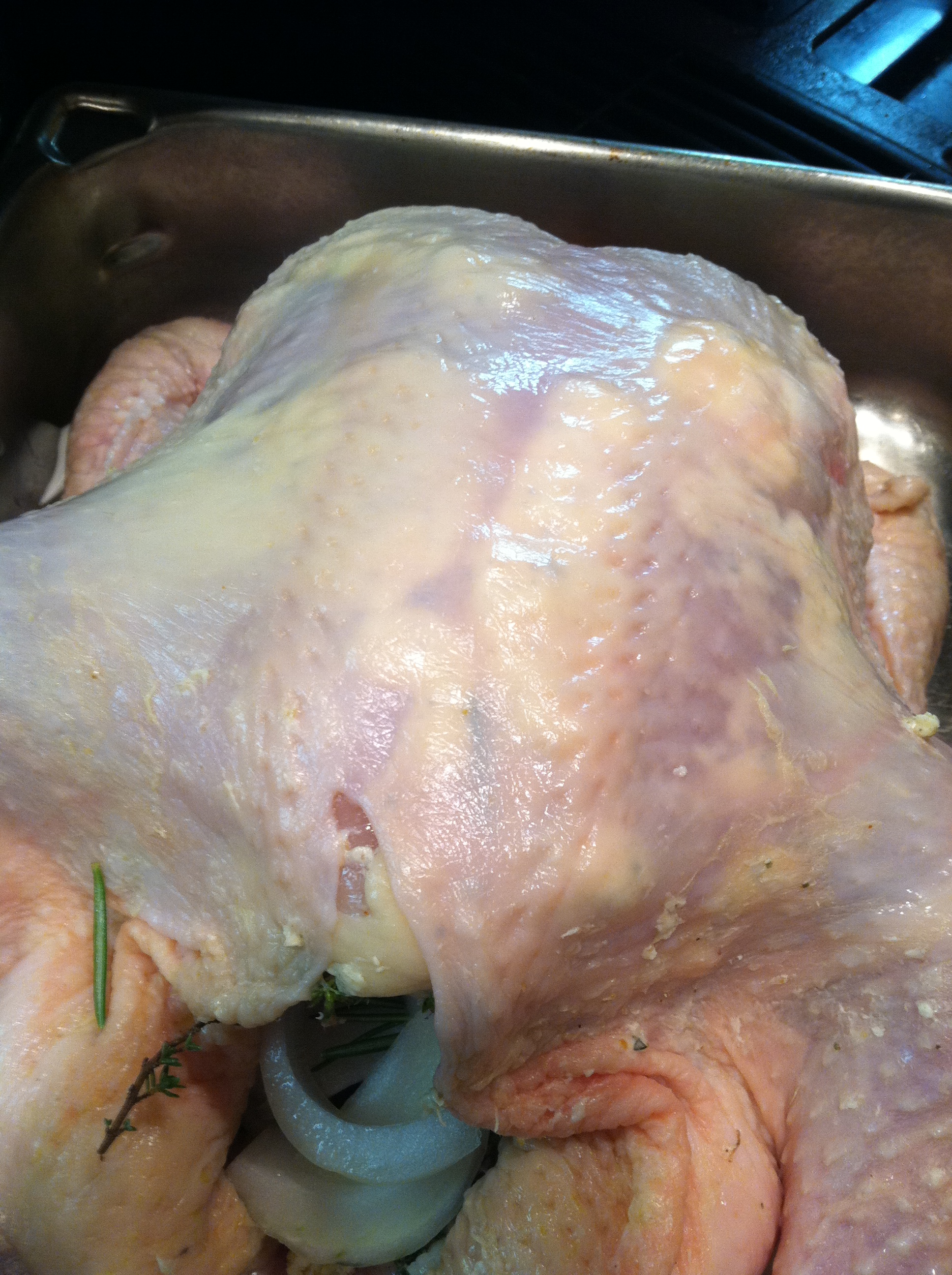
Carefully, using your fingers, loosen the skin but do not tear it.

Look carefully, see the butter under the skin?

Insert compound butter between the skin and the meat, smoosh it around so it almost covers the meat and then rearrange the skin back in place. This will baste the meat with herbs and butter while the bird roasts.

What is compound butter? Soft butter with herbs and seasonings mixed in. Any combination, any flavors, your choice. Toss it in a mixer, mix it up, place in a container and use it anywhere you would use butter. The butter I used here contained thyme, garlic, lemon, shallot and pepper.

To give the bird some flavor while roasting, insert herbs, onion and garlic into the cavity. For this bird I used rosemary, thyme and onion and a bay leaf.

For food safety sake, if you want stuffing, bake it in a separate pan. See note below regarding food safety.

On the bottom of the roasting pan, place chopped carrots, celery and onion (25% carrots, 25% celery, 50% onion ratio) and 1/2 cup or so of water or stock.

Professionally, we call this vegetable ratio “mirepoix”.

Tie the legs together with butchers twine or cotton string. Run the string around the legs and thighs and tie it off under the wings. This holds the bird together in a nice compact bird-like shape, controls the legs and plumps the breasts.

This is how you get a good-looking finished bird that isn’t splaying its parts all over the place.

Season the birds skin. I used Montreal Steak Seasoning for this one. Season as you like.

Season, tie the legs and truss the chicken. Place on top of vegetables to roast.

Place the tied and stuffed bird in the roasting pan on top of the vegetables.

Roast the bird in a 350°F oven for about 2 hours or so for a 3 pound bird. Please use a thermometer to test for 180°F internal temperature in the thigh, not near a bone.

The dark meat takes longer to cook so you test there. Please be sure to cook your chicken all the way.

There is nothing as unappealing as cutting into a whole roasted bird and have blood come out. Obviously, it goes back into the oven to finish cooking, if that happens.

When the bird is done, allow it to “rest” for about 15-20 minutes before carving. This is when I prepare the vegetables and put the final touches on the meal.

Food safety really comes into play with handling chicken.

  • Keep the bird cold.
  • Sanitize the work area with a mild bleach after preparing and handling the bird.
  • We are trying to avoid contaminating our families with Salmonella and Campylobacter jejuni in particular.
  • If your bird is frozen do not allow it to thaw on the counter or in the sink. Put it under cold water that you change frequently or in the refrigerator which takes 2-3 days to thaw, so plan ahead.
  • Always sanitize everything that chicken and your hands come in contact with during preparation with a mild bleach solution when you finish. Knives, boards, spoons, counters, sinks, knobs, handles, towels, aprons, etc.

To make a sauce, use the drippings in the bottom of the roasting pan. Deglaze with chicken stock or white wine. Strain the liquid from the roasting pan into a sauce pot. Bring to a simmer.

Mix equal parts of butter and flour together in a small bowl. Drop small pea sized pearls of the flour and butter mixture into the simmering stock, whisk to incorporate. Season as desired. Simmer for 10-15 minutes to cook out the starch taste. Finish with a pat of cold butter whisked in, adjust salt and pepper. Strain again if desired.

Roasted chicken with sauteed beet greens

We sautéed the beet greens we had on hand from the pickled beet post. Yummy stuff.

There will be another post soon on “How to Cut Up a Chicken”

Enjoy roasting your chickens! I adore the aroma, it smells like home and all things wonderful.

Artichokes!

Artichokes from the market

I found the most amazing artichokes in the farmers market this week. They were huge and hybrids. These artichokes did not have any of the thorns or much of a “choke’ inside either.

The woman at the market asked me “how do you cook them so they are tender?”

Steam them.

I had to find a domed lid to fit the steamer; the artichoke was so big!

All I did with this artichoke is cut the stem so it would fit in the pot with the lid on it and steam. It had to be steamed for about an hour and 15 minutes. Once the water came to a boil, the heat was turned down to low. You will need to check the water level to be sure you don’t burn up a good pot.

If you find the non-hybrid type that have the small thorn on each leaf, you will need to use the kitchen shears and clip them off. After your cut a few, wipe the edges with a cut lemon to prevent the artichoke from turning black.

Any cut you make on a raw artichoke, swipe it with a piece of cut lemon to preserve the color and keep it from oxidizing.

You can tell the artichoke is done cooking when the leaves pull off easily and a knife is easily inserted into the base of the artichoke with no resistance. Do this from the bottom so as not to ruin the presentation.

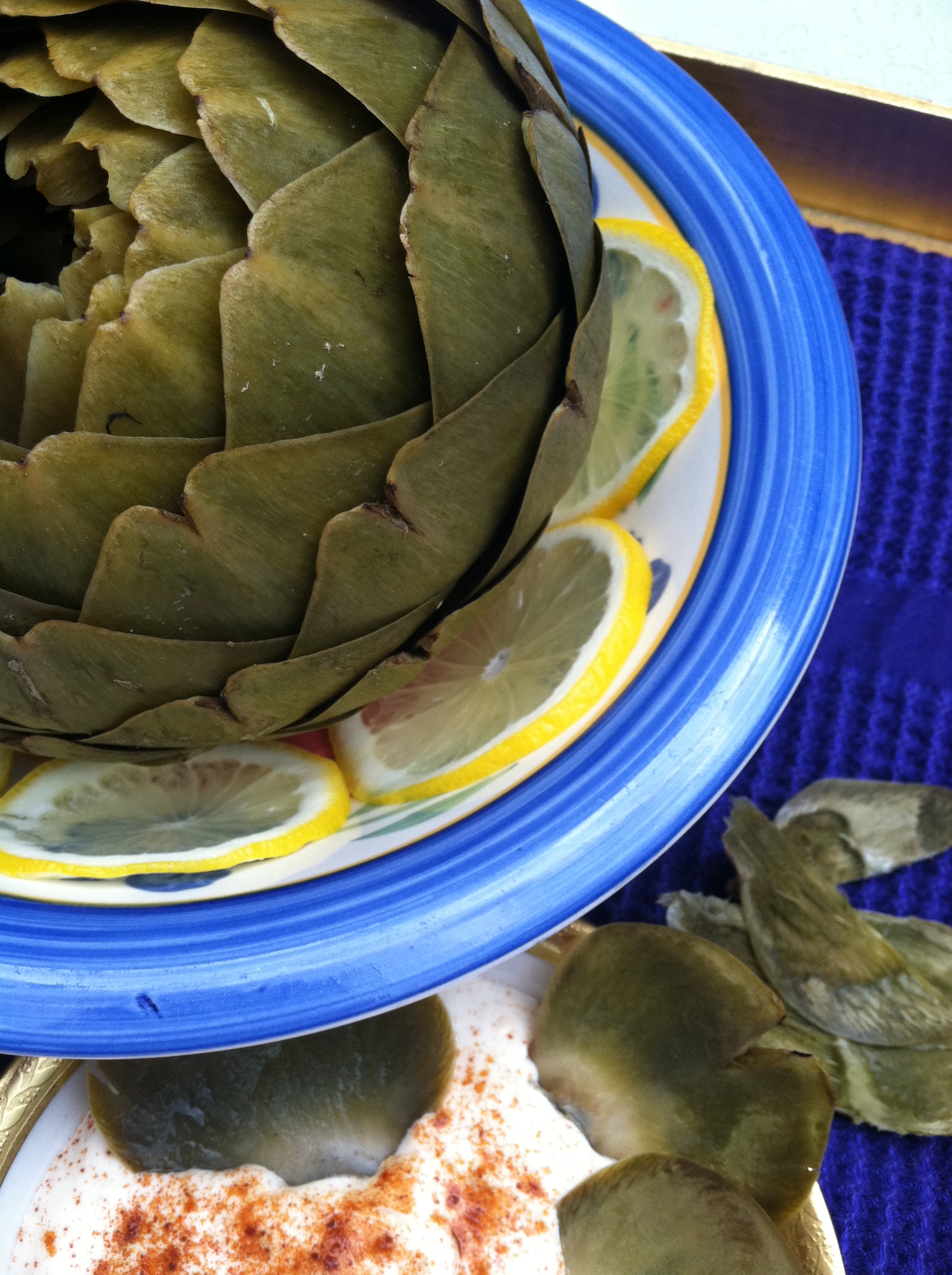
There are a lot of things you can do with an artichoke but today, I am just steaming it and serving it with a couple of sauces.

We will eat it as an hors d’ oeuvre with aperitif before dinner. Serving like this is also an interesting way to put out a snack when guests and friends come visit. We usually gather in the front yard about an hour or so before dinner and friends join us for great conversations, drinks and sometimes an hors d’ oeuvre or two.

A word of caution, artichokes make cheap red wine taste great and good red wine taste awful. So if you are serving artichokes, serve a decent inexpensive red wine.

Please don’t go down as low as Trader Joe’s Two Buck Chuck. That is truly awful stuff. The only thing that makes that better is pouring it down the drain.

The sauces:

Yogurt Sour Cream Sauce

  • 1/4 cup plain Greek yogurt
  • 1/4 cup sour cream
  • 2 tablespoons mayonnaise
  • 1 teaspoon smooth Dijon mustard
  • 1 teaspoon fresh lemon juice
  • 1/8 teaspoon garlic powder
  • 1/8 teaspoon onion powder
  • Salt to taste
  • Sprinkle of sweet paprika for garnish

Mix it all together. Sprinkle sweet paprika lightly over the top.

Let is rest to allow the flavors to blend.

Dip artichoke leaves in sauce.

Lemon Butter Sauce

  • 1/2 cup butter
  • 1 lemon, zested and juiced

Melt the butter, add the juice of the lemon and 1/2 of the zest. Warm through.

Place a couple of slices of lemon in the bowl to serve. Dip artichoke leaves into sauce.

How do you eat a whole artichoke?

Starting at the bottom base, carefully pull a leaf off. It should separate easily. Dip in sauce if desired.

Place the inside of the leaf against your bottom teeth, lightly bite down and scrape the artichoke flesh off the leaf with your bottom teeth and discard the remaining leaf. You have to pull the leaf to effectively scrape it against your teeth.

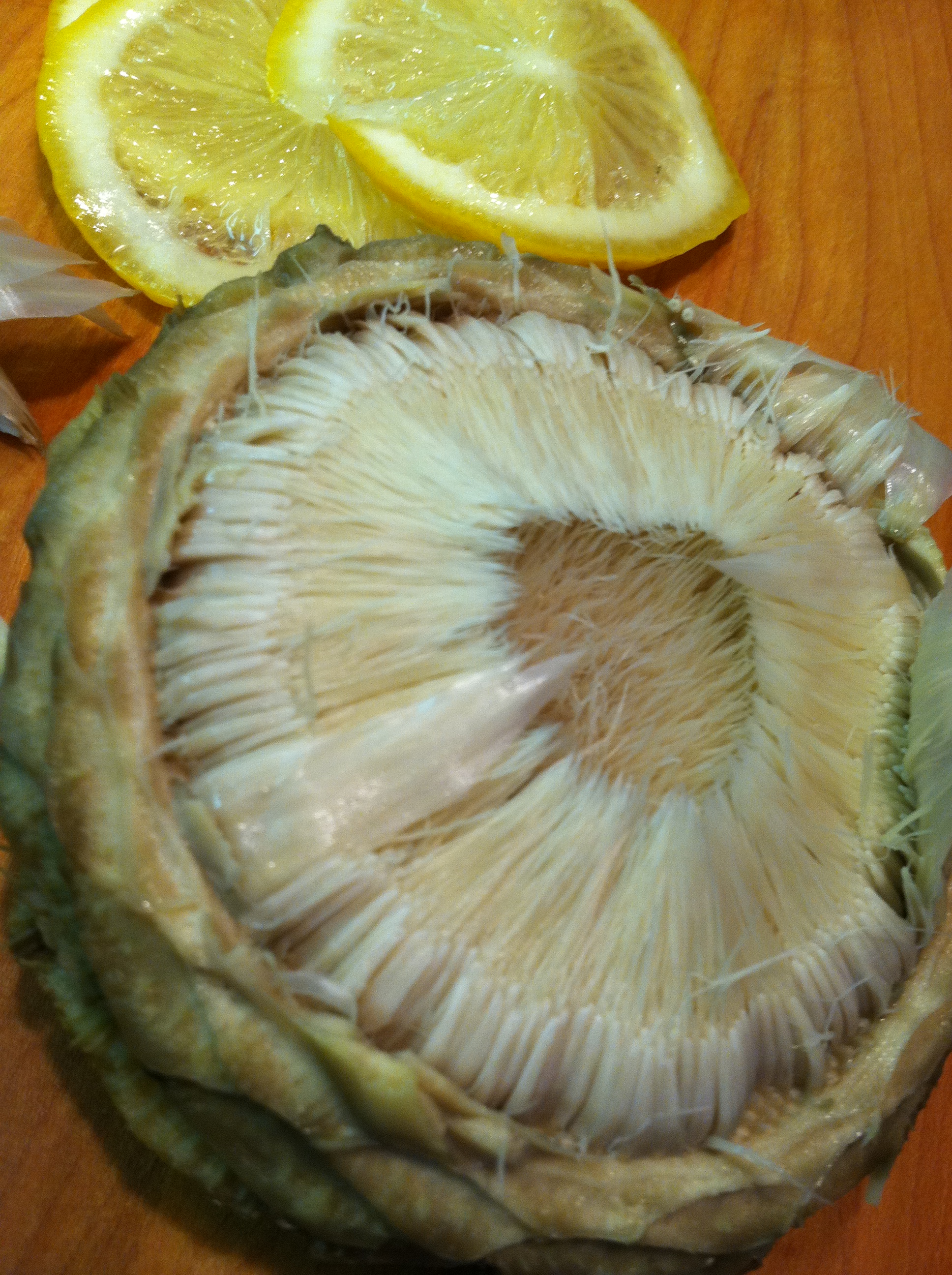
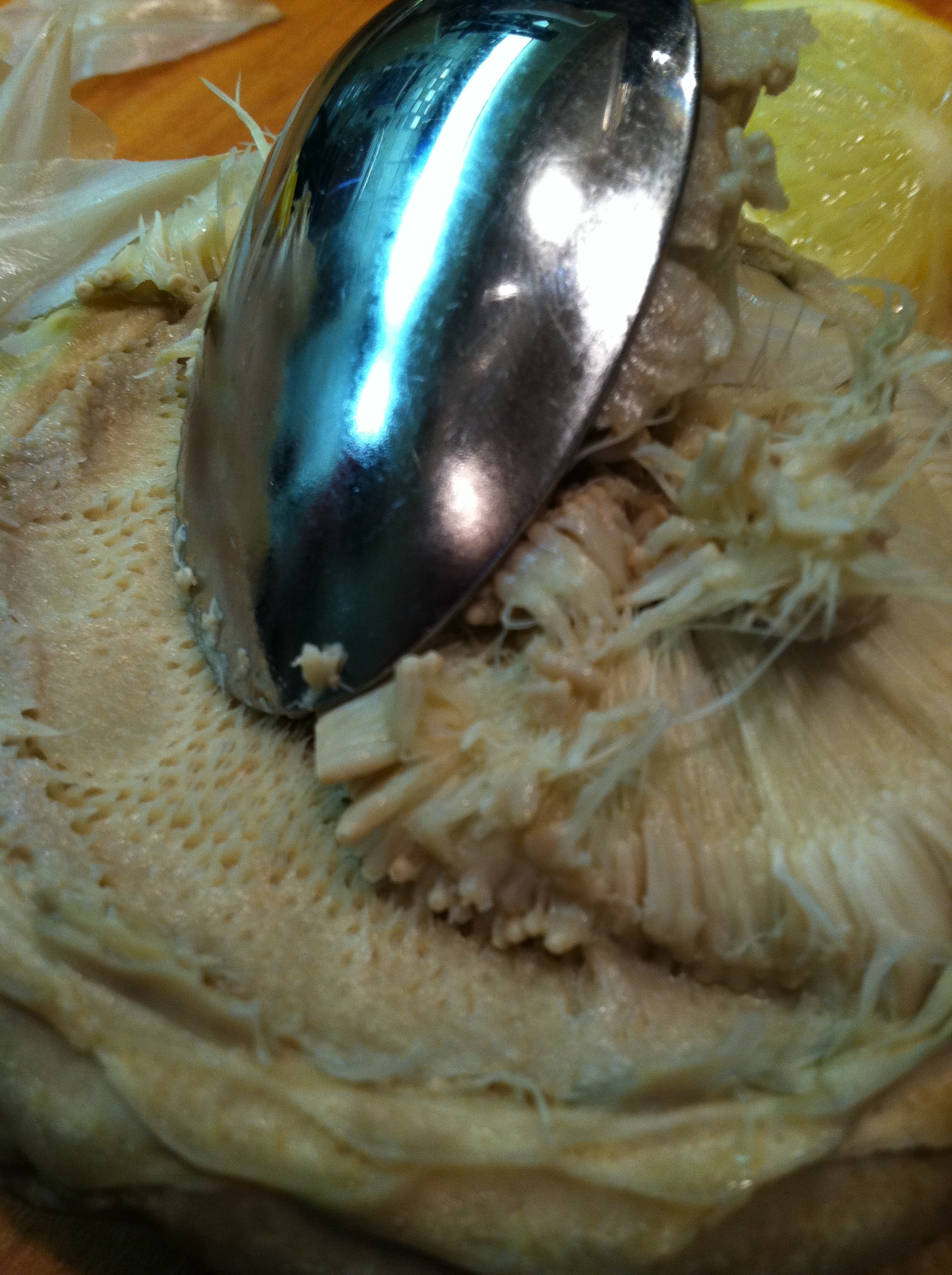
As you consume the leaves, the bottom will become visible. Once all the leaves have been consumed, you will find a “choke” in the very center. It is anchored by the bottom of the artichoke.

The "choke"
Notice how fuzzy it is; not leaf like at all

Scrape the choke away from the bottom; discard

The cleaned artichoke bottom

This is how it looks upside down

Cut artichoke bottom ready to use in salads, dips, etc.

You do not eat the choke because it is inedible and if you attempt to eat it, you will choke!

Scrape away the choke and eat the bottom. For this part, you will need a knife and fork.

You can always save it for slicing, mashing into Spinach Artichoke dip, salads or leave it whole and stuff it for a completely different dish.

If you have any leaves left over, scrape the flesh from the leaves with a spoon and make soup, salad dressings or use the artichoke scrapings in stuffing. There isn’t much shape to the scraping, use it like you would something mashed.

You can try making them the Roman way too. (Thanks, Barbara!)

Steamed Artichoke with Yogurt Sour Cream Dip and Crispy Kale Chips