A story about blue crabs

St. Johns River, Florida

There was a time in my life when I lived on the St. Johns River, south of Jacksonville, FL in a small place named Switzerland.

We had a dock and a couple of boats and crab traps. The traps would get stuffed with chicken necks and then dropped in the river.

Most of the time, we could drop them right off the dock and get traps so full of blue crabs we couldn’t possibly eat them all.

So, we would build a bonfire on the riverbank, pull some coals to the side and place cast iron dutch kettles into the fire to

Maryland Blue Crab

boil water and then fill the pots with crabs, herbs, and seasoning, cover and put it back in the fiery coals to cook the crabs.

When they were cooked, the pot would be spilled all over the picnic table and another pot put into the fire.

Crabs for sale at the Maine Avenue Fish Market...

Friends, family, neighbors would all gather around, eat huge amounts of blue crab, drink beer, I think back then it was Rolling Rock and Heineken. It was great having everyone around talking, sometimes singing and having a great time.

1893 bird's eye view of Jacksonville, with ste...

1893 bird’s-eye view of Jacksonville, with steamboats moving throughout the St. Johns River (Photo credit: Wikipedia)

The families we were with at the time had actually settled the area in the mid to late 1800’s. There were stories of Reggie Moreman sailing down the St Johns to locate and settle the highest point on the river. There were stories of pirate ships sailing down the St Johns to Black Creek to fill water kegs with the tannin water for long voyages; stories of Indians and smoke on the banks across the river near Green Cove Springs.

Two families tried to tame the once wild river banks. One with potato farming and the other established some of the first orange groves in the state of Florida. They had docks that would load with oranges for shipping to anywhere. When the groves got frozen out, they moved to southern Florida to grow pineapples in what is now downtown Miami.

The Moremans stayed in Switzerland, Florida. When I was there, we still ran through the remnants of the groves plucking ripe fruit from the trees before the first frost. Most were sour oranges due to the base stock being sour, but there were still a couple of sweet trees.

The crabs always ran like this in the deep fall, or was it spring? I can’t recall exactly what time of year it was, other than it was chilly, the night air dry and crisp.

This is one of my favorite memories of living on the riverbank  and eating crabs in Switzerland, Florida.

Calling the ferry, St. John River, NB, 1915 (?)

And well before the river got so polluted the fish sprouted two heads. (Really.)

Potatoes Au Gratin

I have been on a comfort food kick the past few days; Potatoes au Gratin are one of my favorite creamy delicious side dishes.

We always had them as a kid sometimes from scratch and sometimes from a box. The box variety always fascinated me.

The clear plastic looking chips, the powdered sauces, pour over boiling water and bake. Voila! Potatoes au gratin or Scalloped Potatoes all from a box. It was amazing stuff.

Making the same potatoes from scratch is far more satisfying, both nutritionally and esthetically.

First you have to get some good starchy potatoes – russets are the best as they are a ‘high-starch, low moisture’ category of potato.

Peeling is your option, but be sure to scrub them clean.

Have everything ready to go before you start slicing the potatoes so they don’t turn colors on you.

If you don’t know what I mean about potatoes turning color, take a slice and just let it sit out on the counter or on a plate. Look at it again in 5 minutes. It is oxidizing with exposure to air. Process potatoes quickly to avoid this color change happening.

“Green” on the potatoes is called “Solanin” and it is a sign of a potato that has been stored incorrectly with an exposure to light.  To avoid green potatoes, always store potatoes in a cool, dark place.

While it would take quite a bit of solanin to cause severe damage, it is an intestinal irritant. Simply cut away the green with your peeler. It isn’t very deep.

Do not store potatoes in the refrigerator, the cold converts the starch to sugar. Restoring to room temperature, over a few days will convert back to starch.

I made this dish for Robert and me but it would easily feed four. I used an All-Clad oval stainless baker pan, you can use any oven-proof dish you want. Adjust the quantities if using a large pan.

Potatoes Au Gratin

Serves 2-4

  • 1 or 2 large russet potato, peeled and sliced thinly
  • 4 whole large shallots, peeled and sliced thinly
  • 1/2 container Herbs and Garlic Boursin cheese (or 1/2 cup any shredded cheese of your choice)
  • 1 cup heavy cream, brought to a boil
  • 2 tablespoons flour
  • Salt and pepper
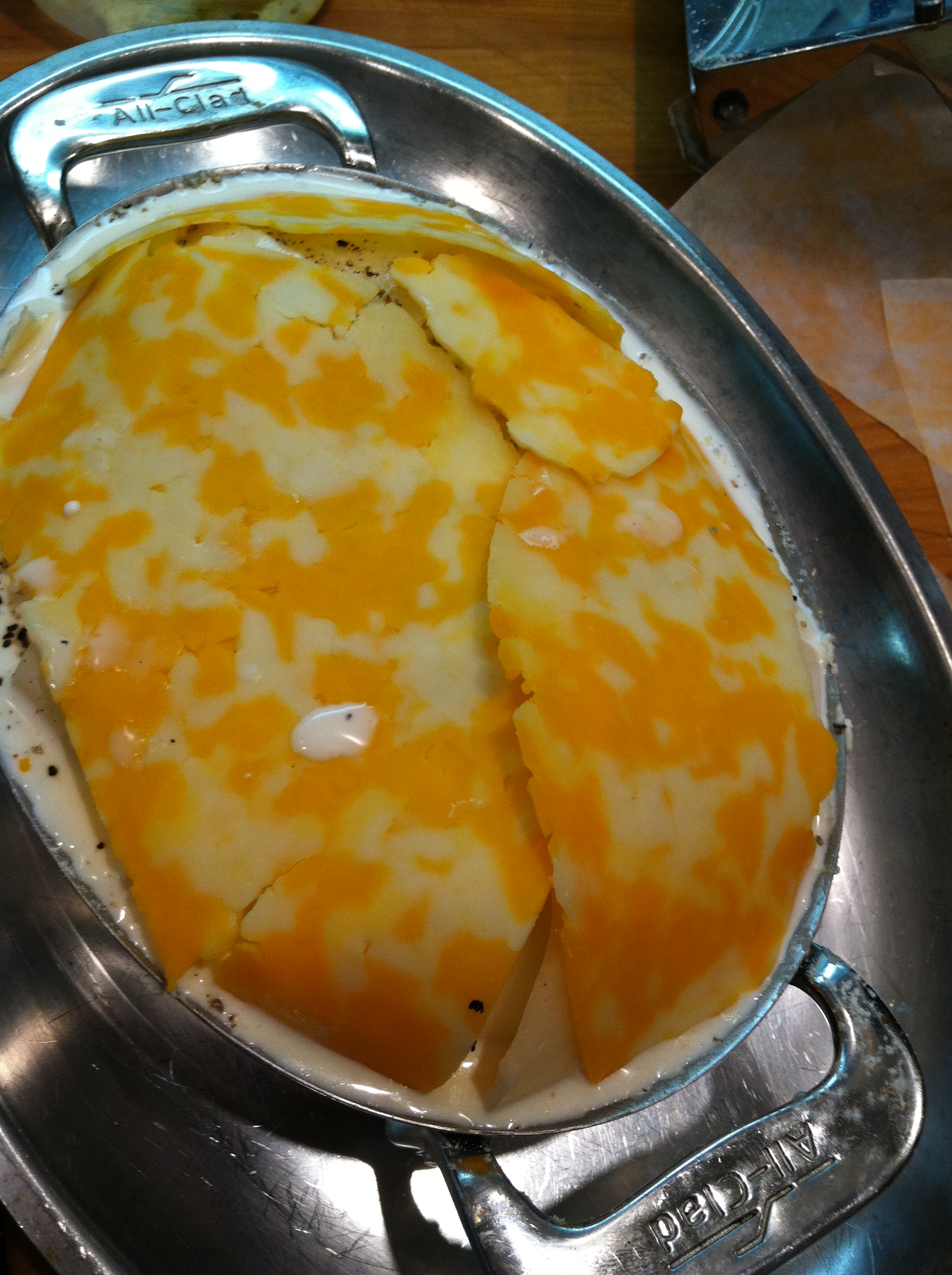
  • Optional: Monterrey Jack cheese to top and get all golden brown

Method:

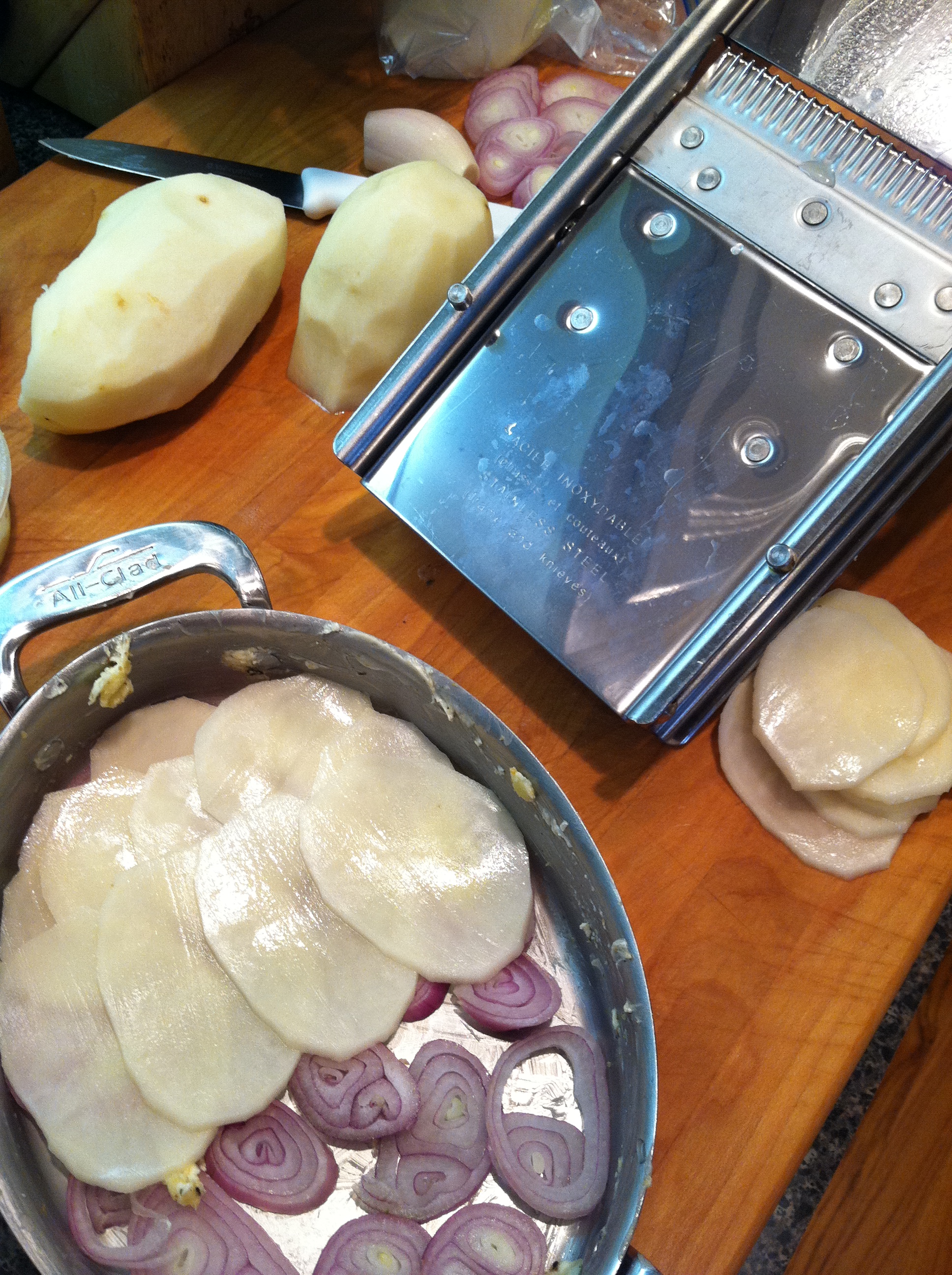
Thinly slice potatoes and shallots by hand or use a mandolin.

Be careful when slicing on a mandolin! Slicing on the mandolin ensures even slices so they cook at the same rate.
HINT: Slice shallots by hand.

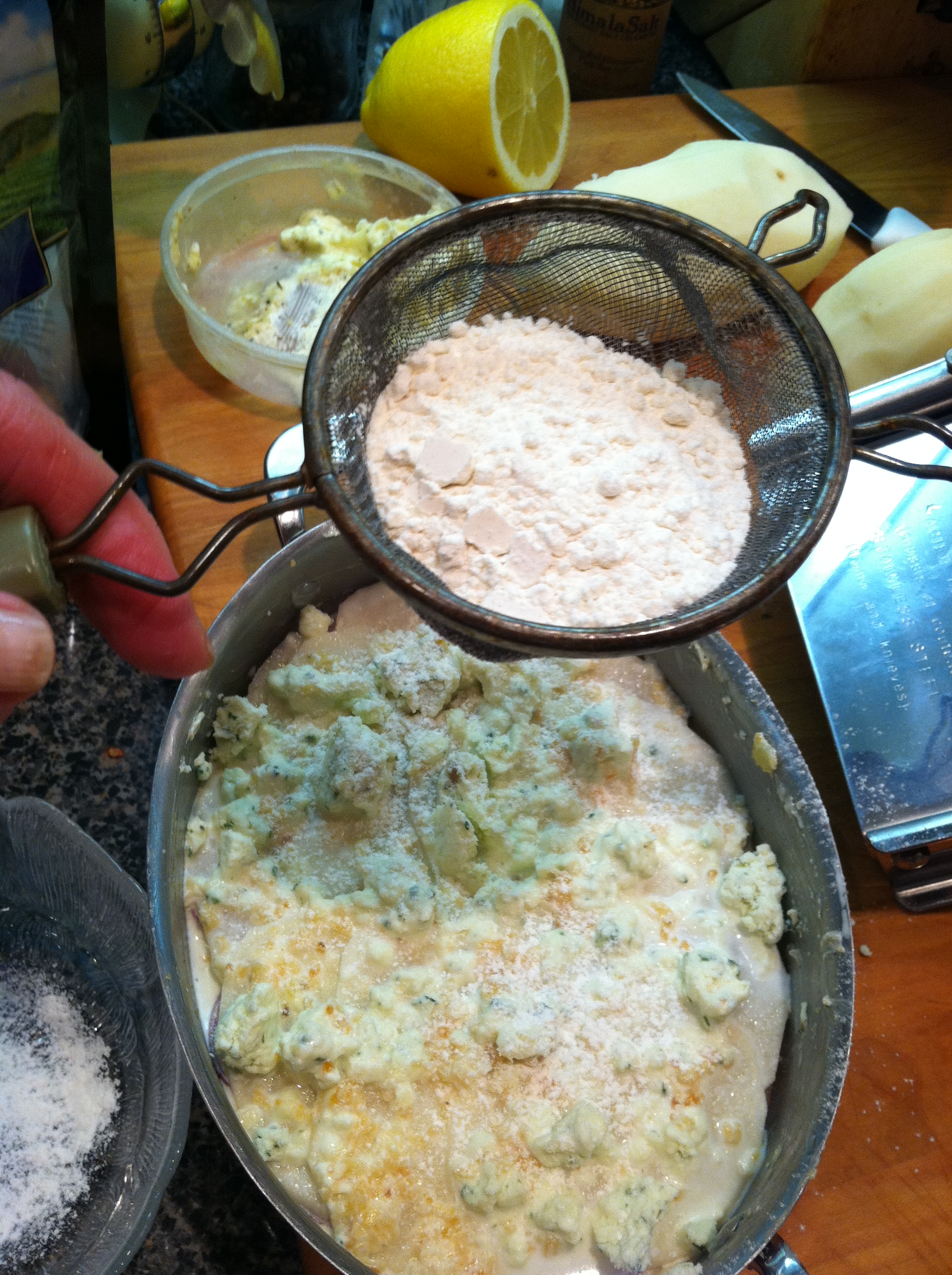
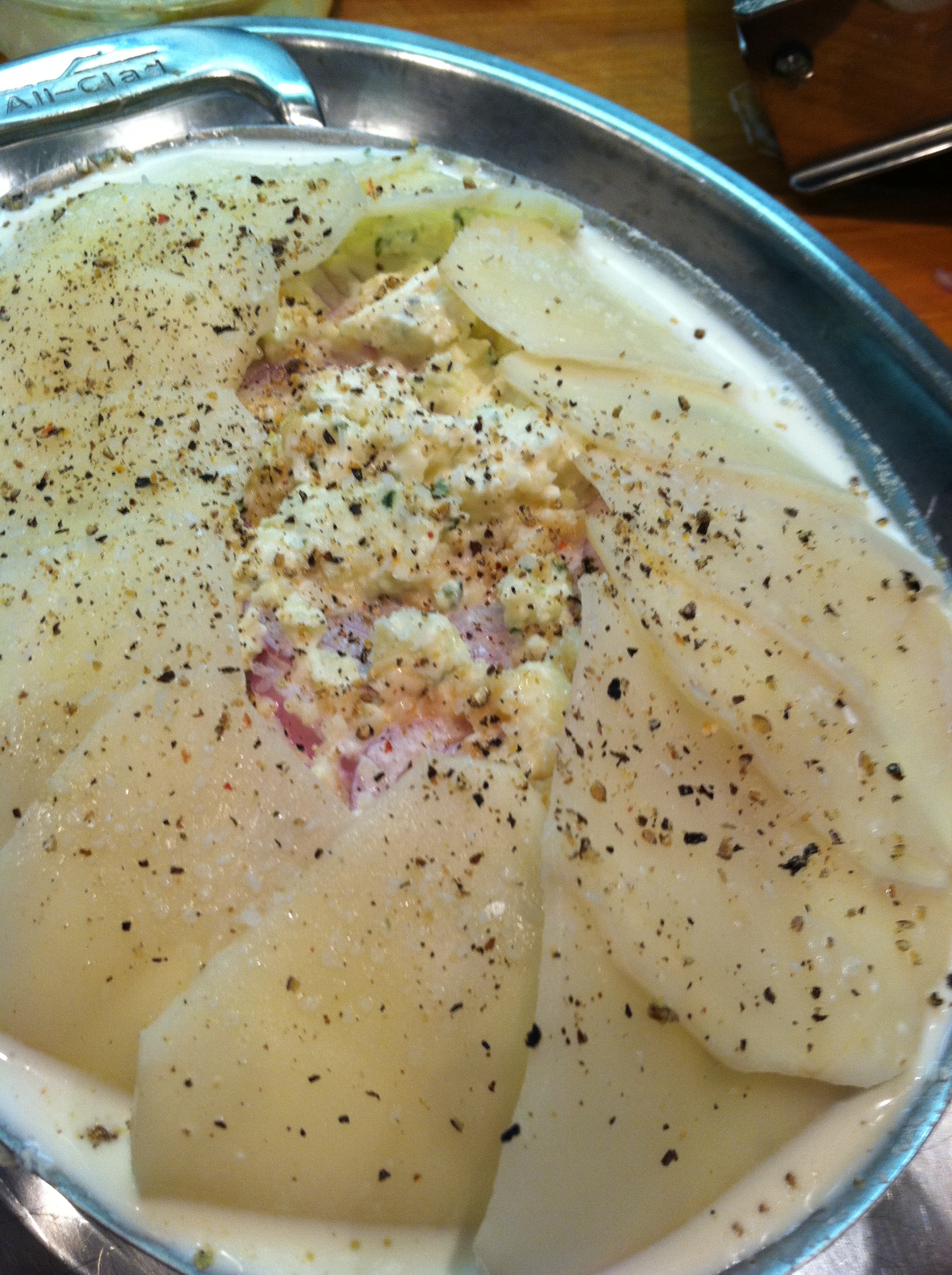
Butter the dish, place a single layer of sliced shallots on the bottom of the pan, top with potatoes laid in a single layer, top with shredded cheese, spoon 1/4 cup of warm cream, sprinkle with salt and pepper, drizzle a light sprinkling of flour and repeat layering until the dish is full. The top layer should be cheese.

Here is the layering sequence again:

  1. sliced shallots
  2. sliced potatoes
  3. cream
  4. salt and pepper
  5. flour
  6. cheese
  7. repeat leaving cheese as the top layer

Butter the dish, layer shallots then potatoes

Notice how the potatoes are shingled into a layer

Sprinkle flour over the cheese and potato layers

Keep alternating layers to the top

Top with cheese and bake

Place the filled dish on a parchment paper lined baking sheet to catch all spills. Place in a 400°F oven for 1 hour or until the dish is bubbling and golden brown on top.

We usually gobble these up pretty quickly but if you have any leftover, cut them into shapes and reheat either in the microwave or the oven until nice and warm in the center.

Variations on the theme:

  • Scalloped Potatoes: Leave out the cheese and make sure enough cream covers the top slightly. Top with breadcrumbs; Bake the same way.
  • Add your favorite herbs for an herbal variety.
  • Use different cheese: Goat cheese, Havarti, Asiago, fontina, add some bleu to the mix.
  • Use cheese that you know will melt nicely. If you want to make this with cheddar, please add some hoop cheese to it for melting purposes. Cheddar does not melt well all on its own.

I’m sure your family will enjoy this as much as mine does. Your home will smell wonderful as they cook. Since they are in the oven for so long, it is a good time to plan a baked chicken or pork chop to go along with the potatoes.

Sometimes I’ll have a plate of just potatoes au gratin for lunch, if there is any left over.

Plated Potatoes au Gratin

“Feed Me Chef!”

Our dear friend June had a mile marker birthday recently. Our gift to her was to go out to the “Feed Me Chef” dinner at Zink American Kitchen in Charlotte, NC.

Robert and June

What a wonderful experience! The premise of the Feed Me Chef dinner is to sit around the bar area that is right up to and nearly in the kitchen. The chef will then create a 5 course meal for you of their choosing.

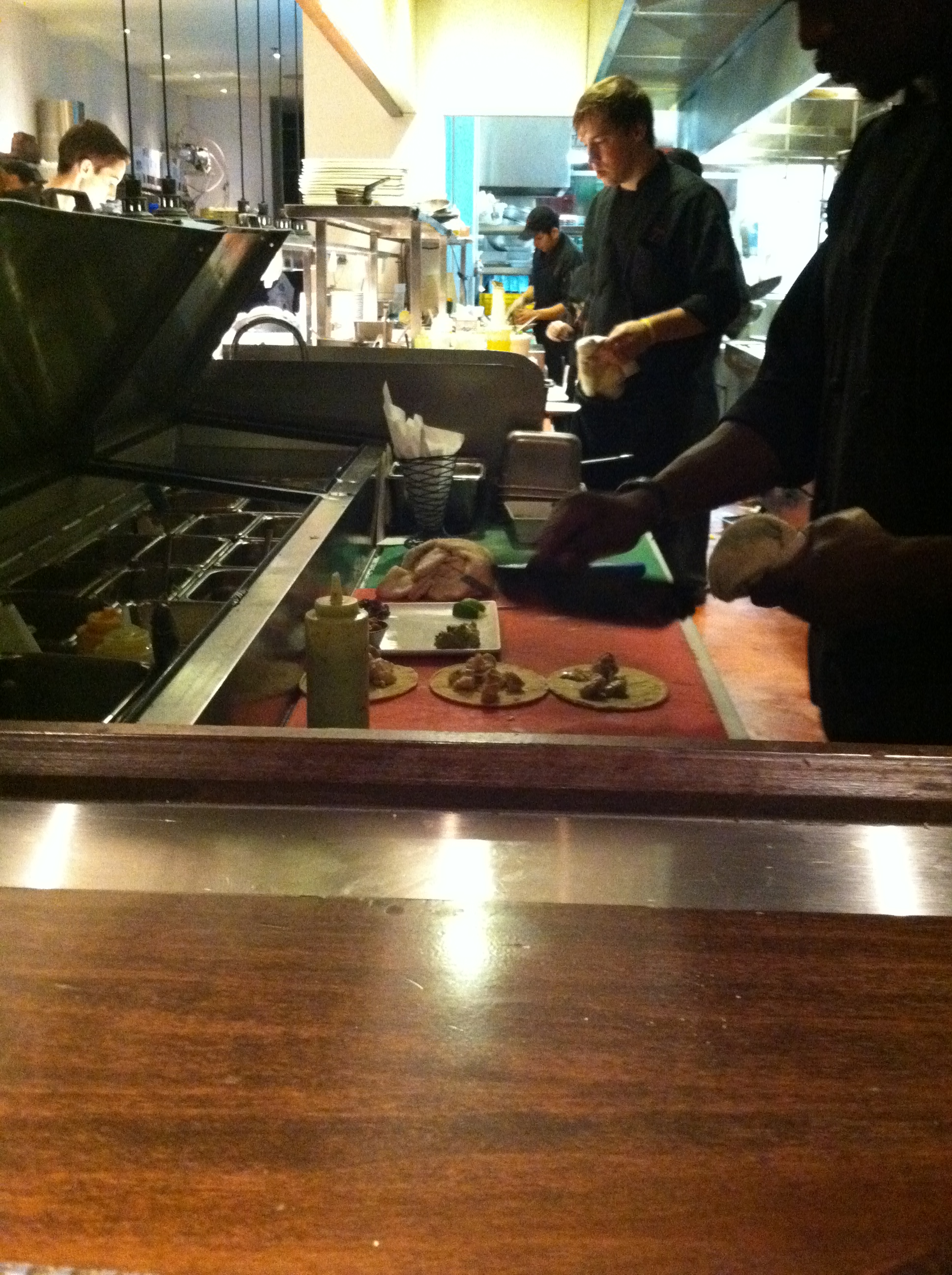
You can watch the kitchen in action

Sitting there, you get a birds-eye view of the kitchen operations from gearing up, getting slammed with the dinner rush and then slowing down slightly as we left 2 hours later.

The hostess had called earlier in the day to ask about allergies, diet restrictions and if there was anything in particular we wanted. These parameters were given to Chef Amy who in turn gets to be creative and create a 5 course meal.

The kitchen crew operated very well together. There was clear communication, effective movements and great looking food. Everyone knew their job and did it well. It was great entertainment.

And you want to know something? In this open kitchen all the crew, both front and back of the house, were so polite not only to the guests, but most important, to each other.

“Please, thank you, you’re welcome, excuse me”, all used frequently amongst the staff even when they were at their slammed best. How refreshing.
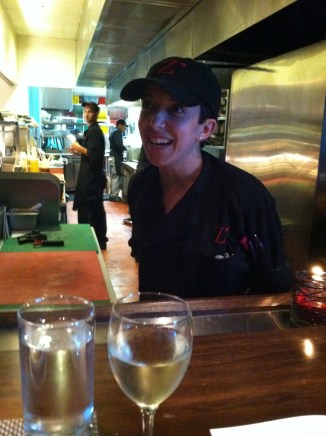
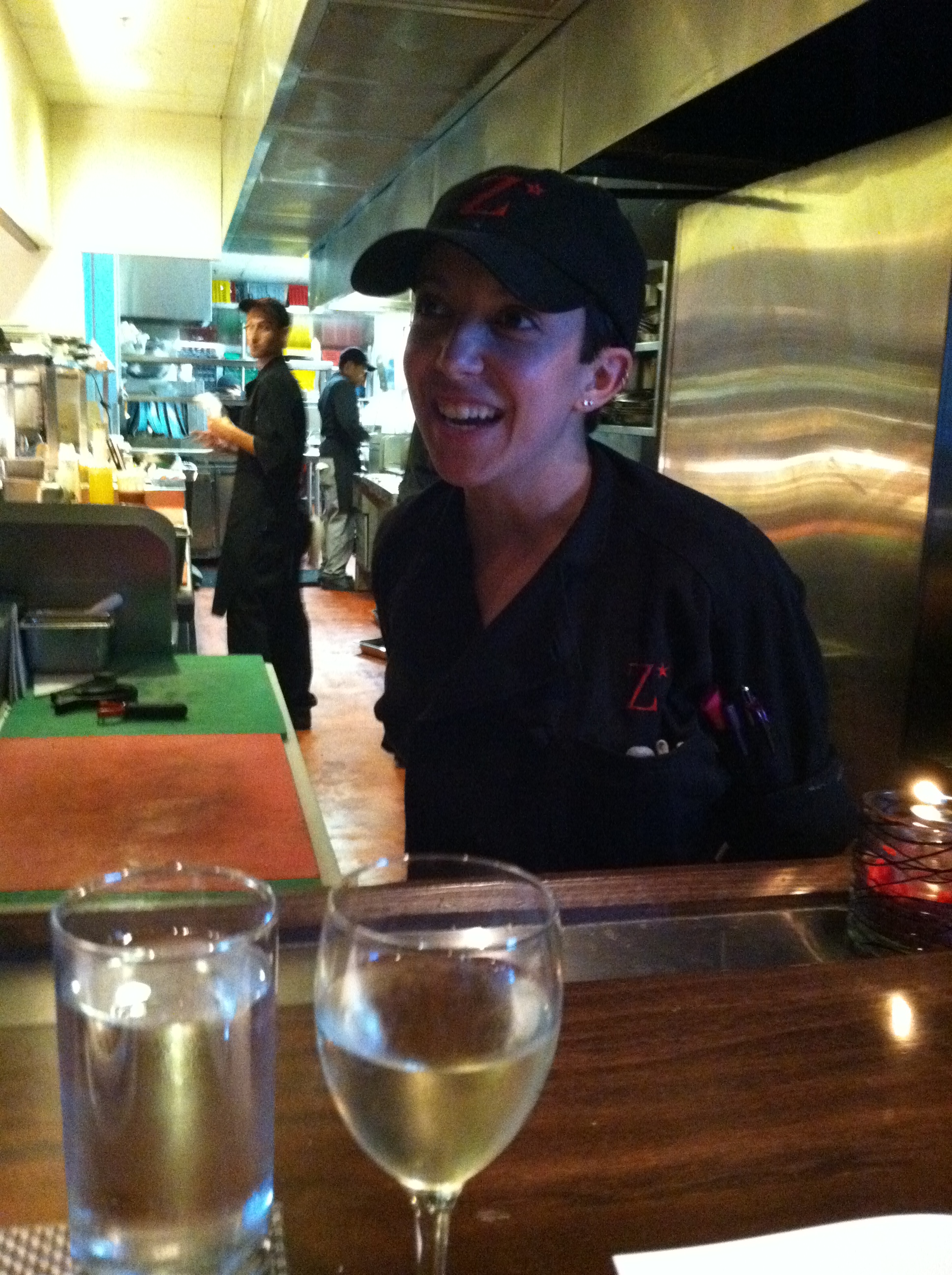
Chef Amy Kumpf

Our chef this evening was Amy Kumpf who was delightful, fun, charming, very skilled and knowledgeable in her craft. If was a lot of fun to watch her and her crew work through the dinner rush, very smooth.

She planned a menu for us and paired the wine for each course. Settling in, our meal began.

Course #1

Yellow Tomato Caprese Salad
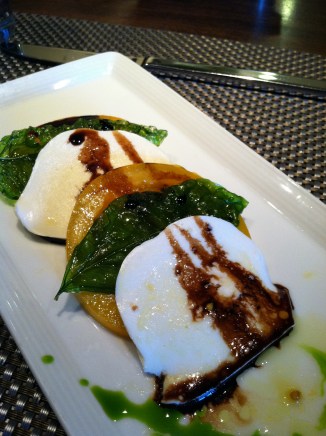
Yellow Tomato Caprese

Instead of using fresh basil, Amy fried the basil for the salad. The result was delicate umami touched with sweet tomato that danced around in your mouth with a party going on.

Amy reduced balsamic vinegar to a coating glaze which she drizzled over the assembled salad. She chose yellow tomatoes, delicious fresh mozzarella, fried basil and balsamic reduction.

Definitely whetted the appetite. It was beautiful and delicious.

To pair wine with this course, Amy chose Cooper Mountain Pinot Grigio from Willamette Vally.

Perfect pairing.

Course #2

Plancha Seared Snapper with Fire Roasted Tomatoes and Cucumber Salsa

Snapper in Tangine

This dish alone would be worthy to come back for again and again. Fabulous!

The cucumber salsa had mango, red peppers, mint, honey and other things. It was very well made, knife skills showed.

Fire roasted tomatoes are roasted and grilled with red peppers and blended to create  a lovely sauce they use on several dishes from pizza to our snapper. This was served in  crisp white Moroccan style tangine.

Tangine

Wine paring: Chamisal Vineyards 2011 Central Coast Stainless Chardonnay (unoaked) Crisp and perfect with the complex flavors of this dish.

Course #3

Hickory Salmon

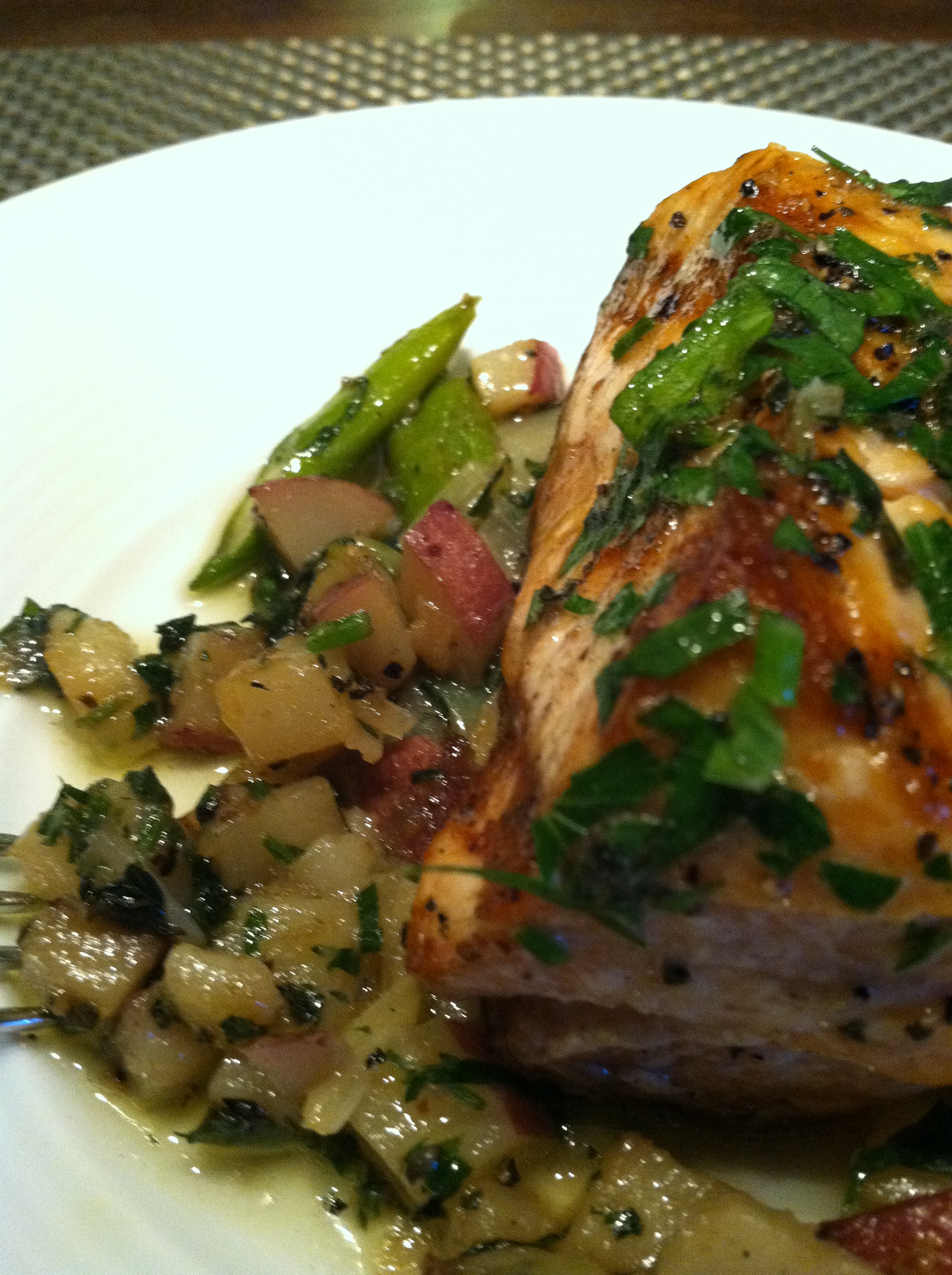
Hickory Salmon with Slow Cooked Potatoes and Asparagus

Another genius dish. The potatoes went so well with the salmon, sweet 100 tomatoes are slow roasted to add a sweet acid punch to the richness of the potatoes and  salmon. Additionally on the plate were fennel confit and melted leeks. Eating this was a pure pleasure experience.

Wine pairing: For some odd reason I didn’t record the Pinot noir chosen for this dish. It was the only one we thought didn’t complement the food. We enjoyed the wine tremendously, just didn’t like the paring.

Perhaps another Pinot with a fruitier base as most US Pinots are known. This one was in the “Burgundian” style which made it rich and robust with full tannins. These rich robust wines are normally my preference. But not with this dish.

The sweet salty nature of the salmon and the delicate texture of the fish wanted something a bit milder.

Course #4

Grilled Flank Steak with Smoked Tomato Cream Sauce and Shaved Asparagus

Seasoned and grilled to perfection. The meat was tender, juicy and full of flavor.

Shaved asparagus was created by peeling asparagus length wise with a “Y” peeler. You can do a lot with a vegetable and a Y peeler. Here, Amy created ‘pasta’ for us with thin shavings of asparagus.

Grilled Flank Steak

By this time we were getting full.  So I tasted everything and then decided to bring the rest of this dish home to eat for lunch and jump into dessert.

Wine Pairing: Brazin Old Vine Zinfandel, Lodi, 2009

Course #5

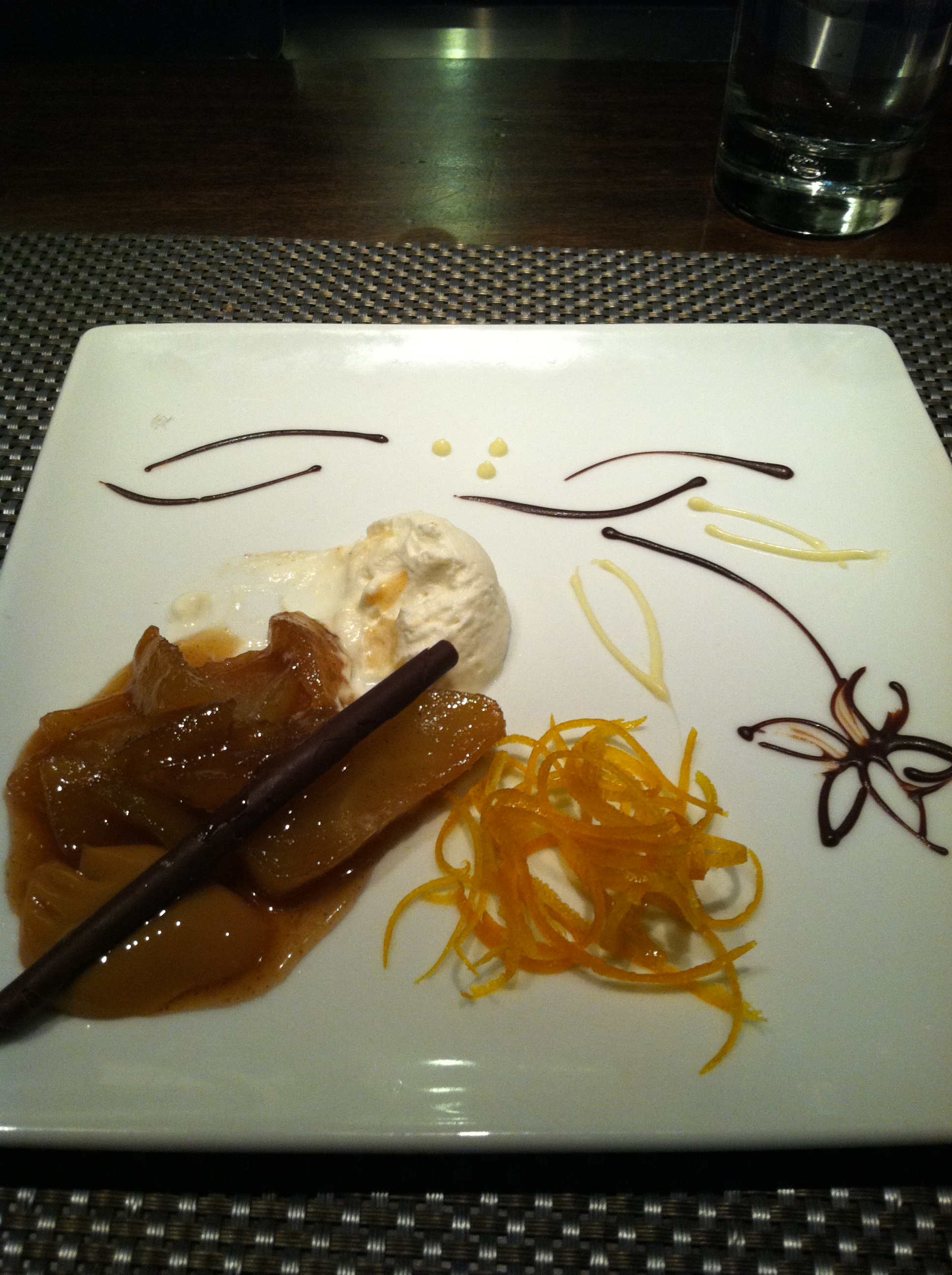
Warm Apple Compote, Whipped Caramel Cream, Orange Confit, Dulche de Leche and Dark Chocolate

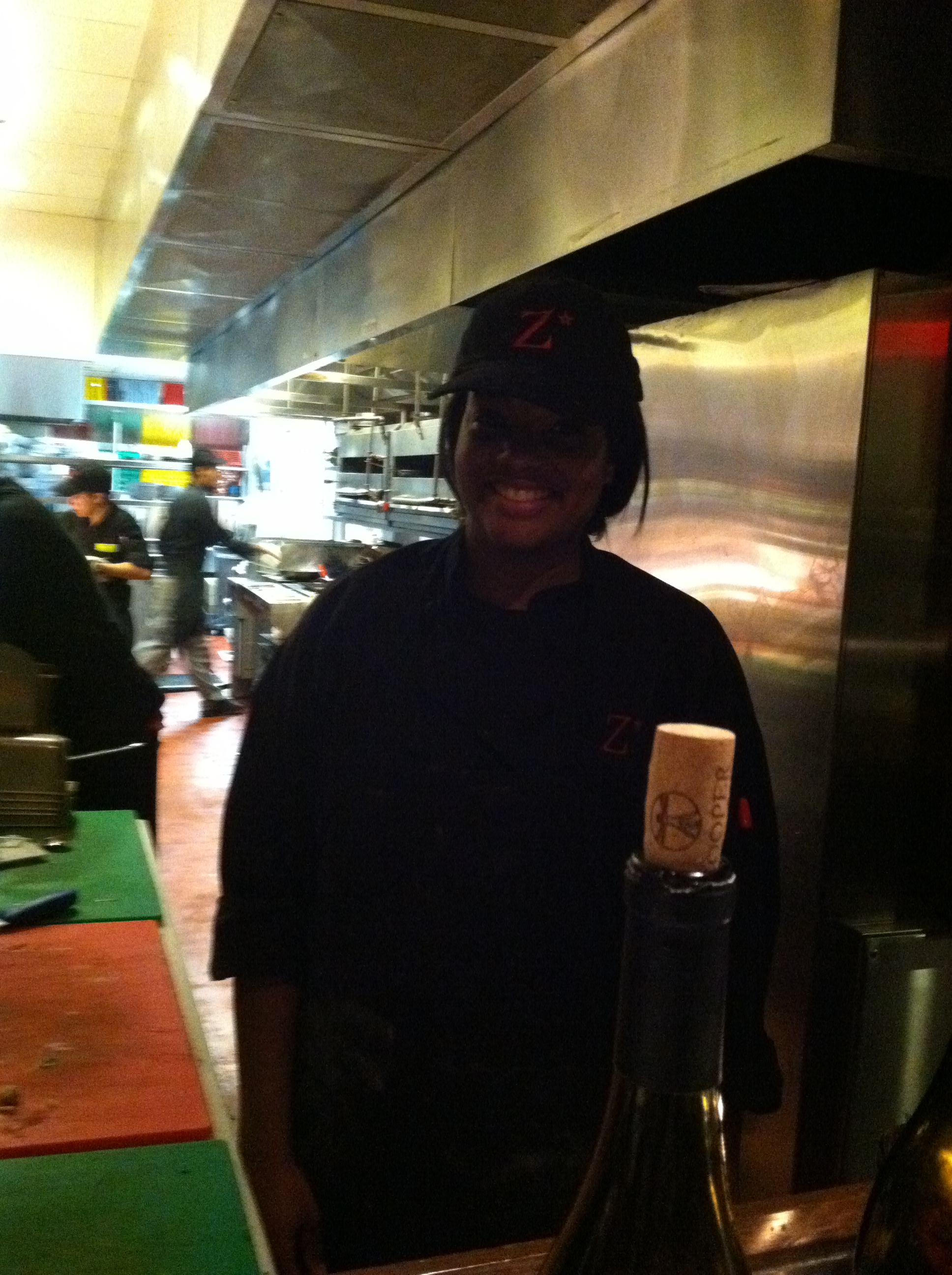
I got a pleasant surprise when the dessert chef came out. She was a student of mine. She said she was nervous but for no reason. Her dessert fit the bill perfectly. (No flour products – part of Junes diet; hence the asparagus pasta.)

Pastry Chef Sheena

Although our tummies were full, we managed to consume every bite.

Brilliant wine paring and fine ending to a great meal: Late  Harvest Mer Soliel
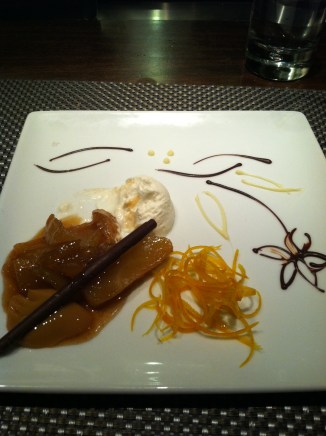
Apple Compote

Robert and me

All in all, we had a great meal and an outstanding evening. I could eat like that every time we go out. The idea of not knowing what your next course will be is intriguing.

We will have to do this again soon and I suggest you go find a place near you who does this kind of service. Ask at your favorite restaurant. Sometimes this style of dining is called a “Chef’s Table” and sometimes tables are in the kitchen. Depends on what the health code is in your area. You may discover such tables need to be reserved well in advance.

We had a delightful interaction with the staff. The entire evening was great fun.

Naturally, if you find yourself in Charlotte, NC, head over to South park and stop in at Zink and say “Feed Me Chef!”

You will be glad you did.

These photos were taken in low-light conditions of the restaurant with the i-phone 4.

How to Roast a Chicken

Here is another basic skills post about how to roast a chicken. The same principle applies to most birds, large or small. Ducks are just a bit different due to the amount of fat on them.

To select a whole chicken, carefully look at the wing tips, they should not be brown in any way. Slightly red is OK but no brown. Look at the neck area, same thing. These areas show age on market chickens. If they are fresh, they will be ‘chicken color’ and possibly red tips on the wings. No brown, green or purple.

The chicken should also not have any odor. Give it a sniff. Pass it by if you smell anything.

Sometimes the inside of the bird contains a small bag of the heart, liver, neck and gizzard. Remove this from the inside of the bird. Throw it away unless you eat heart, liver, neck and gizzard. My father made wonderful sauce from these parts. Sometimes I saute the hearts and livers but there is only one inside each bird so they become the cooks treat. YAY!

Thoroughly rinse the bird inside and out. Pat the bird dry.

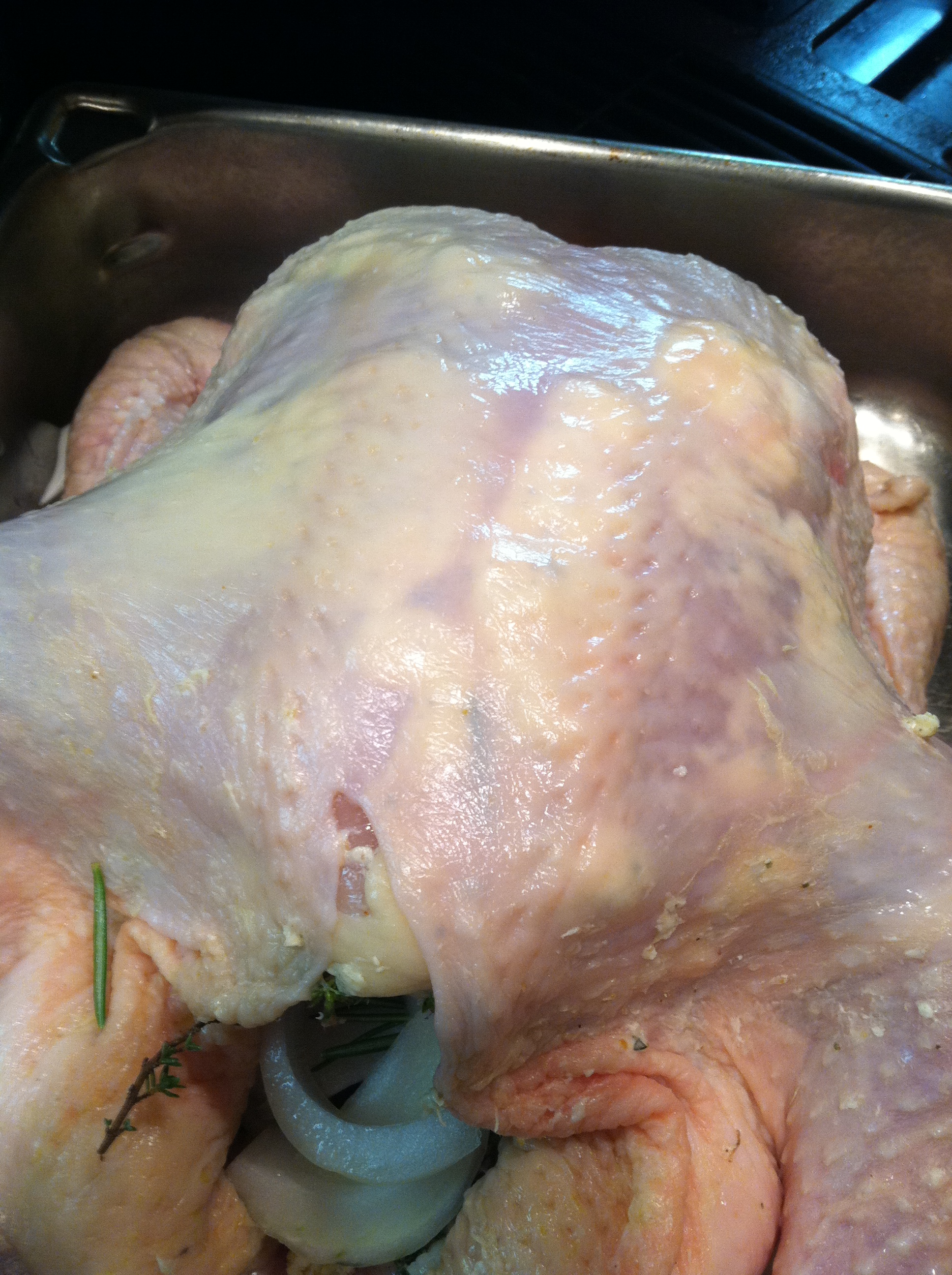
Carefully, using your fingers, loosen the skin but do not tear it.

Look carefully, see the butter under the skin?

Insert compound butter between the skin and the meat, smoosh it around so it almost covers the meat and then rearrange the skin back in place. This will baste the meat with herbs and butter while the bird roasts.

What is compound butter? Soft butter with herbs and seasonings mixed in. Any combination, any flavors, your choice. Toss it in a mixer, mix it up, place in a container and use it anywhere you would use butter. The butter I used here contained thyme, garlic, lemon, shallot and pepper.

To give the bird some flavor while roasting, insert herbs, onion and garlic into the cavity. For this bird I used rosemary, thyme and onion and a bay leaf.

For food safety sake, if you want stuffing, bake it in a separate pan. See note below regarding food safety.

On the bottom of the roasting pan, place chopped carrots, celery and onion (25% carrots, 25% celery, 50% onion ratio) and 1/2 cup or so of water or stock.

Professionally, we call this vegetable ratio “mirepoix”.

Tie the legs together with butchers twine or cotton string. Run the string around the legs and thighs and tie it off under the wings. This holds the bird together in a nice compact bird-like shape, controls the legs and plumps the breasts.

This is how you get a good-looking finished bird that isn’t splaying its parts all over the place.

Season the birds skin. I used Montreal Steak Seasoning for this one. Season as you like.

Season, tie the legs and truss the chicken. Place on top of vegetables to roast.

Place the tied and stuffed bird in the roasting pan on top of the vegetables.

Roast the bird in a 350°F oven for about 2 hours or so for a 3 pound bird. Please use a thermometer to test for 180°F internal temperature in the thigh, not near a bone.

The dark meat takes longer to cook so you test there. Please be sure to cook your chicken all the way.

There is nothing as unappealing as cutting into a whole roasted bird and have blood come out. Obviously, it goes back into the oven to finish cooking, if that happens.

When the bird is done, allow it to “rest” for about 15-20 minutes before carving. This is when I prepare the vegetables and put the final touches on the meal.

Food safety really comes into play with handling chicken.

  • Keep the bird cold.
  • Sanitize the work area with a mild bleach after preparing and handling the bird.
  • We are trying to avoid contaminating our families with Salmonella and Campylobacter jejuni in particular.
  • If your bird is frozen do not allow it to thaw on the counter or in the sink. Put it under cold water that you change frequently or in the refrigerator which takes 2-3 days to thaw, so plan ahead.
  • Always sanitize everything that chicken and your hands come in contact with during preparation with a mild bleach solution when you finish. Knives, boards, spoons, counters, sinks, knobs, handles, towels, aprons, etc.

To make a sauce, use the drippings in the bottom of the roasting pan. Deglaze with chicken stock or white wine. Strain the liquid from the roasting pan into a sauce pot. Bring to a simmer.

Mix equal parts of butter and flour together in a small bowl. Drop small pea sized pearls of the flour and butter mixture into the simmering stock, whisk to incorporate. Season as desired. Simmer for 10-15 minutes to cook out the starch taste. Finish with a pat of cold butter whisked in, adjust salt and pepper. Strain again if desired.

Roasted chicken with sauteed beet greens

We sautéed the beet greens we had on hand from the pickled beet post. Yummy stuff.

There will be another post soon on “How to Cut Up a Chicken”

Enjoy roasting your chickens! I adore the aroma, it smells like home and all things wonderful.

Artichokes!

Artichokes from the market

I found the most amazing artichokes in the farmers market this week. They were huge and hybrids. These artichokes did not have any of the thorns or much of a “choke’ inside either.

The woman at the market asked me “how do you cook them so they are tender?”

Steam them.

I had to find a domed lid to fit the steamer; the artichoke was so big!

All I did with this artichoke is cut the stem so it would fit in the pot with the lid on it and steam. It had to be steamed for about an hour and 15 minutes. Once the water came to a boil, the heat was turned down to low. You will need to check the water level to be sure you don’t burn up a good pot.

If you find the non-hybrid type that have the small thorn on each leaf, you will need to use the kitchen shears and clip them off. After your cut a few, wipe the edges with a cut lemon to prevent the artichoke from turning black.

Any cut you make on a raw artichoke, swipe it with a piece of cut lemon to preserve the color and keep it from oxidizing.

You can tell the artichoke is done cooking when the leaves pull off easily and a knife is easily inserted into the base of the artichoke with no resistance. Do this from the bottom so as not to ruin the presentation.

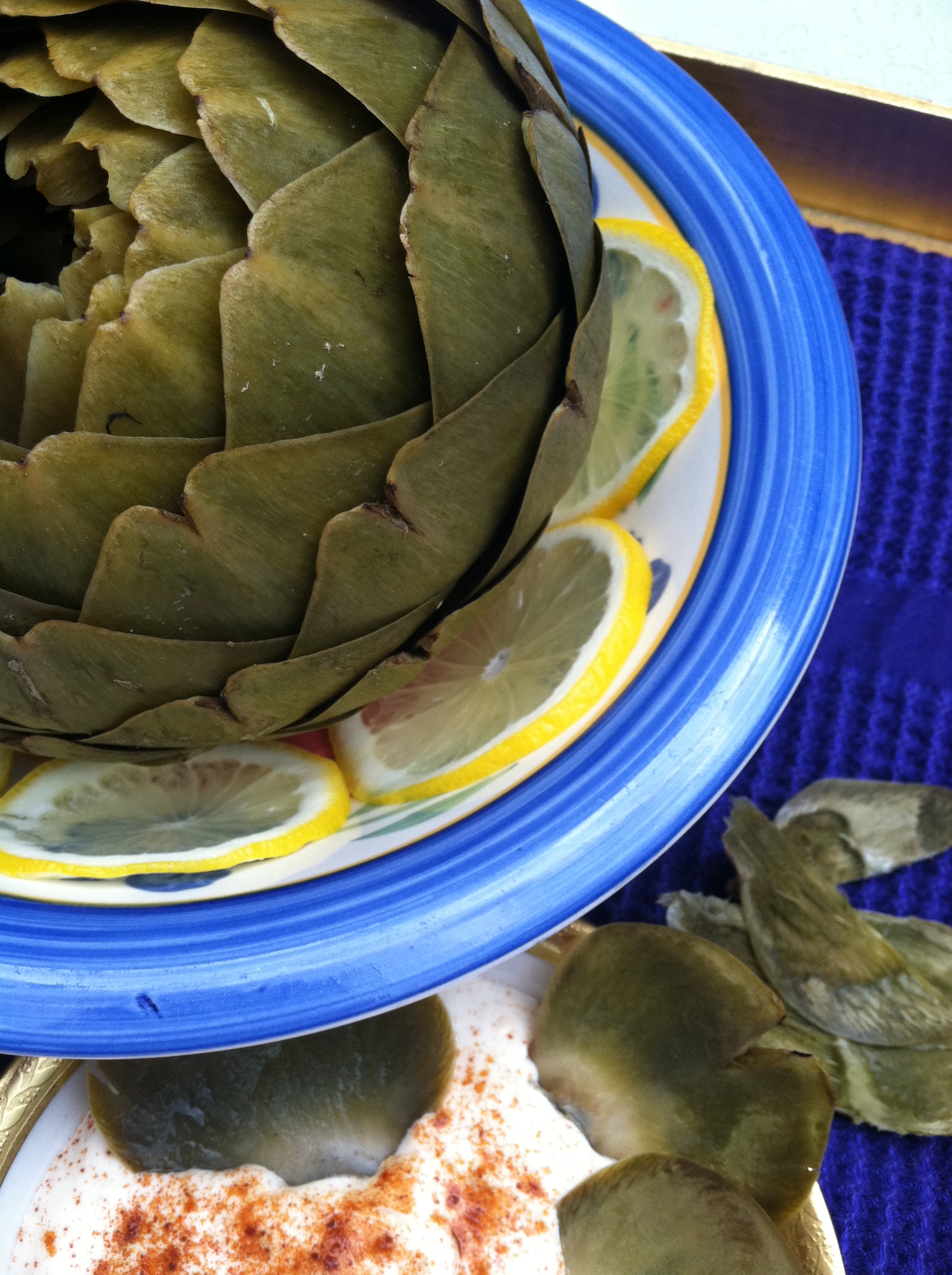
There are a lot of things you can do with an artichoke but today, I am just steaming it and serving it with a couple of sauces.

We will eat it as an hors d’ oeuvre with aperitif before dinner. Serving like this is also an interesting way to put out a snack when guests and friends come visit. We usually gather in the front yard about an hour or so before dinner and friends join us for great conversations, drinks and sometimes an hors d’ oeuvre or two.

A word of caution, artichokes make cheap red wine taste great and good red wine taste awful. So if you are serving artichokes, serve a decent inexpensive red wine.

Please don’t go down as low as Trader Joe’s Two Buck Chuck. That is truly awful stuff. The only thing that makes that better is pouring it down the drain.

The sauces:

Yogurt Sour Cream Sauce

  • 1/4 cup plain Greek yogurt
  • 1/4 cup sour cream
  • 2 tablespoons mayonnaise
  • 1 teaspoon smooth Dijon mustard
  • 1 teaspoon fresh lemon juice
  • 1/8 teaspoon garlic powder
  • 1/8 teaspoon onion powder
  • Salt to taste
  • Sprinkle of sweet paprika for garnish

Mix it all together. Sprinkle sweet paprika lightly over the top.

Let is rest to allow the flavors to blend.

Dip artichoke leaves in sauce.

Lemon Butter Sauce

  • 1/2 cup butter
  • 1 lemon, zested and juiced

Melt the butter, add the juice of the lemon and 1/2 of the zest. Warm through.

Place a couple of slices of lemon in the bowl to serve. Dip artichoke leaves into sauce.

How do you eat a whole artichoke?

Starting at the bottom base, carefully pull a leaf off. It should separate easily. Dip in sauce if desired.

Place the inside of the leaf against your bottom teeth, lightly bite down and scrape the artichoke flesh off the leaf with your bottom teeth and discard the remaining leaf. You have to pull the leaf to effectively scrape it against your teeth.

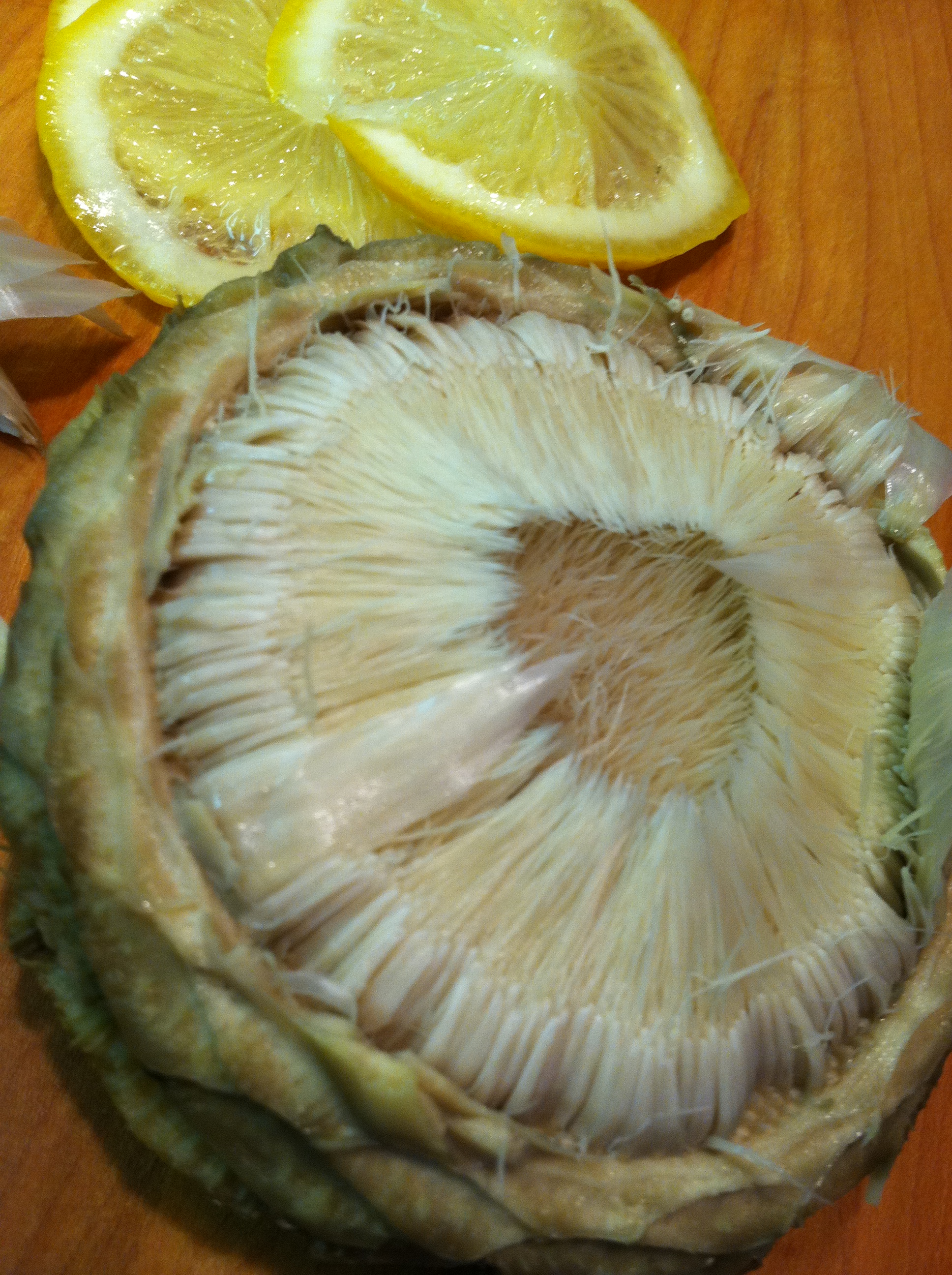
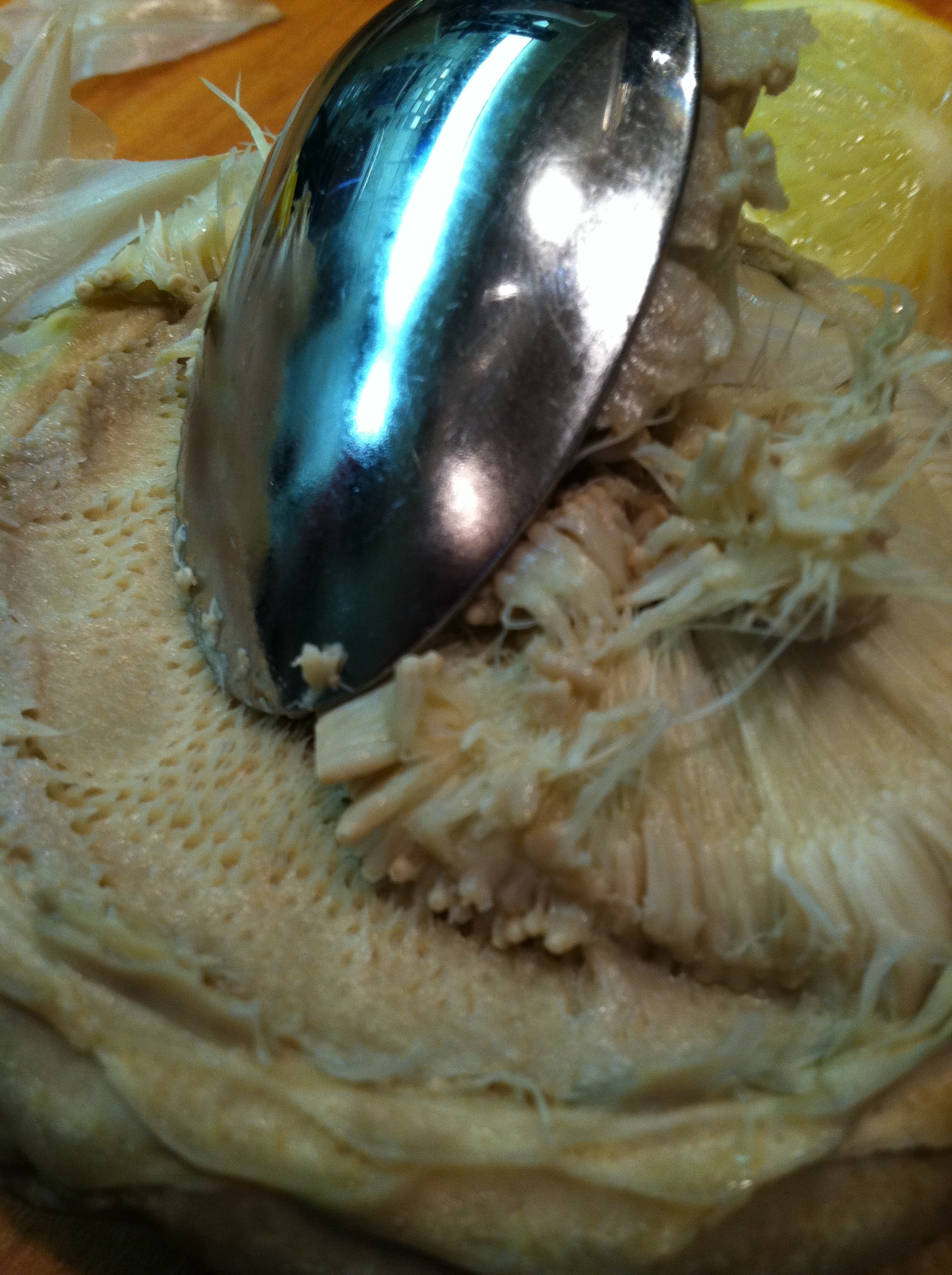
As you consume the leaves, the bottom will become visible. Once all the leaves have been consumed, you will find a “choke” in the very center. It is anchored by the bottom of the artichoke.

The "choke"
Notice how fuzzy it is; not leaf like at all

Scrape the choke away from the bottom; discard

The cleaned artichoke bottom

This is how it looks upside down

Cut artichoke bottom ready to use in salads, dips, etc.

You do not eat the choke because it is inedible and if you attempt to eat it, you will choke!

Scrape away the choke and eat the bottom. For this part, you will need a knife and fork.

You can always save it for slicing, mashing into Spinach Artichoke dip, salads or leave it whole and stuff it for a completely different dish.

If you have any leaves left over, scrape the flesh from the leaves with a spoon and make soup, salad dressings or use the artichoke scrapings in stuffing. There isn’t much shape to the scraping, use it like you would something mashed.

You can try making them the Roman way too. (Thanks, Barbara!)

Steamed Artichoke with Yogurt Sour Cream Dip and Crispy Kale Chips

Pickled Beets

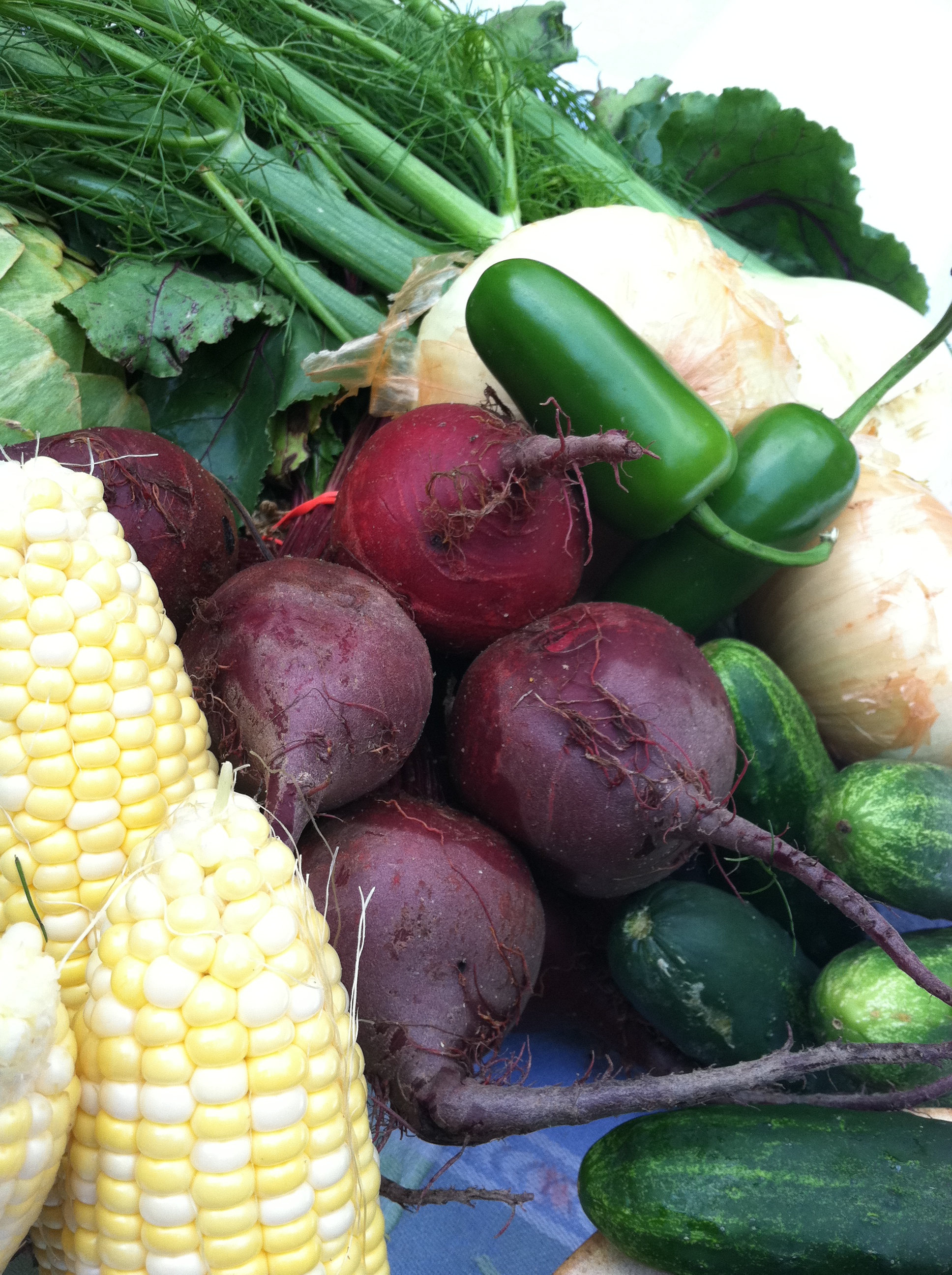
Pickled beets jumped out at me this weekend while at the farmers market. I brought home a beautiful bunch of beets with the greens, for just $2.50 this was a real steal.

I made a list of what I could do with them: Roasted beet salad with blood orange vinaigrette, Beet chutney, beets in butter with a splash of rice vinegar and in the end, pickled beets won.

I suppose I thought the bunch of beets was larger than it really was.

The first step in all the recipes is to cook them.

There are several ways, the best method and least messy is to steam them.

Here’s the thing about beets. They will “bleed” this lovely magenta color everywhere and leave a legacy of stains behind them.

Trick of the trade: Don’t cut, nick or peel them before cooking.

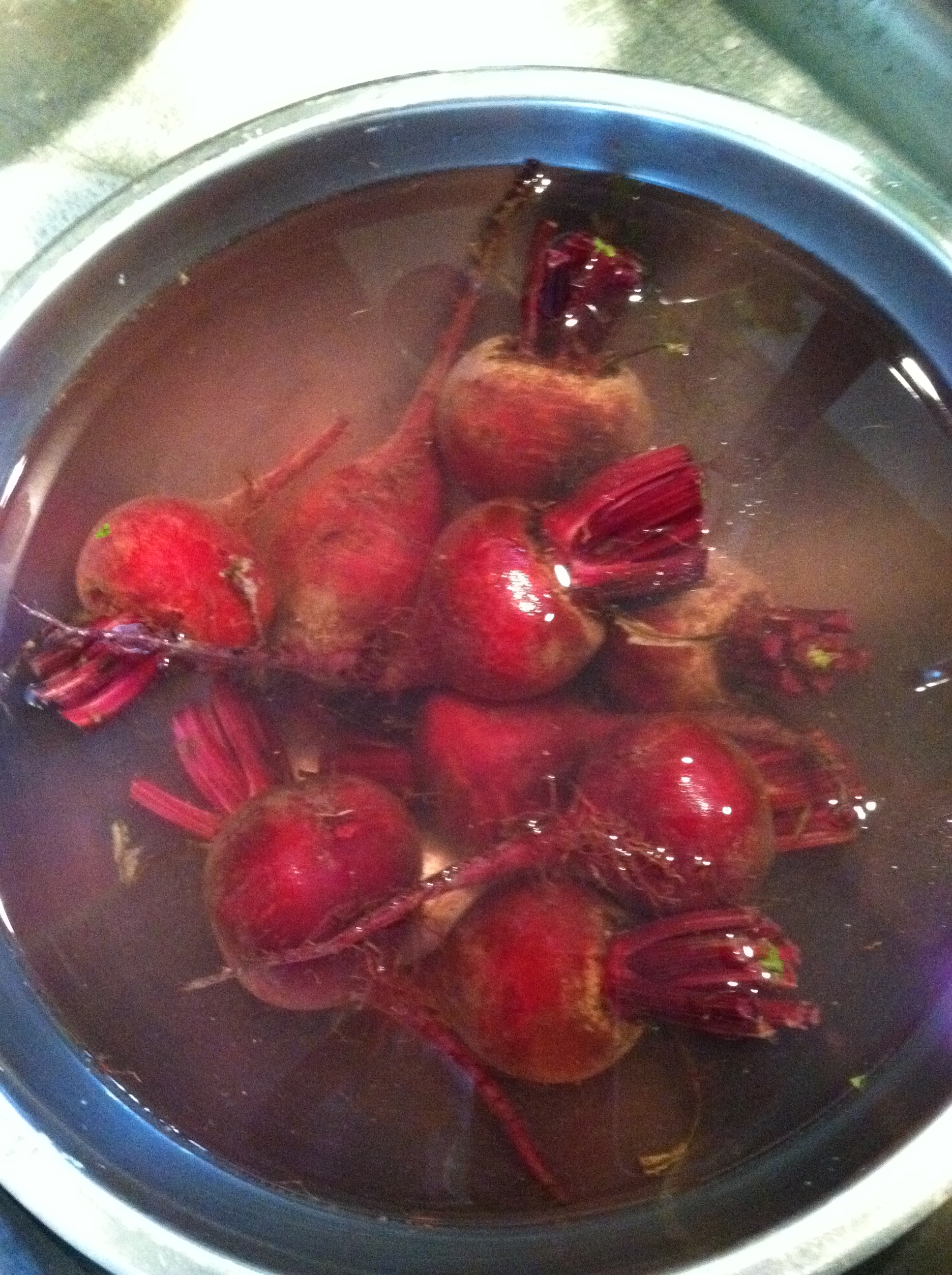
Trim leaving 1-2″ of stem; soak to remove soil and sand.
Do not peel or cut.

Trim the roots from the stems by cutting at least 1-2 inches of stem remaining on the root end. Leave the tap-root end in tact also, don’t trim it, just tuck it out-of-the-way.

Gently wash the beets to remove excess soil and sand. Don’t scrub them as they have a thin skin. Soaking for a few minutes is usually good.

Keep the greens. Set them aside in a large deep bowl of cold water. Remove any yellowish or ‘spotted’ leaves you wouldn’t want to eat.

Soak the leaves in cold water. Swish the leaves in the water gently. The sand will fall to the bottom of the bowl. Lift the leaves from the bowl without disturbing the bottom and repeat at least 4 times. You will be amazed how much sand and soil the leaves can hold.

Soak greens to remove dirt, and sand.
Change water 3-4 times

Lastly, rinse the leaves under running water, wrap in a towel, cover with plastic wrap or bag and store in the refrigerator until you want to use them in the next couple of days. That is another post.

How to use the beet greens is another post coming soon. The greens need to be cared for as soon as you remove the root ends so you don’t lose quality. If the greens look limp at first, they crisp up during the soaking process.

If you buy beets with greens and plan to use them later, separate the green tops and the root ends because the greens will pull nutrients, sugars and moisture from the roots during storage. (same with radishes, carrots, bulb onions etc.)

This recipe for pickled beets is simple and very flavorful. Some folks say they can eat the entire batch at once but that’s not recommended.

Steaming the beets takes the longest amount of time.

So here is how to make Pickled Beets:

Pickled Beets

  • Servings: 2 quarts
  • Difficulty: medium
  • Print

1 bunch of beets (8 medium size beets as close to the same size as possible)

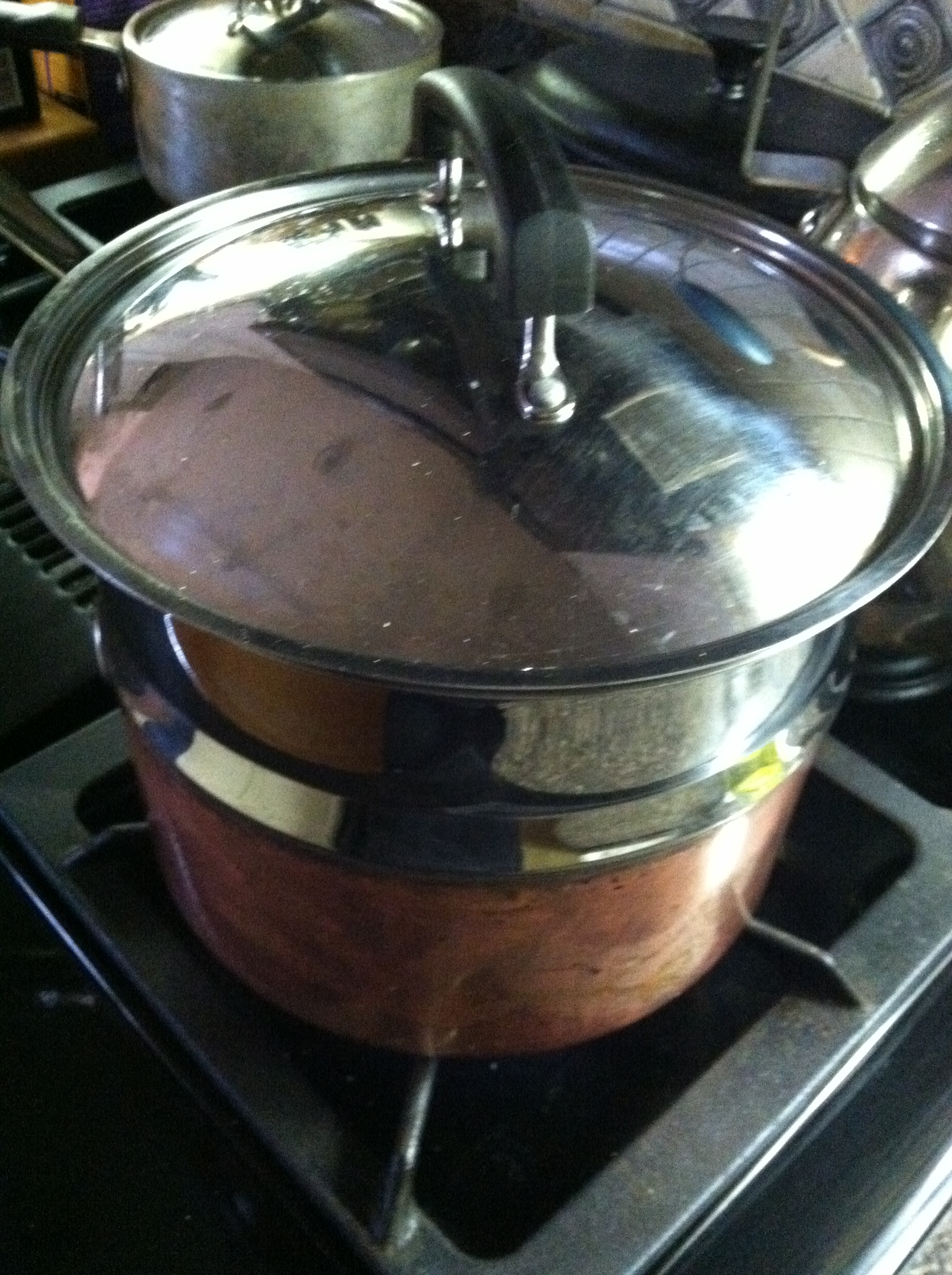
Steam the beets by placing them in a steamer pot with a tight-fitting lid. Use good quality water to steam the beets. You will use 1/2 cup of this water in the pickling brine.

Steam the beets until tender

Steam the beets until easily pierced with a paring knife, just as you test a baked potato for doneness.

Do not pierce the beets often or all over as they will “bleed”. You want them to retain the color. Just test the biggest ones.

When the beets are done,  save the water in the bottom pot and place the beets in a big bowl of cold water. Once they are cool, underwater, using your hands, slip the skins off.The skins slip off very easily.

Set the peeled beets aside in another bowl.

Peeling underwater helps keep your hands from staining magenta.

Using a cutting board you can bleach later, trim the top and bottom, then slice the beets into thick slices and place them back into the bowl.

Make the brine and have the jars or containers you are going to store the finished beets in ready to fill.

Pickling brine

  • 3/4 cup apple cider vinegar
  • 3/4 cup water from steaming pot with beet drippings
  • 2 tablespoons sugar
  • 1/2 teaspoon kosher salt (or any non-iodized salt)
  • 3-4 black peppercorns
  • 2-3 whole cloves
  • 2 bay leaves
  • 1 cinnamon stick
  • 1 small sweet onion sliced

Bring the beet water and vinegar to a boil, add the remaining ingredients, including the onion and return to a boil. Boil for 1 minute.

Pour the hot mixture over the beets and gently stir with a rubber spatula to ensure all the beets are coated.

Pour the hot brine over beets, place in storage jars, cool. Serve cold.

Gently place the beets and all the brine into the storage jar. Allow to cool then refrigerate.

The pickled beets are ready to eat after 24 hours. One of my favorite parts are the onions that get pickled too. Slightly crunchy and  what a taste treat!

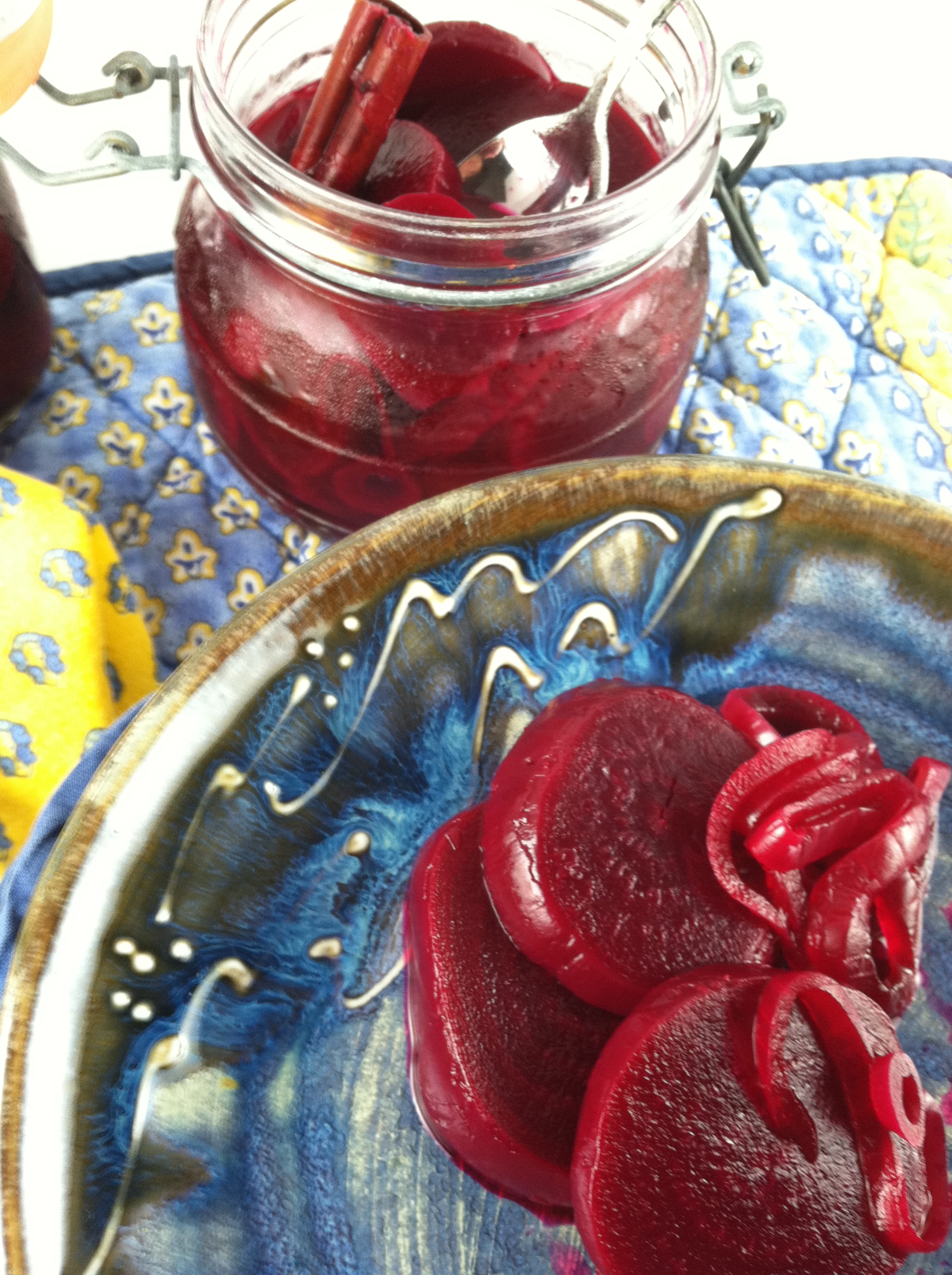
Pickled beets

Pickled Beets – I could eat the whole jar!

Serve very cold.

Roasted Duck, Kale and White Bean Soup

Since it is cold and raining outside, making a soup from roasted duck, kale and white beans sound good. It is time to use up what is in the refrigerator.

Roasted Duck, Kale and White Bean Soup

You will need

  • 2 tablespoons olive oil
  • 1/2 sweet onion, diced small
  • 2 carrots, peeled and sliced thin
  • 1 tablespoon minced fresh garlic
  • 1 small russet potato, peeled and diced small
  • 3-4 sprigs of fresh thyme
  • 1 quart chicken stock
  • 1 cup leftover roasted duck meat, diced small
  • 1 cup cooked or 1-15 oz. can of white beans, drained
  • 1 medium tomato, peeled, seeded and diced OR 1-15 oz can diced tomatoes
  • 2 cups roughly chopped and stemmed fresh kale
  • Salt and pepper to taste (Start with 1 tablespoon and adjust to suit your taste)
Carrots of many colors.

Carrots of many colors. (Photo credit: Wikipedia)

Saute the onions and carrots in oil for 3 minutes, add the garlic, potatoes and thyme, stir.

When the onions are translucent, add the stock and bring to a boil.

Add the duck and the white beans, bring to a simmer.

Add the tomatoes, simmer for 5 minutes.

Stir in the kale and simmer for 5 minutes more.

When the carrots and potatoes are done, adjust the seasonings with salt and pepper.

Serve with good bread and crispy kale chips.

How to Boil an Egg and what to make with them

How to boil an egg is a basic procedure that needs to have a couple of “rules” to follow in order to turn out right.

There are a few suggestions on what to do with your hard-boiled eggs after you master the technique at the end of this post.

So often the yolks have a dark green sulfur ring around them and the whites are rubbery rather than tender. This happens from the eggs being overcooked or being old after they are cooked. The reason they start to stink when they age is due to the sulfur content which is also what makes the green ring around the yolk form, a simple chemical reaction.

You can avoid this and have beautiful boiled eggs by following this method and eating them soon after.

The rules are simple:

  • Start with cold water.
  • Bring to a boil
  • Add salt (only after the water boils)
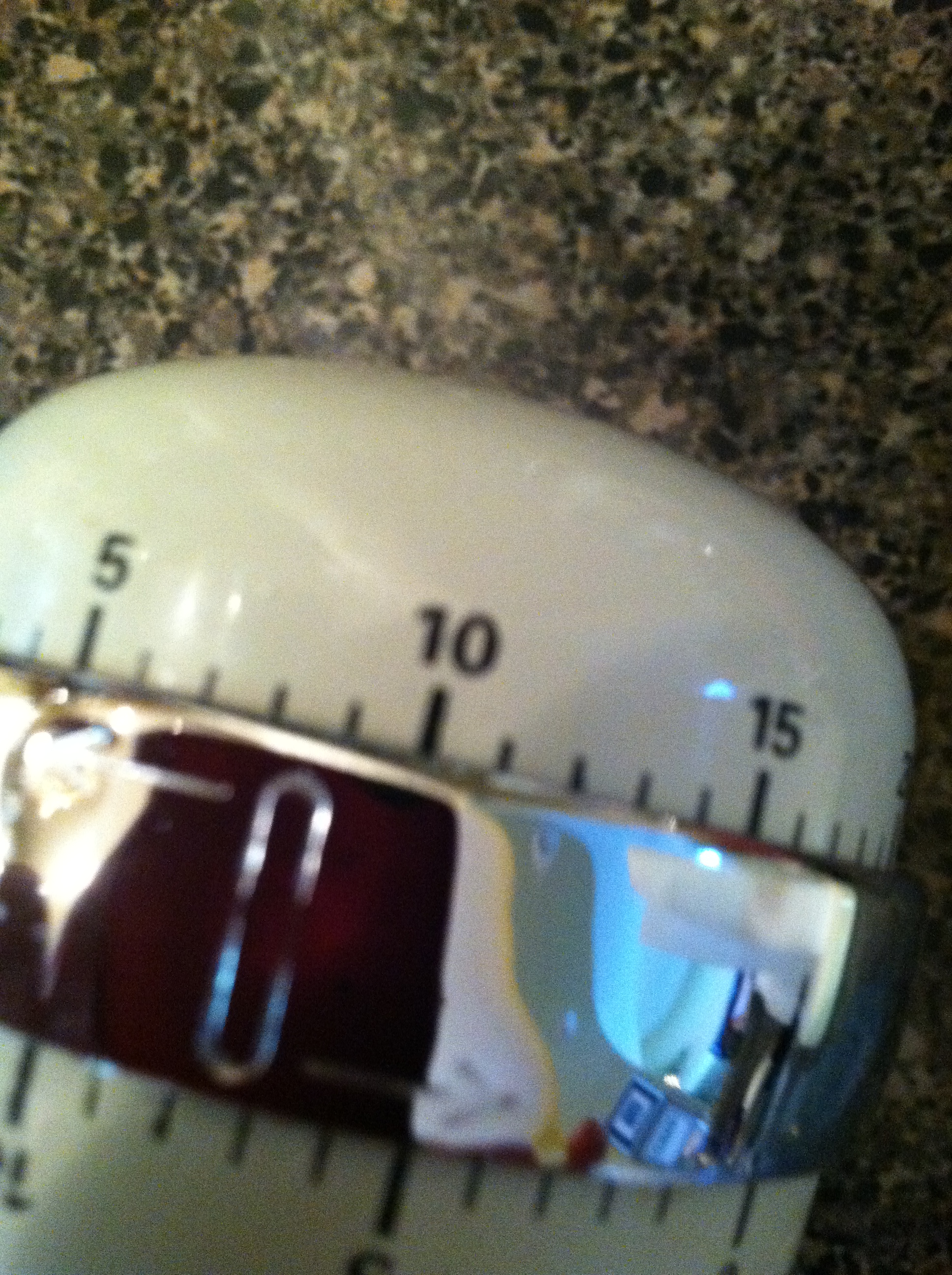
  • Boil for 10 minutes

    Set timer for 10 minutes

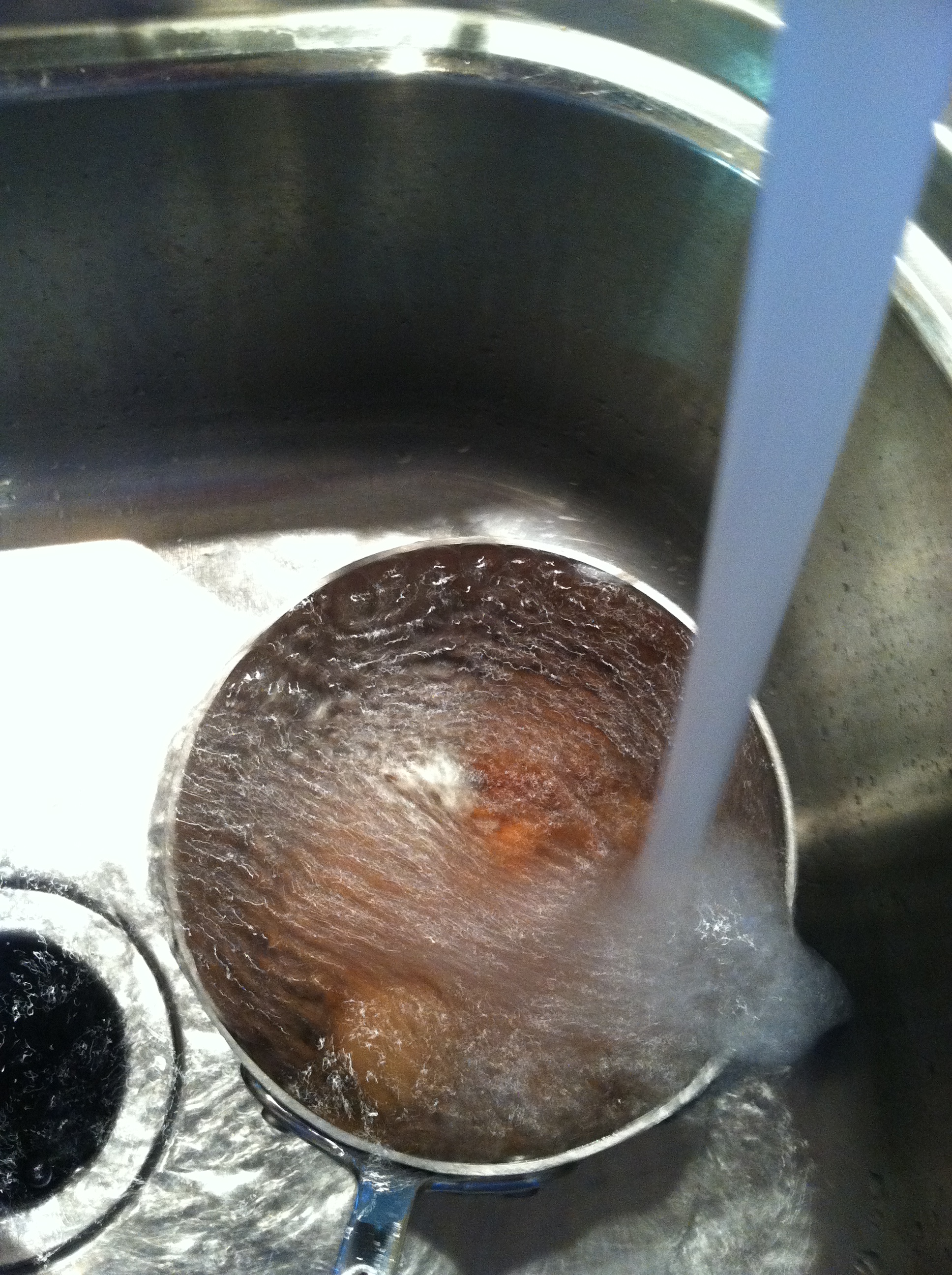
  • Cool quickly in cold water

Cool by running cold water over the cooked eggs until they cool

Cool under cold water

down. You will need to change the water as it warms up from the hot eggs. Keep the water cool and in about 15 minutes you will have perfectly cooked hard-boiled eggs.

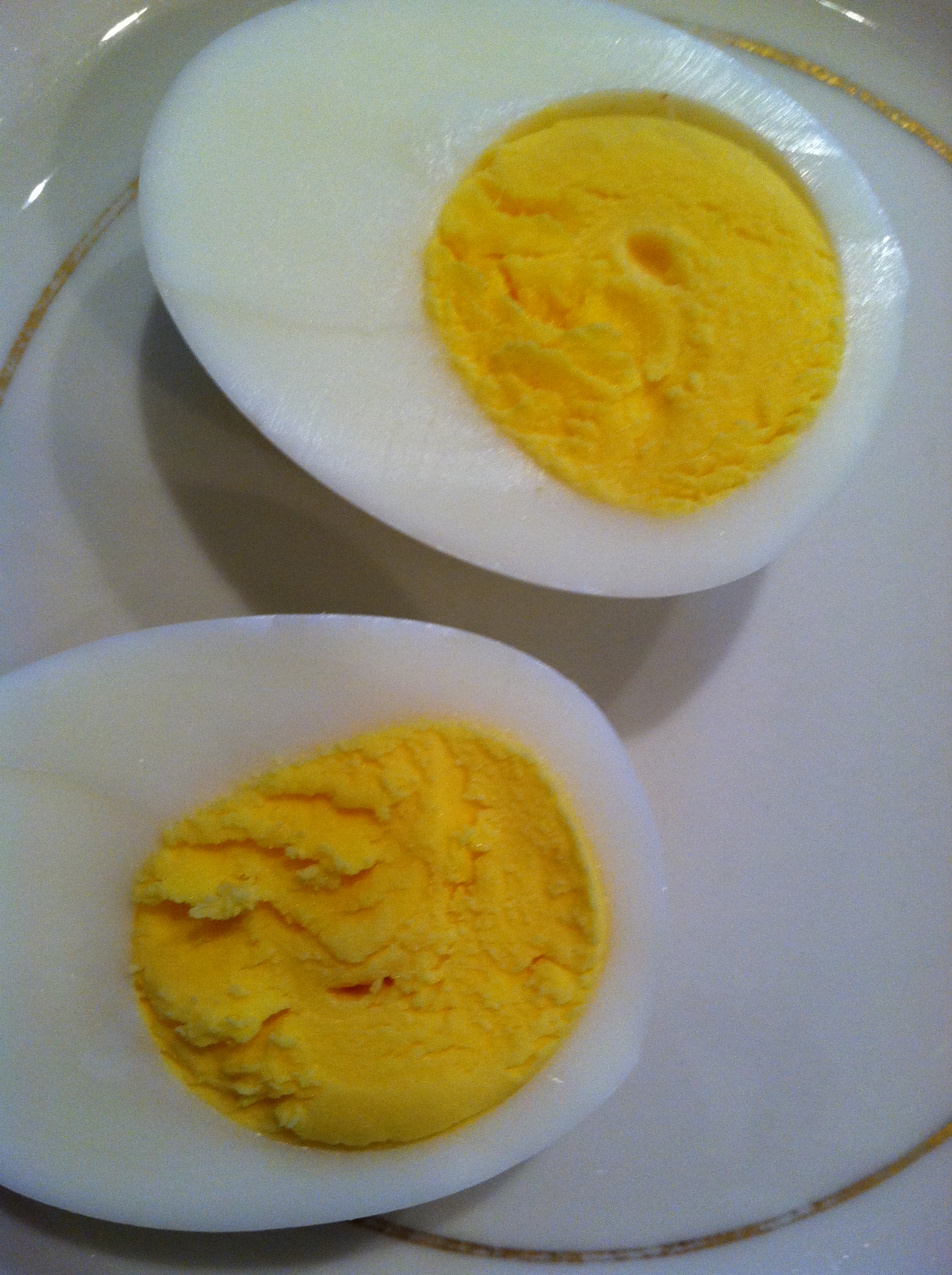
A perfectly cooked hard-boiled egg is yellow throughout the yolk

Perfectly cooked hard-boiled eggs

and the whites are tender.

Using this method, they

Gently tap to crack the shell all over

should be easy to peel. Gently tap the shell on the counter until it cracks. Gently roll the egg so the shell gets cracked all over; then peel the shell off.

Starting with cold water and adding salt after the boil all contribute to successful peeling.

A lot of Europeans will leave their eggs out on the counter, in the US we keep them in the refrigerator. Either way, it is best to start with cold water. Place the eggs in the pot, fill with cold water to cover the eggs by at least an inch or more. This helps keep the eggs from cracking due to temperature change.

Use a pot that can comfortably hold all the eggs you are boiling neatly on the bottom of the pot. There should be enough room for them to roll a little, but not too much. (See the photo of the eggs in the pot earlier in this post) Some people put a small towel in the bottom to cushion the eggs. This is totally unnecessary, but you can do it if you like.

Add salt after the water comes to a boil. This saves the bottom of your cookware from getting pitted from years of salting cold water. Save your cookware, salt only after water boils.

Some people will save the egg cooking water for plants, I don’t due to the salt.

Carefully peel, rinse and dry

The eggs will absorb some of the salt while boiling.

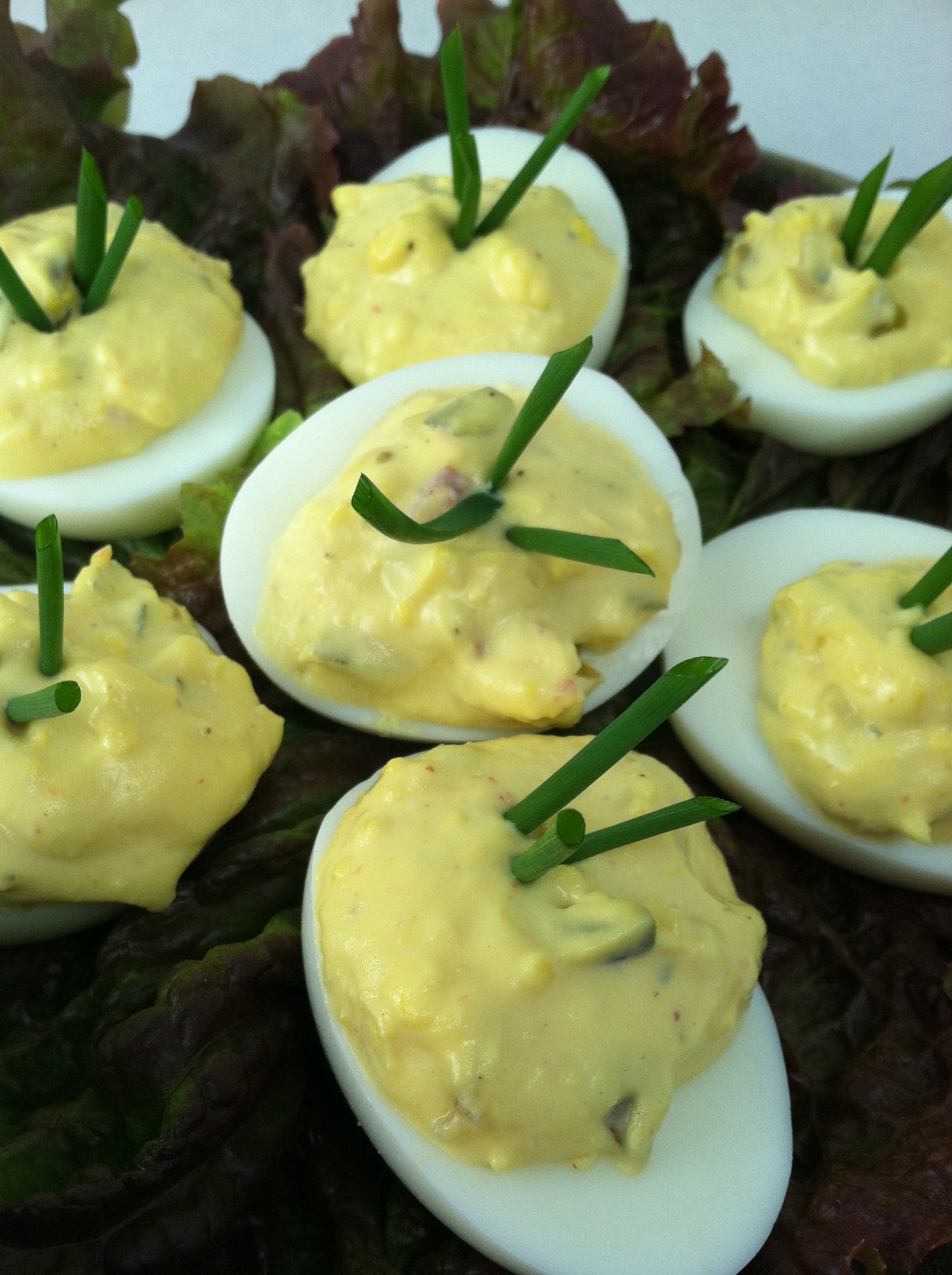
Here is a traditional Southern dish named “Deviled Eggs“. I have always been around Deviled Eggs so I am not sure how well-known they are in other parts of the world.

Here in the South, we have dishes known as “egg plates” made specifically for holding Deviled Eggs. I used to have several in different styles but alas, I no longer own an egg plate. Not even an egg plate shaped like a holiday wreath, not a glass one nor a china one. Where did they go? It’s not like I swore off ever making deviled eggs again. Puzzling how things come and go. Maybe one day I decided I would rather have the space than the egg plates. I don’t recall making that decision.

Be careful when adding the pickle relish. Don’t add too much liquid or else  your egg filling will be runny. If that happens add some cheese or bread crumbs or go commercial and add xanthan gum to thicken it back up. You could always boil some more eggs too.

Here is the recipe:

Deviled Eggs

  • 6 eggs, hard-boiled, split in half.
  • 2 Tablespoons Mayonnaise
  • 1 Tablespoon Sweet Pickle Relish
  • 1/8 Teaspoon Onion Powder
  • 1/8 Teaspoon Garlic powder
  • 1/2 Teaspoon Kosher salt
  • 1/2 teaspoon Capers
  • Chives or scallion for garnish

Remove the yolks from the whites, place the yolks in a bowl. Add the remaining ingredients and mash

Tray of Deviled Eggs garnished with scallion green, caper and chive flower

together with a fork until smooth.

Adjust the quantities of the ingredients to match the yolks and your personal taste.

Perfectly cooked hard-boiled eggs
Remove yolks to make filling for Deviled Eggs

Spoon the yolk mixture back in to the whites. Top each with a bias cut chive or scallion green.

Deviled Eggs

Sprinkle lightly with sweet paprika and finely ground black pepper.

What else can you do with hard-boiled eggs?

Add them to tuna salad, make egg salad for sandwiches, slice and serve with spinach salad, make Pad Thai and sprinkle chopped hard boiled eggs, peanuts and cilantro over the noodles.

Personally, I can eat them sprinkled with a touch of Fleur de sel.

Spinach Salad

Main thing to remember, start with cold water and boil only for 10 minutes.

Cooking Note: A “BOIL” is 212°F or when the bubbles roll rapidly and break the surface of the water.

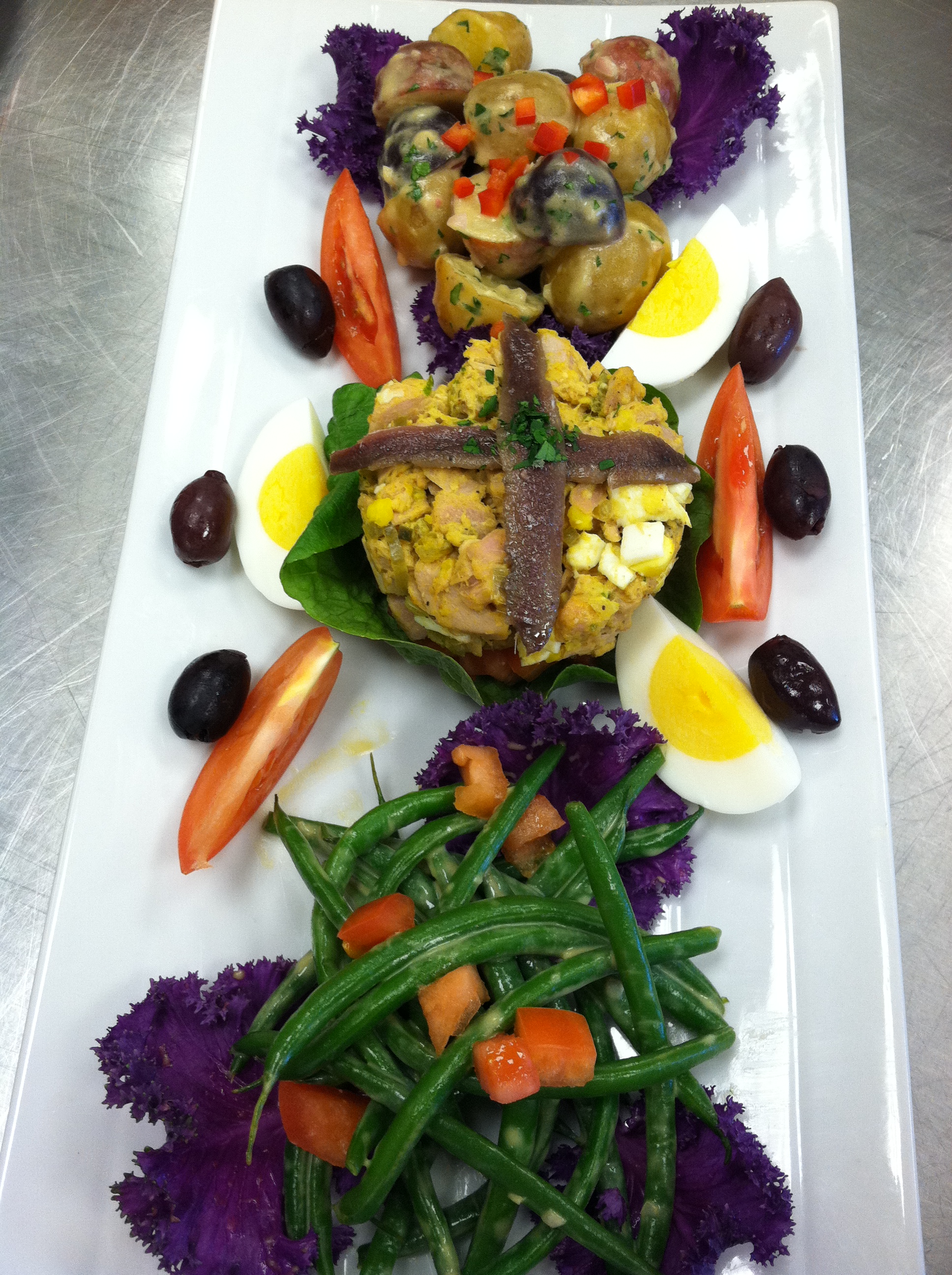
Use hard-boiled eggs in Salad Nicoise