Crab Cakes with Leeks and Corn

Crab Cakes with Leeks and Corn

Crab Cakes get so abused. Tender sweet succulent crab; why do so many ruin the delicate flavor by adding red or green peppers to the mix?

When I think of crab cakes, I think of the delicious flavor of crab, not a nasal hit of red or green peppers. While I love peppers, they do have their place. In my opinion, that place is not in a crab cake.

What is the star of your dish? Is it the crab? How much did you pay for the crab? Usually a lot of money or labor if you cleaned your own crabs. Why would you want to hide the star of your dish with the pungent flavor of red or green pepper?

Peppers have a dominate flavor, they overpower everything. Which is why they are the stars in the dishes they are featured. Stuffed peppers, sausage and peppers, red pepper hummus, roasted pepper salads, great dishes with strong dominate flavors.

If you didn’t guess already, adding peppers to delicate crab meat is a pet peeve of mine. I feel strongly about it. If you like peppers in your crab cakes, fine, I’d ask you though if you really know what crab tastes like.

Enough of that rant, on to the crab cakes!

Crab, any kind of crab, has a delicate flavor. Enhance the flavor with a dab of smooth Dijon mustard, sautéed shallot, roasted garlic and sliced scallions or chives and lemon zest. Hold the mix together with an egg and coat the outside of each formed crab cake with a layer of panko bread crumbs and you have an amazing cake for either an appetizer, entrée or salad. How to and the recipe are below.

Crab comes in many forms. You can purchase live blue crabs  or king or queen crab legs and boil your  own for a great outdoor dinner party.

Colossal size crab meat from Blue Swimming Cra...

Colossal size crab meat from Blue Swimming Crab. Courtesy of Newport International. (Photo credit: Wikipedia)

Crab comes in canned or pasteurized form in addition to fresh. Here is the translation as to what kind of crab you are getting according to classification:

  • Colossal Lump: Very large white, unbroken pieces of crab.
  • Jumbo Lump:  largest white pieces of crab meat from the body portion adjacent to the back fin appendage. may contain broken pieces.
  • Back fin: A blend of large lump pieces and special meat.
  • Special: Flake white meat from the body portion of the crab.
  • Claw: This meat is from the crab claws. It is darker in color but sweeter in flavor.
  • Cocktail Claws: Claw meat intact on the claw with the outer shell removed.

Colossal Lump is typically the most expensive. If you think of the labor that goes into cleaning a crab, you would understand why.

Cocktail Claw crab meat from Blue Swimming Crab.

Cocktail Claw crab meat from Blue Swimming Crab. (Photo credit: Wikipedia)

The other night there was a pasteurized can of jumbo lump in my fridge. We had crab in salads and make crab cakes.

There were leeks and corn in the fridge too so I sautéed a nice side to go with the crab cakes.

Leek and Corn Saute

2 tablespoons vegetable or olive oil

1 shallot, sliced

1 clove garlic, minced fine

1 leek, washed and sliced thin

1 cup frozen corn or cut fresh corn from 2 ears

1/2 cup dry white wine or chicken stock

Salt and pepper to taste

Heat a saute pan over medium heat, add oil, shallot and garlic, stir.

Saute leeks and corn

Add rinsed leeks and corn, saute 2-3 minutes, add white wine and simmer until the pan is nearly dry. Taste and season with salt and pepper. Set aside and keep warm.

Crab Cakes

1/2 pound jumbo lump crab meat (or any market form you like but cocktail claws)

1 egg

1/2 cup panko bread crumbs

1 tablespoon fresh lemon zest and juice from 1 lemon

1 tablespoon minced shallots

2 scallions thinly sliced, white and green part

1 teaspoon minced roasted garlic

1 teaspoon old Bay Seasoning

Salt and pepper to taste

Optional: 1 tablespoon capers

To remove any cartilage that may still be in the crab meat, place the meat on a parchment lined sheet pan, place it in a 350°F oven for 2-3 minutes. Any cartilage will turn bright white or red and can easily be picked out.

Working in a restaurant, the sheet pan method is used to quickly identify any unwanted cartilage. This method also preserves the shape of the meat if using precious lump meat. High volumes of crab meat can be processed quickly this way.

Combine everything in a large bowl except the crab,  add the crab meat last so it does not get broken up too much.

Carefully, take a small handful and shape the crab cake between your thumb and forefinger as if you are making a hand gesture to say OK. This makes the sides and size consistent.

Roll each cake carefully in breadcrumbs.

Heat a saute pan with 2 tablespoons of oil. Cook the crab cakes until golden brown on each side. If you move them very little while cooking they won’t fall apart.

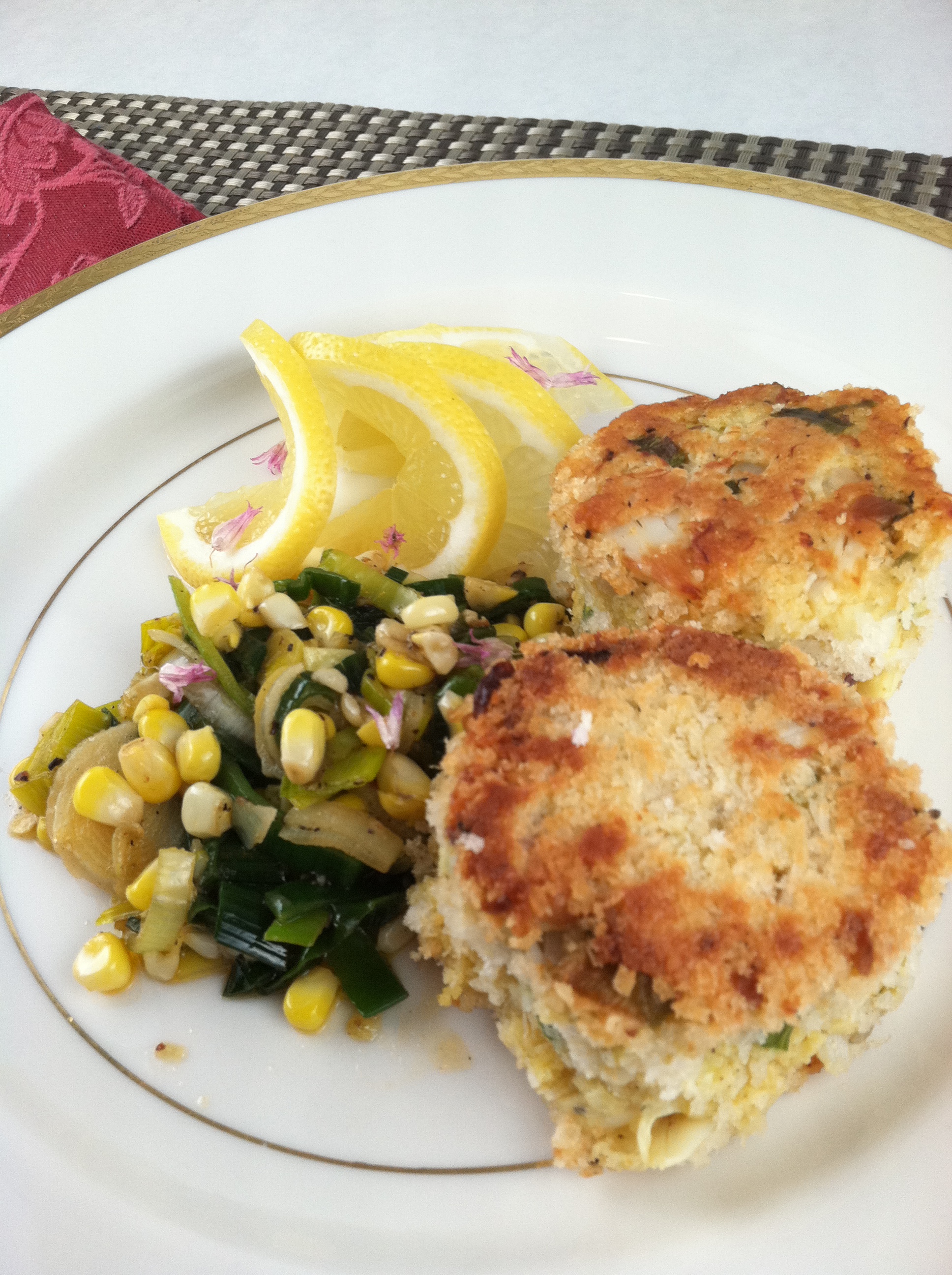
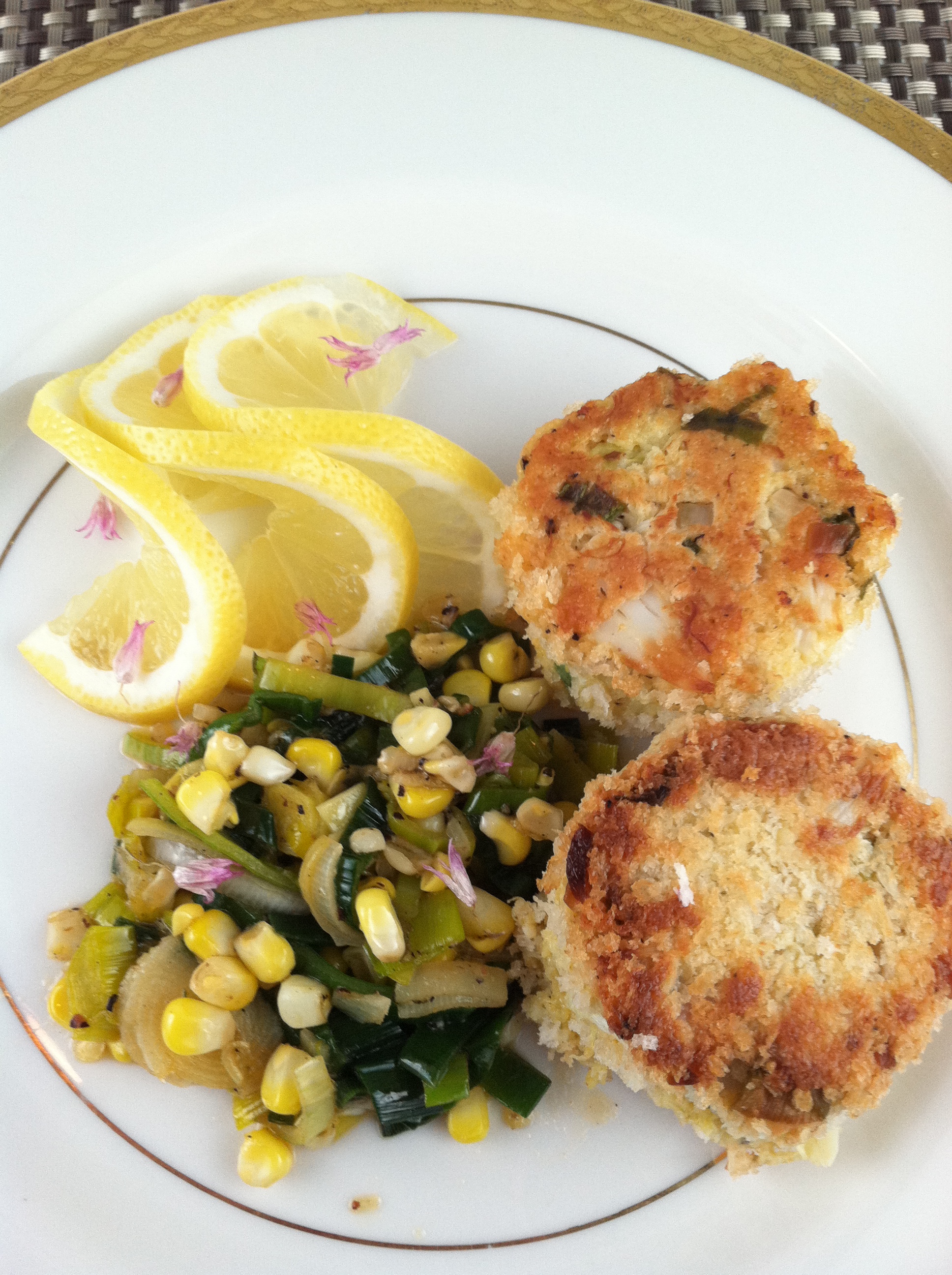
Serve with lemon, sautéed leeks and corn on the side.

Crab cakes with leek and corn

A Southern Staple: Simple Syrup

Bottle of simple syrup

This basic southern staple, simple syrup, is a must have in any kitchen or bar.

This style of syrup is used all over the world for lots of things, not just in the south.

It is, however the secret to true southern iced tea.

Simple syrup is easy and quick to make and there are endless ways to use it in the kitchen and bar.

Basic Simple Syrup

Ingredients:

  • 2 cups granulated sugar
  • 2 cups water, enough to cover the sugar by 1/2 inch.
  • 3-4 drops lemon juice

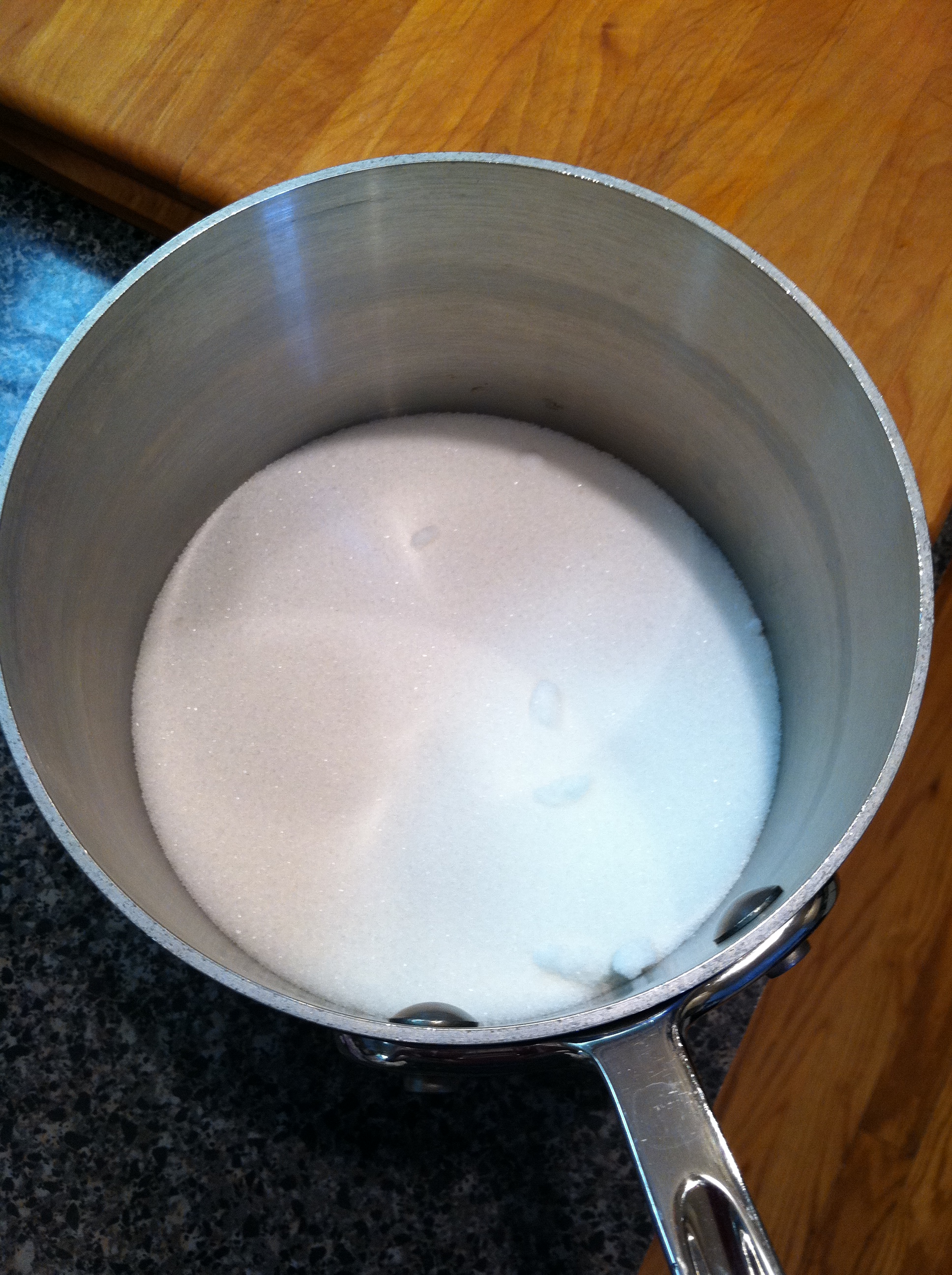
Put sugar in a sauce pot

Add water to cover sugar by 1/2 inch; add 2-3 drops of lemon juice, stir

Bring to a boil; boil for 1-2 minutes

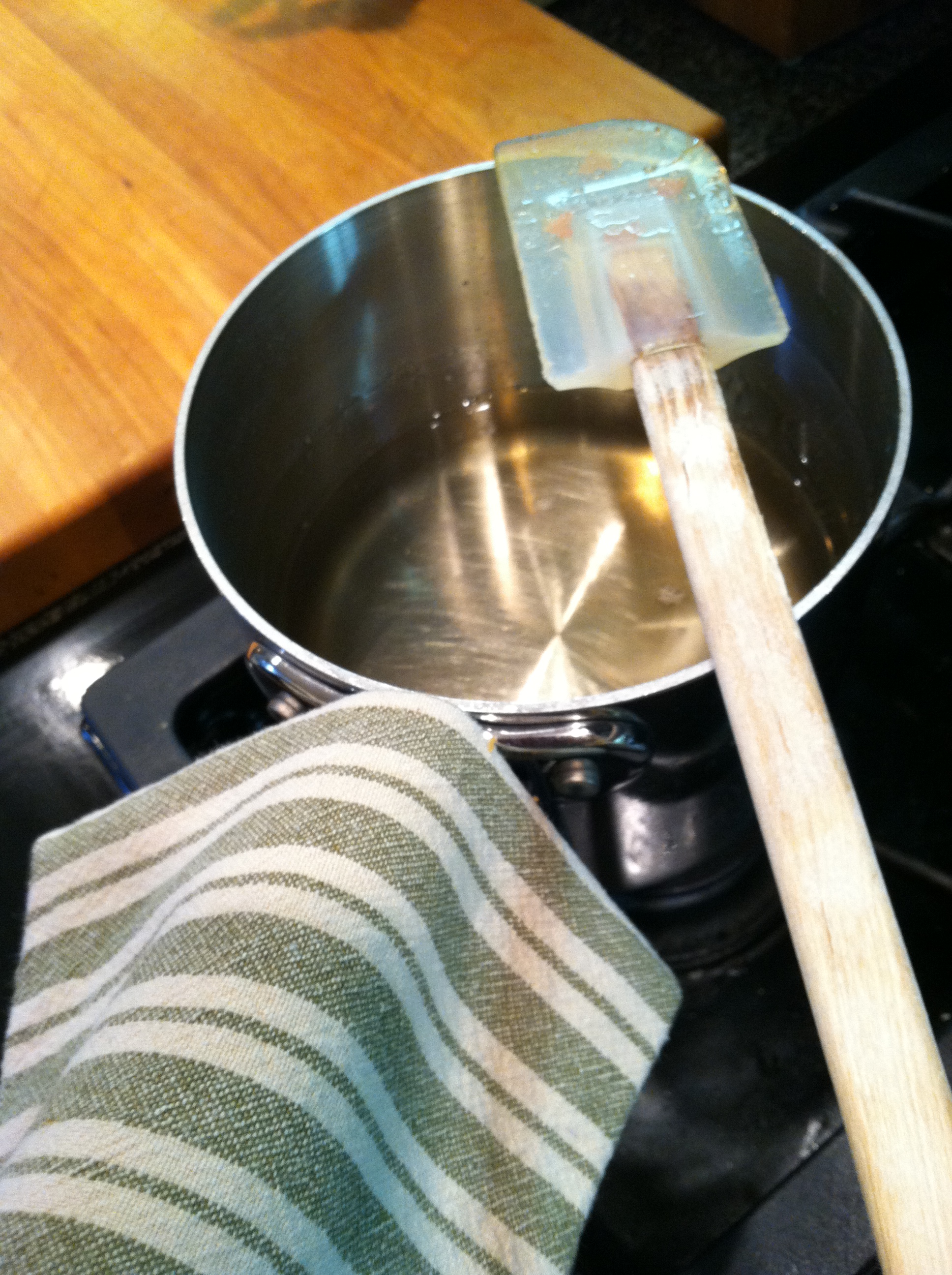
Place a ‘sign or symbol’ to signify pot is hot;
Put the pot away from accidents to cool

Method:

Put the sugar in a sauce pot, add water to cover the sugar by 1/2 inch. Stir well.

Place the pot over high heat; add the lemon juice and bring to a boil.

Stir, not constantly, but often enough to prevent scorching on the bottom.

Once the mixture comes to a boil, the sugar will turn clear. Allow to boil for 1-2 minutes, turn off.

Cool the mixture before transferring to a jar or bottle.

While the sugar syrup is cooling, put some kind of “sign or symbol” on the  handle so others know the pot and contents are hot and to leave the pot alone.

Use caution and place the pot well to the back of the stove out of harms way.

Sugar burns are very nasty and go really deep. Avoid at all costs, especially around children.

The syrup is shelf stable. Keep it handy to sweeten iced tea, lemonade, tea or coffee, use it over fresh fruit, in meringues, or even in marinades and specialty bar drinks.

You can infuse flavors into simple syrup, add a vanilla pod, lemon, lime or orange zest, fruit puree, basil, lavender, or mint for a few ideas. Be sure to strain the flavor elements out before using. The vanilla pods or herb leaves do look nice in the bottle.

My favorite way to use this syrup is to splash some into iced tea and top with a lemon wedge.

The perfect thirst quencher!

Iced Tea and Simple Syrup

Potatoes Au Gratin

I have been on a comfort food kick the past few days; Potatoes au Gratin are one of my favorite creamy delicious side dishes.

We always had them as a kid sometimes from scratch and sometimes from a box. The box variety always fascinated me.

The clear plastic looking chips, the powdered sauces, pour over boiling water and bake. Voila! Potatoes au gratin or Scalloped Potatoes all from a box. It was amazing stuff.

Making the same potatoes from scratch is far more satisfying, both nutritionally and esthetically.

First you have to get some good starchy potatoes – russets are the best as they are a ‘high-starch, low moisture’ category of potato.

Peeling is your option, but be sure to scrub them clean.

Have everything ready to go before you start slicing the potatoes so they don’t turn colors on you.

If you don’t know what I mean about potatoes turning color, take a slice and just let it sit out on the counter or on a plate. Look at it again in 5 minutes. It is oxidizing with exposure to air. Process potatoes quickly to avoid this color change happening.

“Green” on the potatoes is called “Solanin” and it is a sign of a potato that has been stored incorrectly with an exposure to light.  To avoid green potatoes, always store potatoes in a cool, dark place.

While it would take quite a bit of solanin to cause severe damage, it is an intestinal irritant. Simply cut away the green with your peeler. It isn’t very deep.

Do not store potatoes in the refrigerator, the cold converts the starch to sugar. Restoring to room temperature, over a few days will convert back to starch.

I made this dish for Robert and me but it would easily feed four. I used an All-Clad oval stainless baker pan, you can use any oven-proof dish you want. Adjust the quantities if using a large pan.

Potatoes Au Gratin

Serves 2-4

  • 1 or 2 large russet potato, peeled and sliced thinly
  • 4 whole large shallots, peeled and sliced thinly
  • 1/2 container Herbs and Garlic Boursin cheese (or 1/2 cup any shredded cheese of your choice)

  • 1 cup heavy cream, brought to a boil
  • 2 tablespoons flour
  • Salt and pepper
  • Optional: Monterrey Jack cheese to top and get all golden brown

Method:

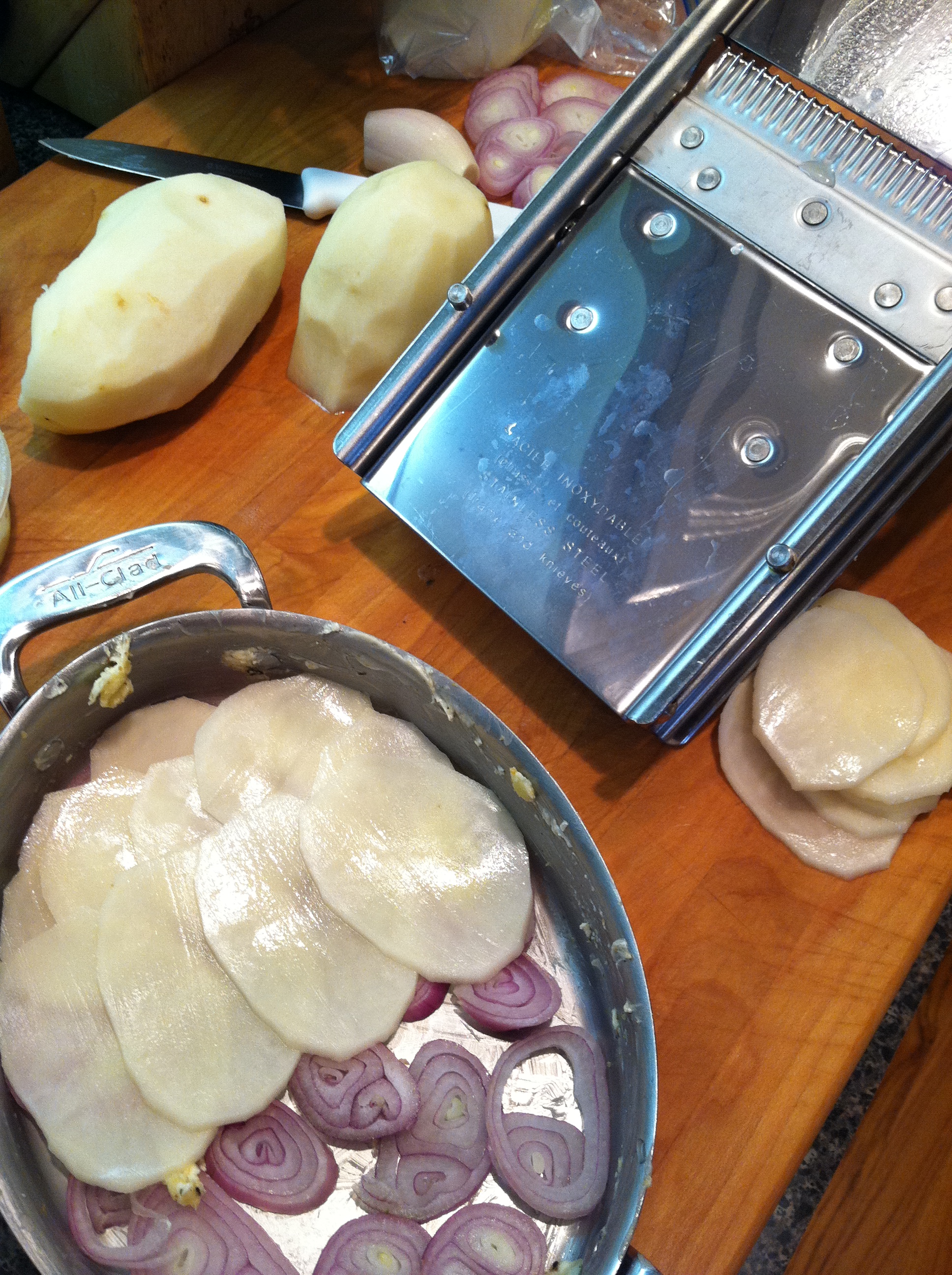
Thinly slice potatoes and shallots by hand or use a mandolin.

Be careful when slicing on a mandolin! Slicing on the mandolin ensures even slices so they cook at the same rate.
HINT: Slice shallots by hand.

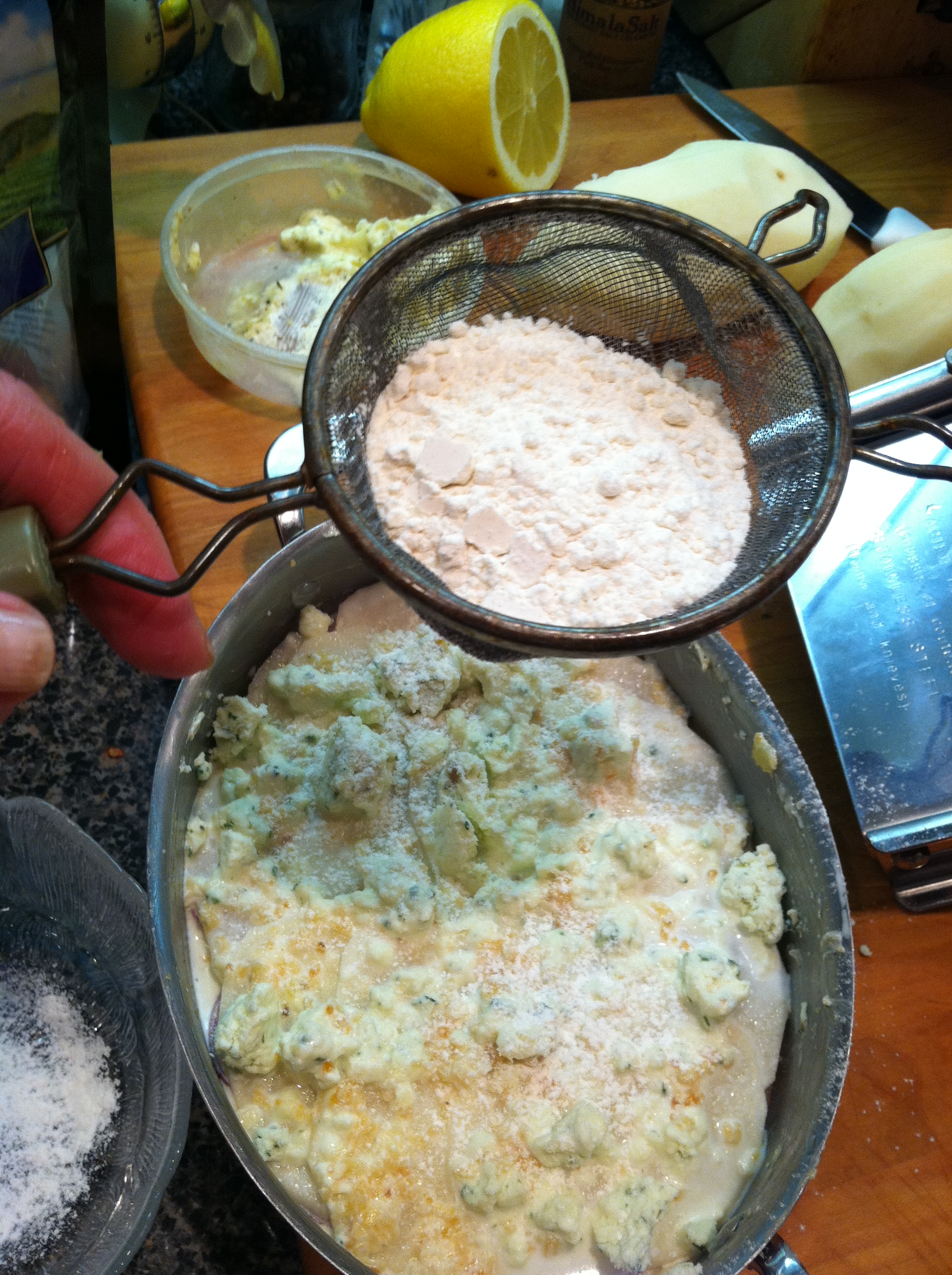
Butter the dish, place a single layer of sliced shallots on the bottom of the pan, top with potatoes laid in a single layer, top with shredded cheese, spoon 1/4 cup of warm cream, sprinkle with salt and pepper, drizzle a light sprinkling of flour and repeat layering until the dish is full. The top layer should be cheese.

Here is the layering sequence again:

  1. sliced shallots
  2. sliced potatoes
  3. cream
  4. salt and pepper
  5. flour
  6. cheese
  7. repeat leaving cheese as the top layer

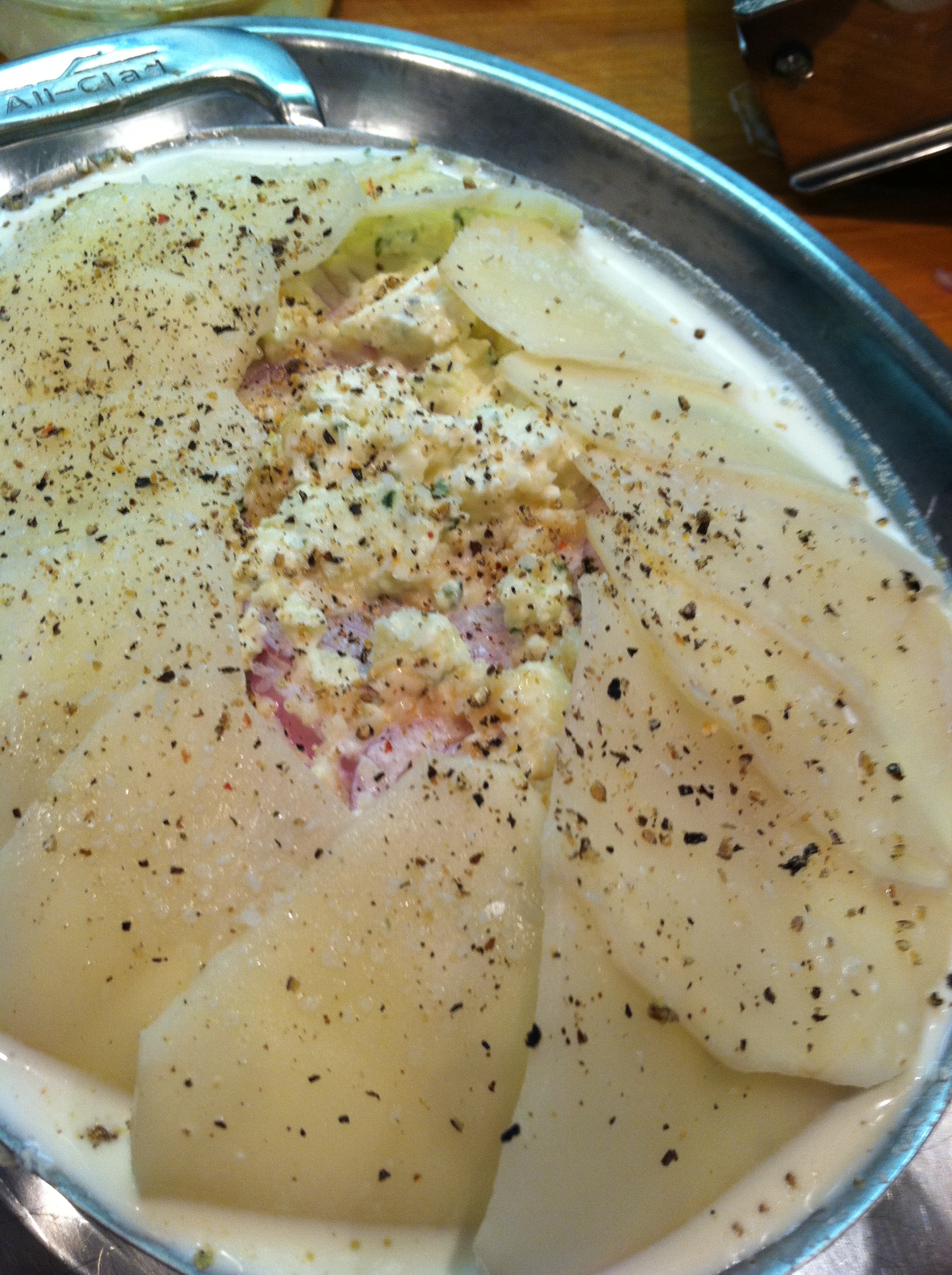
Butter the dish, layer shallots then potatoes

Notice how the potatoes are shingled into a layer

Sprinkle flour over the cheese and potato layers

Keep alternating layers to the top

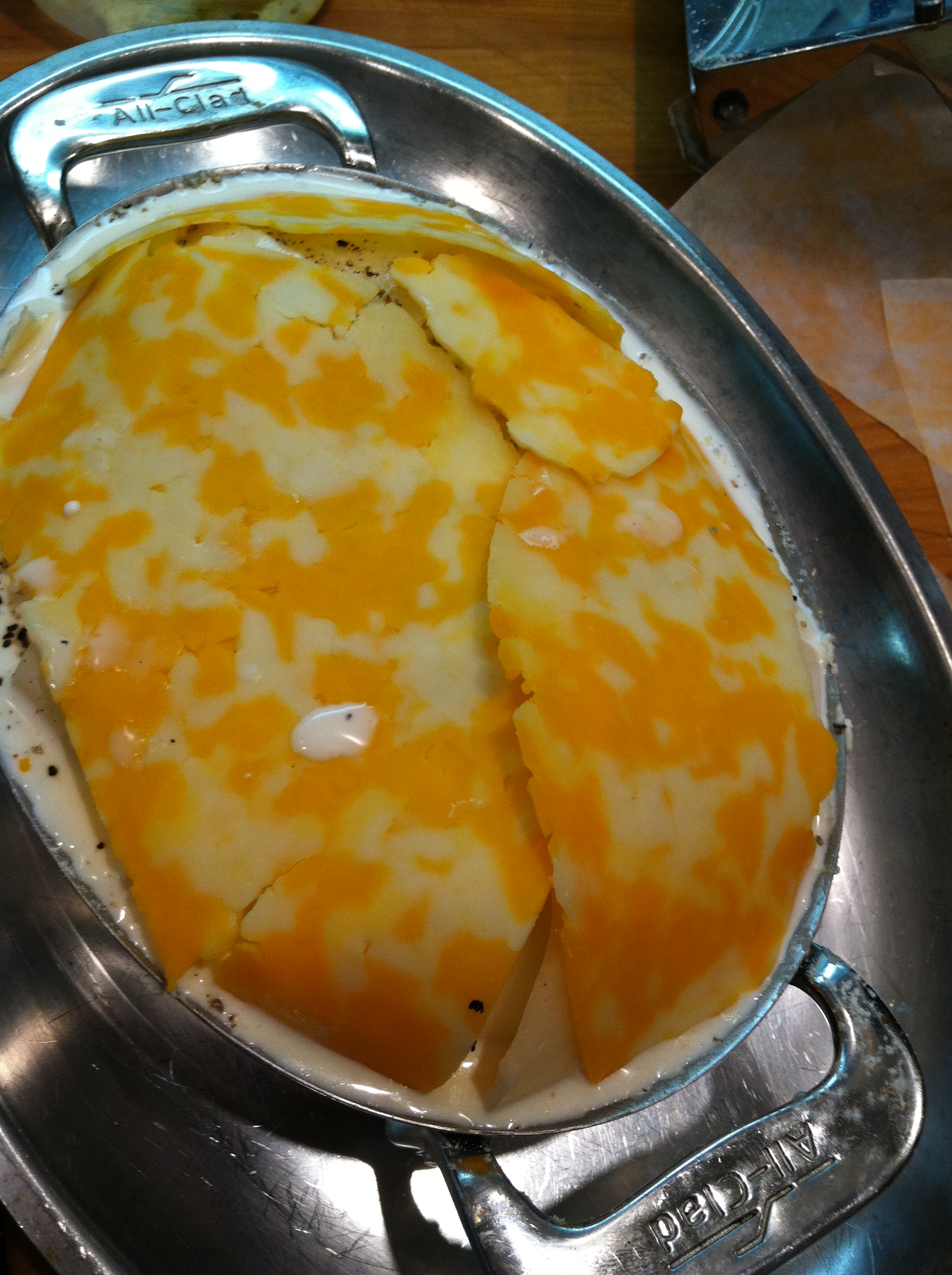
Top with cheese and bake

Place the filled dish on a parchment paper lined baking sheet to catch all spills. Place in a 400°F oven for 1 hour or until the dish is bubbling and golden brown on top.

We usually gobble these up pretty quickly but if you have any leftover, cut them into shapes and reheat either in the microwave or the oven until nice and warm in the center.

Variations on the theme:

  • Scalloped Potatoes: Leave out the cheese and make sure enough cream covers the top slightly. Top with breadcrumbs; Bake the same way.
  • Add your favorite herbs for an herbal variety.
  • Use different cheese: Goat cheese, Havarti, Asiago, fontina, add some bleu to the mix.
  • Use cheese that you know will melt nicely. If you want to make this with cheddar, please add some hoop cheese to it for melting purposes. Cheddar does not melt well all on its own.

I’m sure your family will enjoy this as much as mine does. Your home will smell wonderful as they cook. Since they are in the oven for so long, it is a good time to plan a baked chicken or pork chop to go along with the potatoes.

Sometimes I’ll have a plate of just potatoes au gratin for lunch, if there is any left over.

Plated Potatoes au Gratin

Mushroom Risotto

I made mushroom risotto just to see if there could be any left over to make the risotto balls Frugal Feeding made. Only he called them Rosemary and Garlic Arancini. I suppose that is the correct Italian name for them more than “risotto balls.”

By any other name they are still just as good.

Let’s make  Mushroom Risotto and if you have any left, you can hop over to Frugals site and make the Arancini.

But first a note on how to clean mushrooms:

Think of them like little sponges. if you run them under water or (horrors!) soak them in a bowl of water to ‘clean’ them, you are water logging the poor little mushroom. The mushroom will release that water while you cook, you will not get a good color on them when cooking. Instead of saute, you will be braising them.

Instead, wipe them with a clean towel, trim the tough part of the stem (shiitake – remove the entire stem, it is tough) your are ready to go.

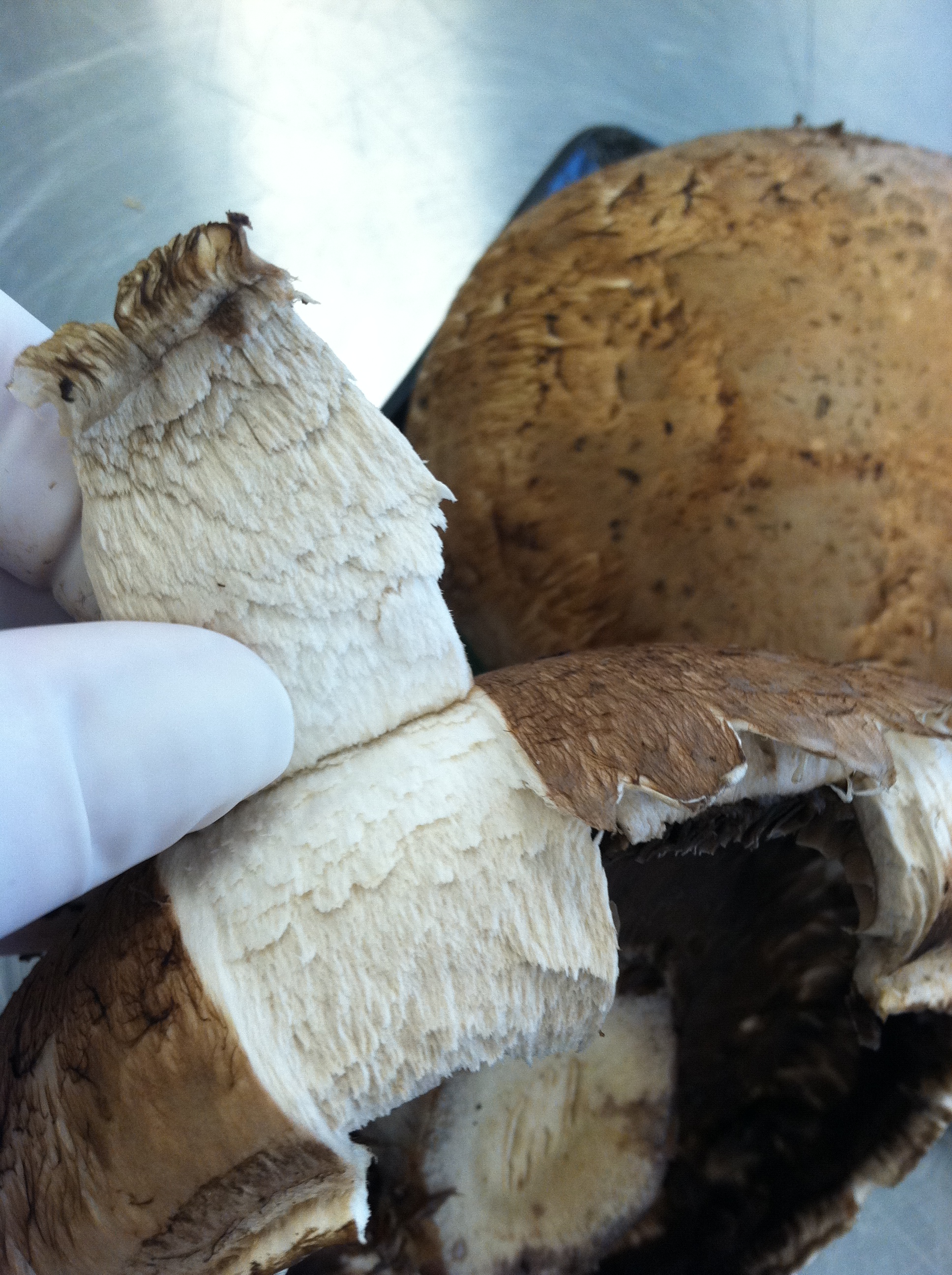
Portobello mushrooms can be ‘peeled’ to create a prettier mushroom. Use a spoon to scrape out the gills and then peel the lip of the mushroom to remove the top layer, peeling towards the top middle of the mushroom cap.

Save the scraps for flavoring stocks for soup or sauces.

Peeling a Portobello

Use a spoon to scrape out the gills

1 peeled Portobello and 1 not peeled ; see the difference?
Save those scraps! Freeze them.

Mushroom Risotto

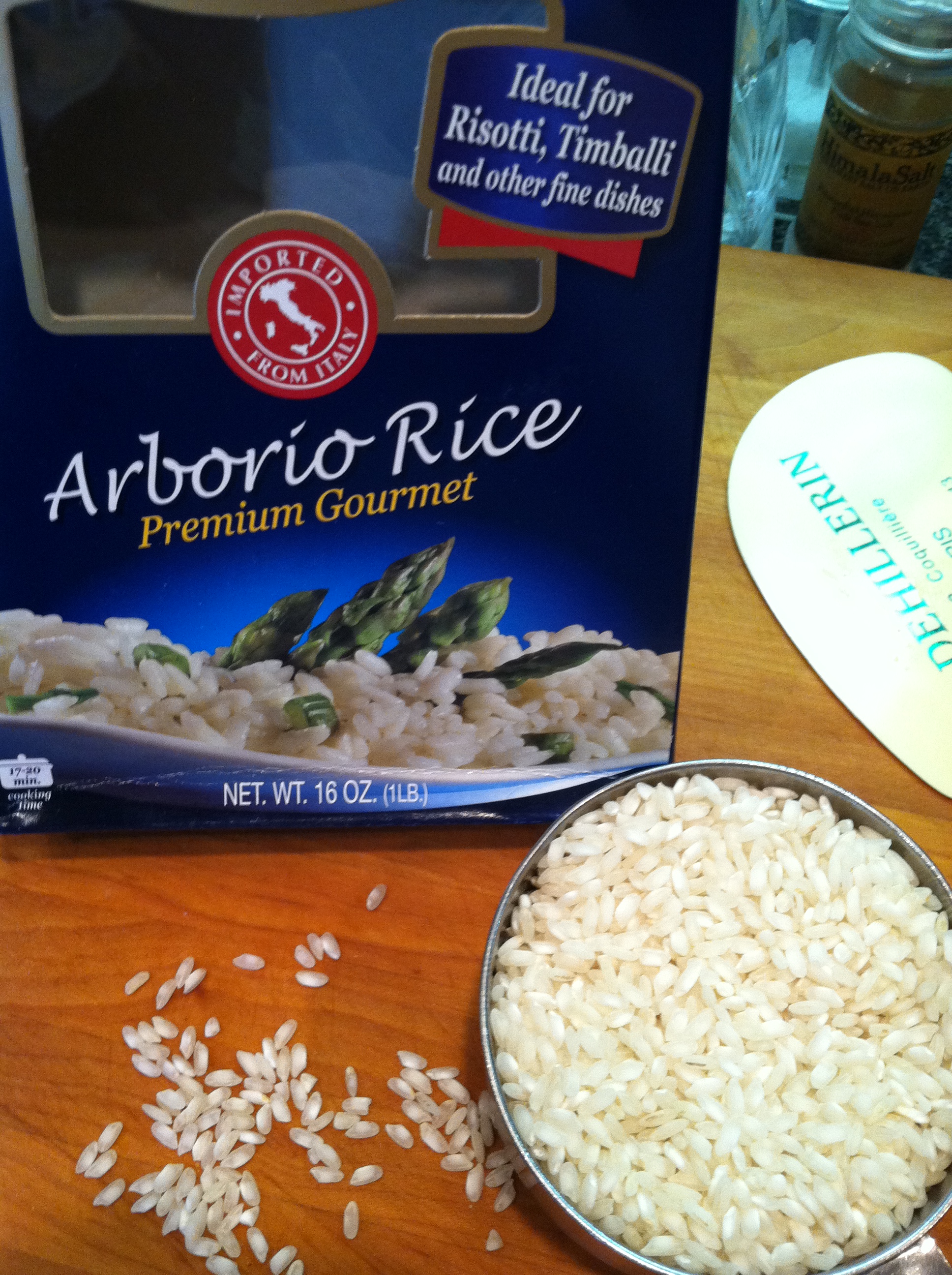
1 cup arborio rice

2 tablespoons finely minced shallots

1 tablespoon  fresh minced garlic

1 cup cleaned and sliced fresh mushrooms of your choice

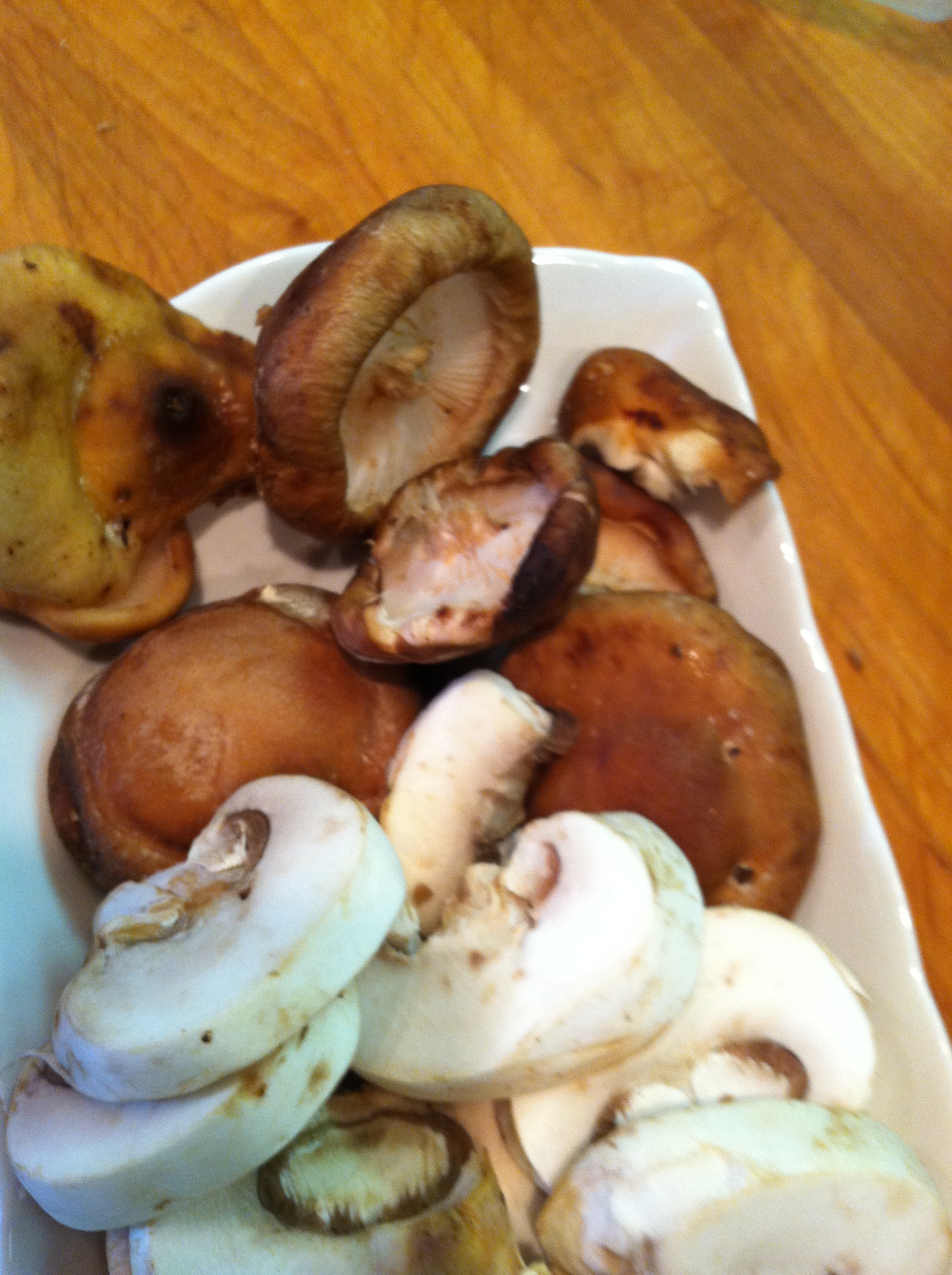
White button and shiitake mushrooms

If you use Portobello mushrooms, be sure to clean the gills out from under the cap. They turn everything a dark, almost black color.


1 up to 1 quart of warm chicken stock

If you use a stock that has salt in it, adjust your salt flavor at the end. Salt concentrates as liquids evaporate.

1/2 cup dry white wine

1 cup Parmesan cheese, shredded, not graded

1 tablespoon butter

Salt and pepper to taste

Cook the mushrooms first in the same pan you will cook the risotto. This allows the mushrooms to develop that deep flavor for which mushrooms are so famous.

Sautéed Mushrooms

  • 1 pound mushrooms of your choice, cleaned and sliced
  • 2 tablespoons oil or clarified butter
  • 1 shallot sliced
  • 2 clove fresh garlic smashed and minced
  • 1/2 cup white wine
  • 1 sprig fresh thyme
  • salt and pepper to taste

Heat the pan over high heat, add oil.

Add mushrooms sliced shallots, garlic saute until they begin to develop color and start to release their juices. Add white wine to deglaze and cook until the pan is nearly dry.

Now add the rice and continue with the risotto recipe below.

Note: This is a great way to saute mushrooms for any other way you want to eat mushrooms, steak, Quiche, soup

  • Heat the chicken stock in a pot and have it nearby with a ladle.
  • In the same pan you cooked the mushrooms above, add the rice.
  • Saute for 2 minutes. Stir to coat the rice with the mushroom goodness in the pan.
  • Ladle about 8 ounces of warm stock into the rice pan.
  • Stir to combine and continue stirring until the stock has been absorbed.
  • Repeat 3 more times.
  • Taste the rice, there should be a slight bite to the grain, known as “al-dente.”
  • The last addition will be 1/2 cup white wine, stir until the wine has been absorbed.
  • Stir in the Parmesan cheese and the butter.
  • Adjust seasonings and serve.

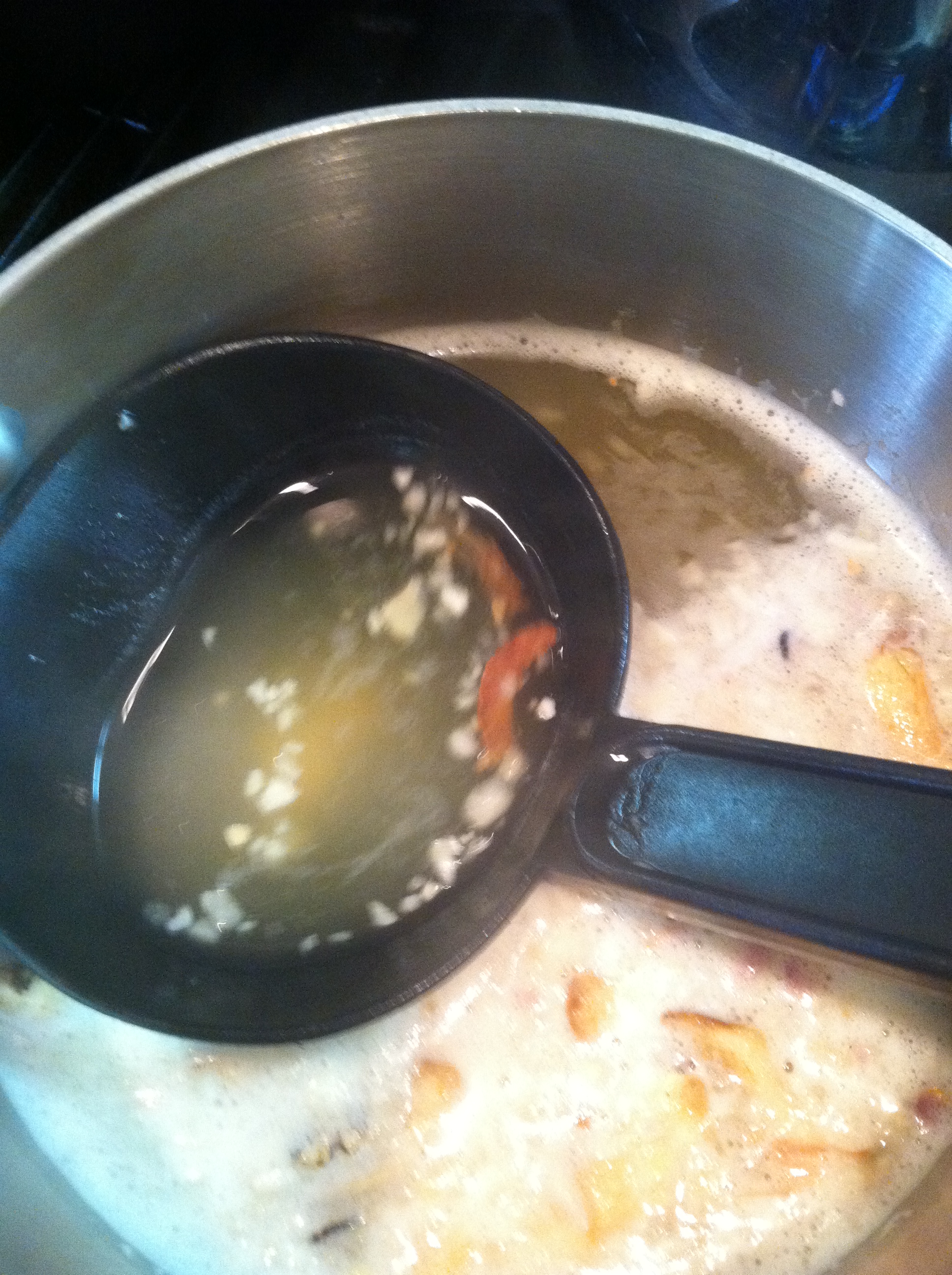
Warm chicken stock, have a ladle handy

Saute the mushrooms, shallots, garlic, thyme and wine to develop flavor in the mushrooms before adding rice. Cook down to nearly dry again.

Add rice, saute to coat the rice with oil and mushroom jus

Add warm stock and stir until absorbed

Stir until all stock has been absorbed; add more stock

Add more stock and keep stirring

I learned to make risotto the old-fashioned way; by stirring a lot. Stirring makes it creamy. There are some methods where you cook it much like you do plain rice. I don’t find the results as creamy as the stir-like-a-madman method.

Besides, it gives your arms a decent work out.

If you want to make risotto and hold it for serving later, take it only half way through the steps of adding stock. Cool it down.

When you are ready to finish, heat more stock, add the rice and finish the cooking process.

Serve immediately as risotto can get quite gluey as it cools down after it finishes cooking.

I made enough to have some leftover for the Arancini but when I went to make them, there was no leftover risotto.

So the myth continues, there is no such thing as leftover risotto.

I haven’t seen much leftover wine either.

Why is that?

Robert said to just make more risotto and make the Arancini immediately.

I think he just wants more risotto.

Mushroom Risotto

How to Roast a Chicken

Here is another basic skills post about how to roast a chicken. The same principle applies to most birds, large or small. Ducks are just a bit different due to the amount of fat on them.

To select a whole chicken, carefully look at the wing tips, they should not be brown in any way. Slightly red is OK but no brown. Look at the neck area, same thing. These areas show age on market chickens. If they are fresh, they will be ‘chicken color’ and possibly red tips on the wings. No brown, green or purple.

The chicken should also not have any odor. Give it a sniff. Pass it by if you smell anything.

Sometimes the inside of the bird contains a small bag of the heart, liver, neck and gizzard. Remove this from the inside of the bird. Throw it away unless you eat heart, liver, neck and gizzard. My father made wonderful sauce from these parts. Sometimes I saute the hearts and livers but there is only one inside each bird so they become the cooks treat. YAY!

Thoroughly rinse the bird inside and out. Pat the bird dry.

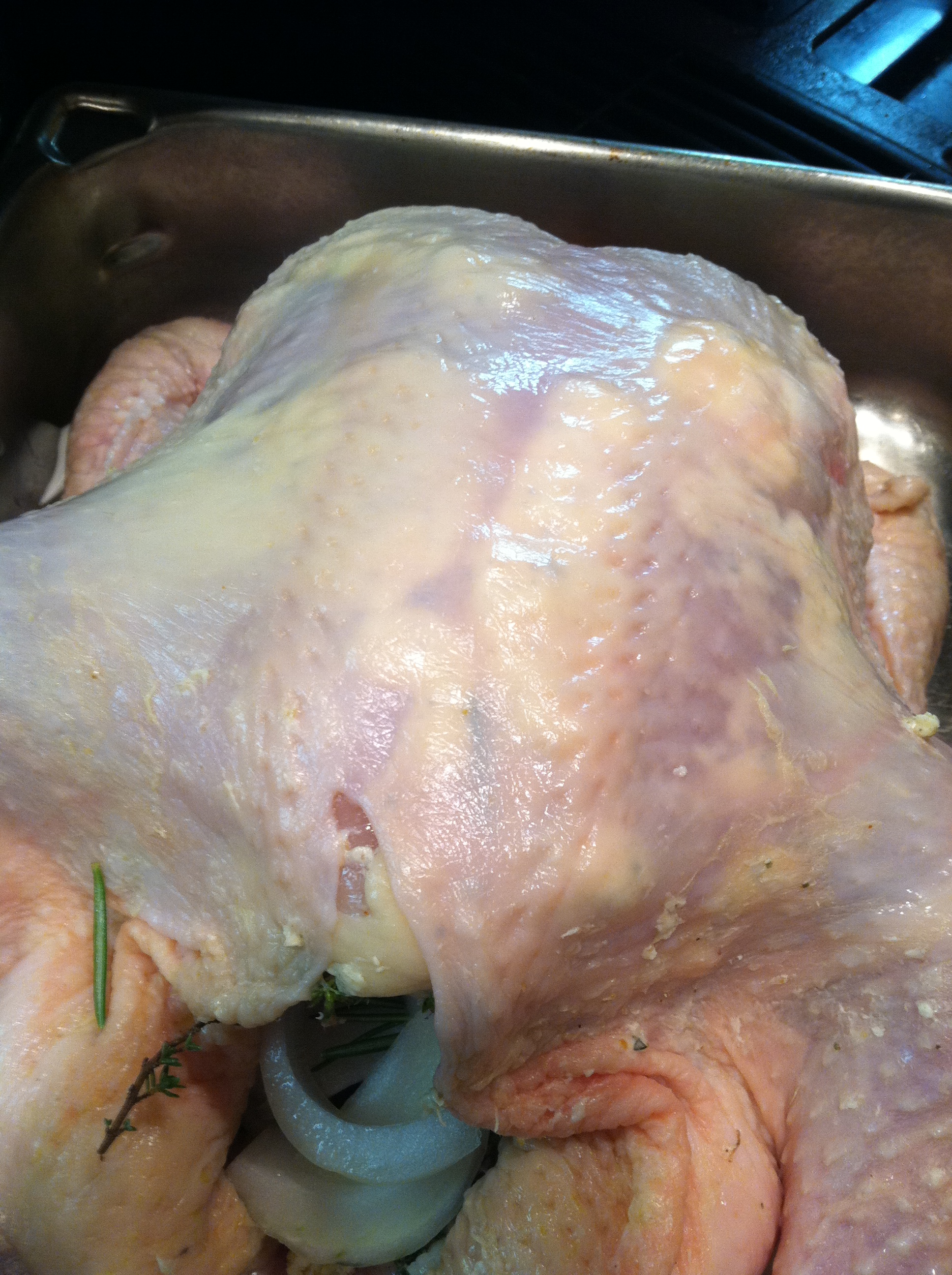
Carefully, using your fingers, loosen the skin but do not tear it.

Look carefully, see the butter under the skin?

Insert compound butter between the skin and the meat, smoosh it around so it almost covers the meat and then rearrange the skin back in place. This will baste the meat with herbs and butter while the bird roasts.

What is compound butter? Soft butter with herbs and seasonings mixed in. Any combination, any flavors, your choice. Toss it in a mixer, mix it up, place in a container and use it anywhere you would use butter. The butter I used here contained thyme, garlic, lemon, shallot and pepper.

To give the bird some flavor while roasting, insert herbs, onion and garlic into the cavity. For this bird I used rosemary, thyme and onion and a bay leaf.

For food safety sake, if you want stuffing, bake it in a separate pan. See note below regarding food safety.

On the bottom of the roasting pan, place chopped carrots, celery and onion (25% carrots, 25% celery, 50% onion ratio) and 1/2 cup or so of water or stock.

Professionally, we call this vegetable ratio “mirepoix”.

Tie the legs together with butchers twine or cotton string. Run the string around the legs and thighs and tie it off under the wings. This holds the bird together in a nice compact bird-like shape, controls the legs and plumps the breasts.

This is how you get a good-looking finished bird that isn’t splaying its parts all over the place.

Season the birds skin. I used Montreal Steak Seasoning for this one. Season as you like.

Season, tie the legs and truss the chicken. Place on top of vegetables to roast.

Place the tied and stuffed bird in the roasting pan on top of the vegetables.

Roast the bird in a 350°F oven for about 2 hours or so for a 3 pound bird. Please use a thermometer to test for 180°F internal temperature in the thigh, not near a bone.

The dark meat takes longer to cook so you test there. Please be sure to cook your chicken all the way.

There is nothing as unappealing as cutting into a whole roasted bird and have blood come out. Obviously, it goes back into the oven to finish cooking, if that happens.

When the bird is done, allow it to “rest” for about 15-20 minutes before carving. This is when I prepare the vegetables and put the final touches on the meal.

Food safety really comes into play with handling chicken.

  • Keep the bird cold.
  • Sanitize the work area with a mild bleach after preparing and handling the bird.
  • We are trying to avoid contaminating our families with Salmonella and Campylobacter jejuni in particular.
  • If your bird is frozen do not allow it to thaw on the counter or in the sink. Put it under cold water that you change frequently or in the refrigerator which takes 2-3 days to thaw, so plan ahead.
  • Always sanitize everything that chicken and your hands come in contact with during preparation with a mild bleach solution when you finish. Knives, boards, spoons, counters, sinks, knobs, handles, towels, aprons, etc.

To make a sauce, use the drippings in the bottom of the roasting pan. Deglaze with chicken stock or white wine. Strain the liquid from the roasting pan into a sauce pot. Bring to a simmer.

Mix equal parts of butter and flour together in a small bowl. Drop small pea sized pearls of the flour and butter mixture into the simmering stock, whisk to incorporate. Season as desired. Simmer for 10-15 minutes to cook out the starch taste. Finish with a pat of cold butter whisked in, adjust salt and pepper. Strain again if desired.

Roasted chicken with sauteed beet greens

We sautéed the beet greens we had on hand from the pickled beet post. Yummy stuff.

There will be another post soon on “How to Cut Up a Chicken”

Enjoy roasting your chickens! I adore the aroma, it smells like home and all things wonderful.

Oatmeal Cranberry Cookies

Interview Cookies

I was asked to bring cookies to a job interview one day so I made a batch of Oatmeal Cranberry Cookies. Walking across the street for the interview, I realized the cookies were still on my kitchen counter. Going in empty-handed was not an option so running home as fast as possible, I grabbed the cookies and waltzed into the interview only a few minutes before it was time to start. Typically being there 5-10 minutes early is preferred rather entering right on time. Luckily I lived close by.

I was right about going home to get the cookies. There was a “refreshment” table set with a big empty space for the platter. Milk, tea, coffee, plates and napkins –  a successful interview hinged on good cookies. The interview panel was outfitted by the colleges cookie monsters.

Being cookie monsters, they were satisfied munching while they took turns grilling me with questions. After the cookie interview, it was required to film a ten-minute lesson of their random choosing.

I wondered what they wanted to eat next.

After several more interviews over several weeks, they awarded me the position.  I always wondered if they were curious why I talked so fast or was out of breath at the initial interview. Probably not.

My son called from college the other day and asked for some cookies. These will work nicely.

Oatmeal Cranberry Cookies

Recipe adapted from Quaker Oats Company “Vanishing Oatmeal Cookies”
  • 1/2 cup ( 1 stick) + 6 tablespoons soft room temperature butter
  • 3/4 cup  dark brown sugar, firmly packed
  • 1/2 cup granulated sugar
  • 2 large eggs
  • 1 teaspoon vanilla
Dry Ingredients
  • 1- 1/2 cups all-purpose flour
  • 1 teaspoon baking soda
  • 1 teaspoon ground cinnamon
  • 1/8 teaspoon ground allspice
  • 1/2 teaspoon non-iodized salt
Measure to fold in last
  • 3 cups uncooked old-fashioned oats
  • 1 cup dried cranberries

Pre-heat oven to 350°F

Using an electric mixer, beat the butter and sugars on medium speed until creamy.

Add eggs and vanilla; beat well.

Combine flour, baking soda, cinnamon, cloves and salt in a large bowl.

Mix  the dry ingredients together well with a dry whisk, spoon or fork.

On low-speed, slowly add the dry flour mixture to the creamed eggs and sugar.

Add the oats, then the cranberries, mix well to combine all ingredients.

Use a scoop and scrape it along the edge of the bowl to level the portion size for consistent sized cookies

Drop by rounded spoonfuls, or use a cookie scoop, onto a parchment lined sheet pan. Space 2″ apart.

Space evenly 2" apart to allow spreading. Use silpat or parchment on the baking sheet.

Bake at 350°F for 8-10 minutes or until light golden brown. Remove from oven and allow the cookies to cool on the sheet pan for 5 minutes before transferring to a wire cooling rack. Use a spatula to lift the cookies from the parchment.

Cool completely.

Drizzle the cookies with icing. Make note of the parchment and tray under the cookies to catch icing drips.

Watch out, cookies disappear before they are finished!

Drizzle with fondant icing if desired.

Fondant Icing

1 cup 10x confectioners sugar

pinch of salt

1/2 tablespoon milk and more as needed.

Place the 10x sugar in a bowl. Add the milk and stir. Drip more milk, drop by drop, into the sugar until drizzling consistency is reached.

It is easy to make this too liquid so start with a small amount of milk first and add while stirring. It changes quickly.

Using a fork, drizzle the frosting over the cookies while still on the cooling rack.

Allow the frosting to dry before storing in an air tight container.

These cookies are best inside of tummies, guarded by a glass of milk or cup of tea.

Take a bite!

Arugula and Pickled Beet Salad

Today’s shared bounty is some lovely arugula (aka rocket). The added bonus of this shared bounty is roots! After washing what we would eat, I choose some to plant and grow more.

Thanks Adria!

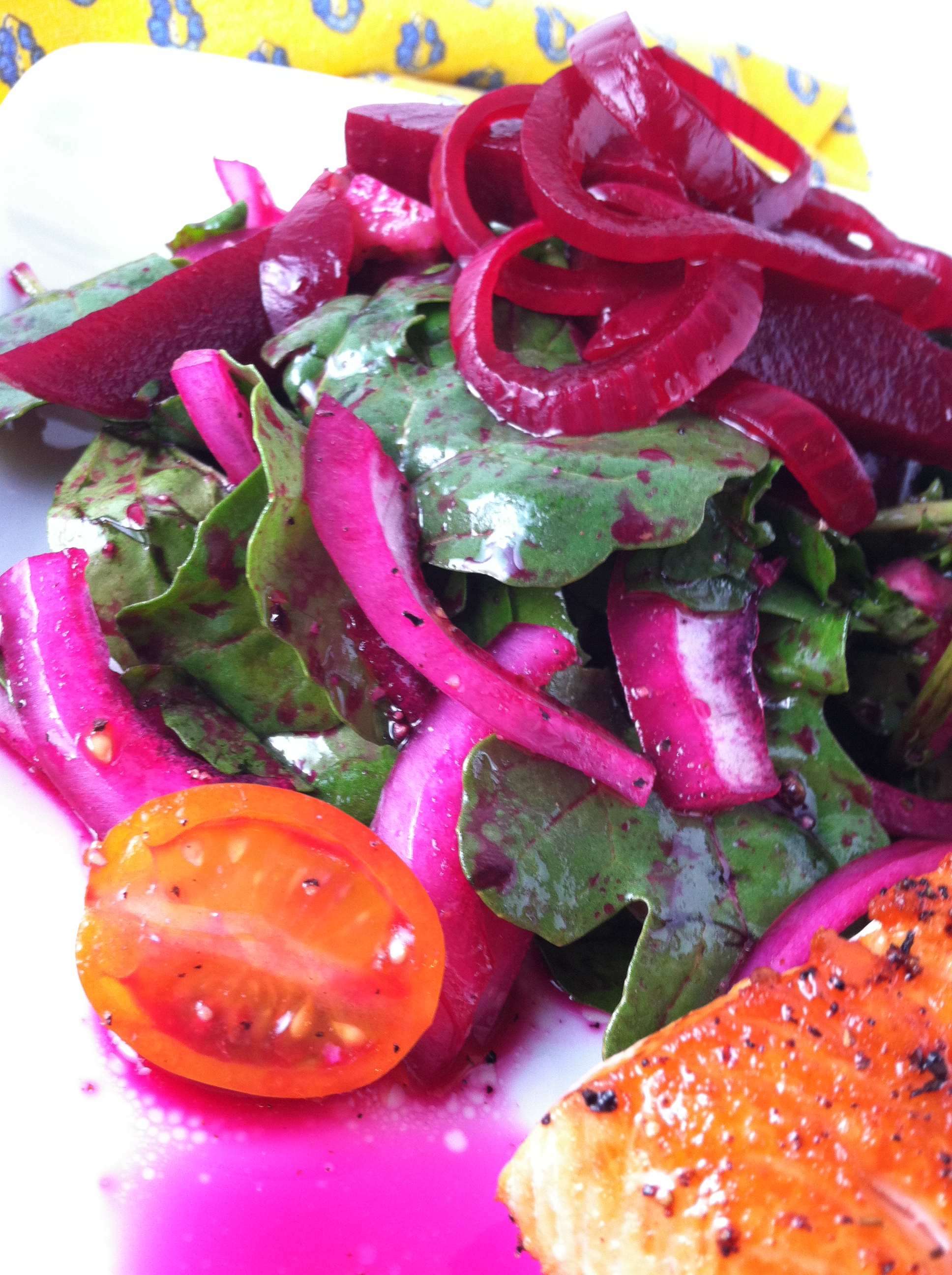
Washed and refreshed, arugula is ready for a terrific, quick and easy salad from things created over the last few days for posts on Spoon Feast.

Picking some fresh red-leaf lettuce from the garden, combining it with arugula, garnishing with fresh tomatoes, cucumbers, steamed artichokes, pickled beets and hard-boiled eggs.

All food gathered from a walk to the farmers market Saturday and shared bounty from friends and colleagues. Oh, add salmon, wild caught, from Alaska.

We tossed the salad with a chive blossom vinaigrette to bring it all together then added croutons and slabs of fresh bread and a few shavings of cheese.

You could use the beet juice from the pickling jar and drizzle a bit of olive oil for the dressing.

I drank champagne; Robert, Stella Artois.

We got to eat the duck, kale and white bean soup earlier

This is how we get to use up a weekend of playing in the kitchen. I don’t just write about recipes and food, we live it. Every day, every meal.

Only a small percentage of what I really cook ever gets written about. I call that “cooking without documentation.”

I cook and create food every single day for as many meals as I can. Sounds like we would be fat porkers, but we aren’t.

Eat responsibly is the key. Love and enjoy food but don’t overdo it.

Robert loves the results. I must admit, it sure is fun to finish with all the cooking and writing and photography; go take a bath and fall asleep. The next day go down to the kitchen and enjoy all the tasty things there are to eat over the next couple of days.

It leads to more posts, more food and photographs.

Robert does not like his food photographed.

Arugula and Pickled Beet Salad with Salmon

So, I make a plate to shoot before we eat. Maybe that’s why he doesn’t like his food photographed, he wants to eat first.

I try not to waste food by eating what is photographed. Sometimes it is necessary to dedicate a plate to the shoot. Others, the plate gets consumed as soon as the camera lights fade.

This time of year is my favorite as there is so much produce, fruit, and flowers available to play with.

I encourage you to try using arugula/rocket in a salad. It is great to top a pizza or drop into soup.

Use arugula/rocket just as you would spinach, raw and cooked. The home-grown varieties  seem to have more peppery flavor than commercial products.

Let me know how you like this crazy green.

Oh, Grasshopper!

Fair warning: If you are squeamish about grasshoppers or insects, move on to the next post. Just a fair warning.

There is a student in my Garde Manger class who brought grasshoppers to class.

A pan of grasshoppers

Even though eating grasshoppers is not the mainstay diet of my readers, I thought it was so interesting I had to write about it. I am not an extreme food consumer, but if it was all there was to eat, I speculate a way would be found.

Comedienne Mary Asher and the Grasshoppers

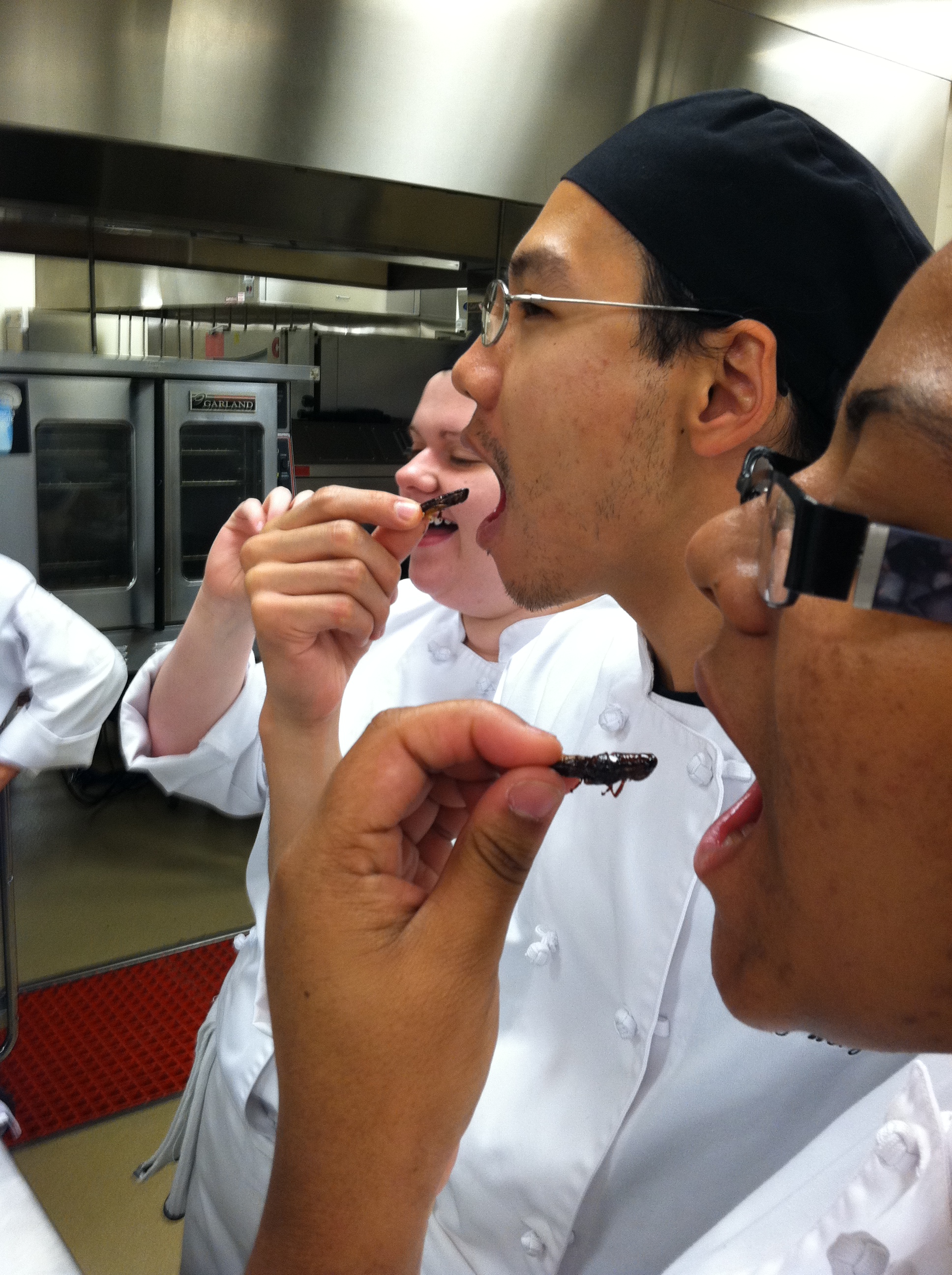
I couldn’t bring myself to eat one, however, several students were excited to try.

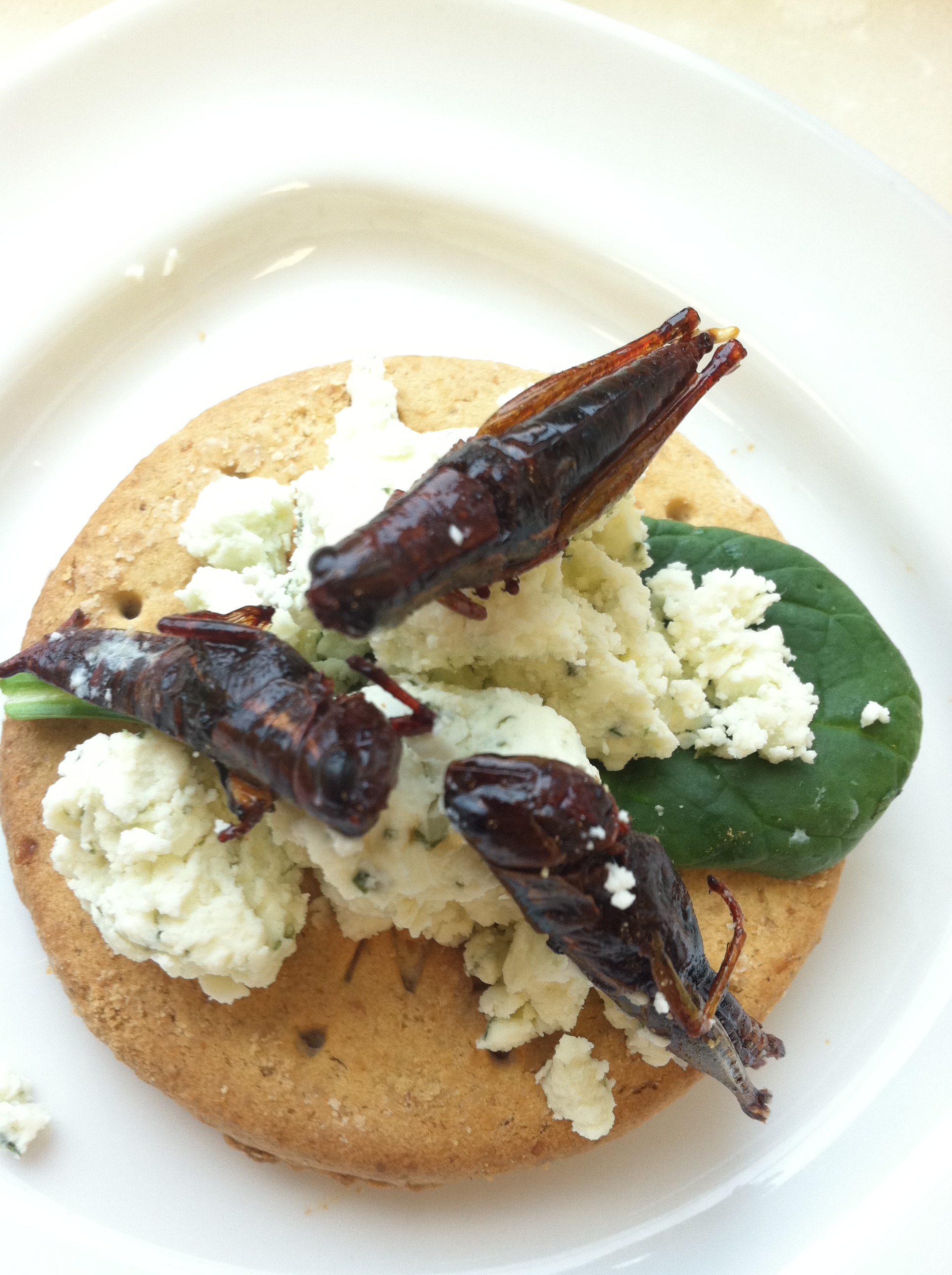
Yong made them nice and crispy and made a Korean style teriyaki sauce and another of his teammates, Andrew, covered them with dark chocolate. Some were paired with cheese on a cracker.

Yong was telling us how in Korea, they raise grasshoppers in very clean ‘grasshopper farms’. I visioned tall blades of lush grass with jumpy, springing green grasshoppers leaping blissfully from blade to blade.

It was fun to watch the adventurous eaters explain: “crunchy like a grassy twig”, “Can I pull the legs off?”, “I don’t like the wings”, “Are they overcooked?” “They make me want to jump around.”

Snacking Grasshoppers

Chocolate Grasshoppers

Grasshoppers with cheese and crackers

Serving Grasshoppers

At least he didn’t bring in hissing cockroaches.

Artichokes!

Artichokes from the market

I found the most amazing artichokes in the farmers market this week. They were huge and hybrids. These artichokes did not have any of the thorns or much of a “choke’ inside either.

The woman at the market asked me “how do you cook them so they are tender?”

Steam them.

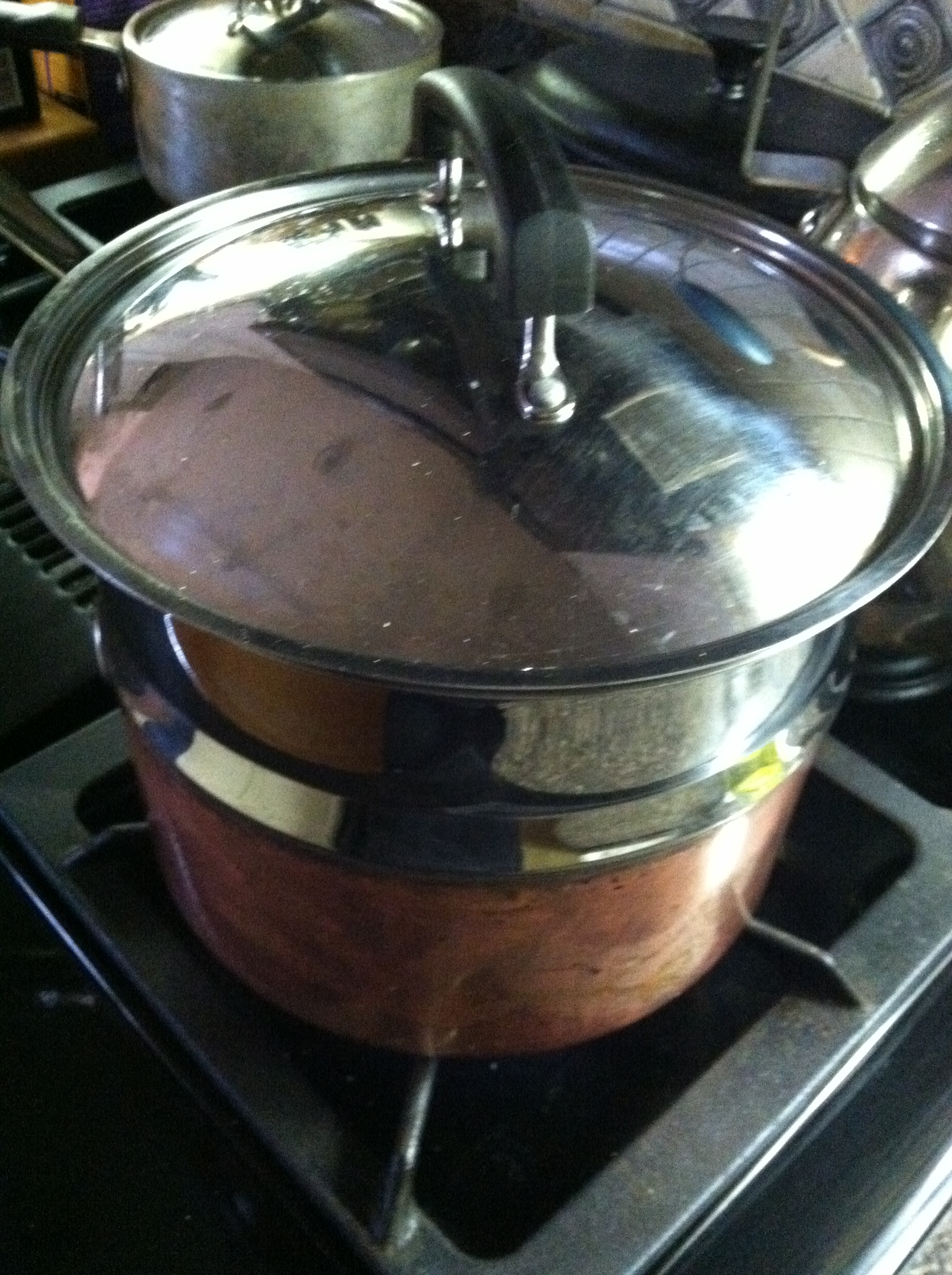
I had to find a domed lid to fit the steamer; the artichoke was so big!

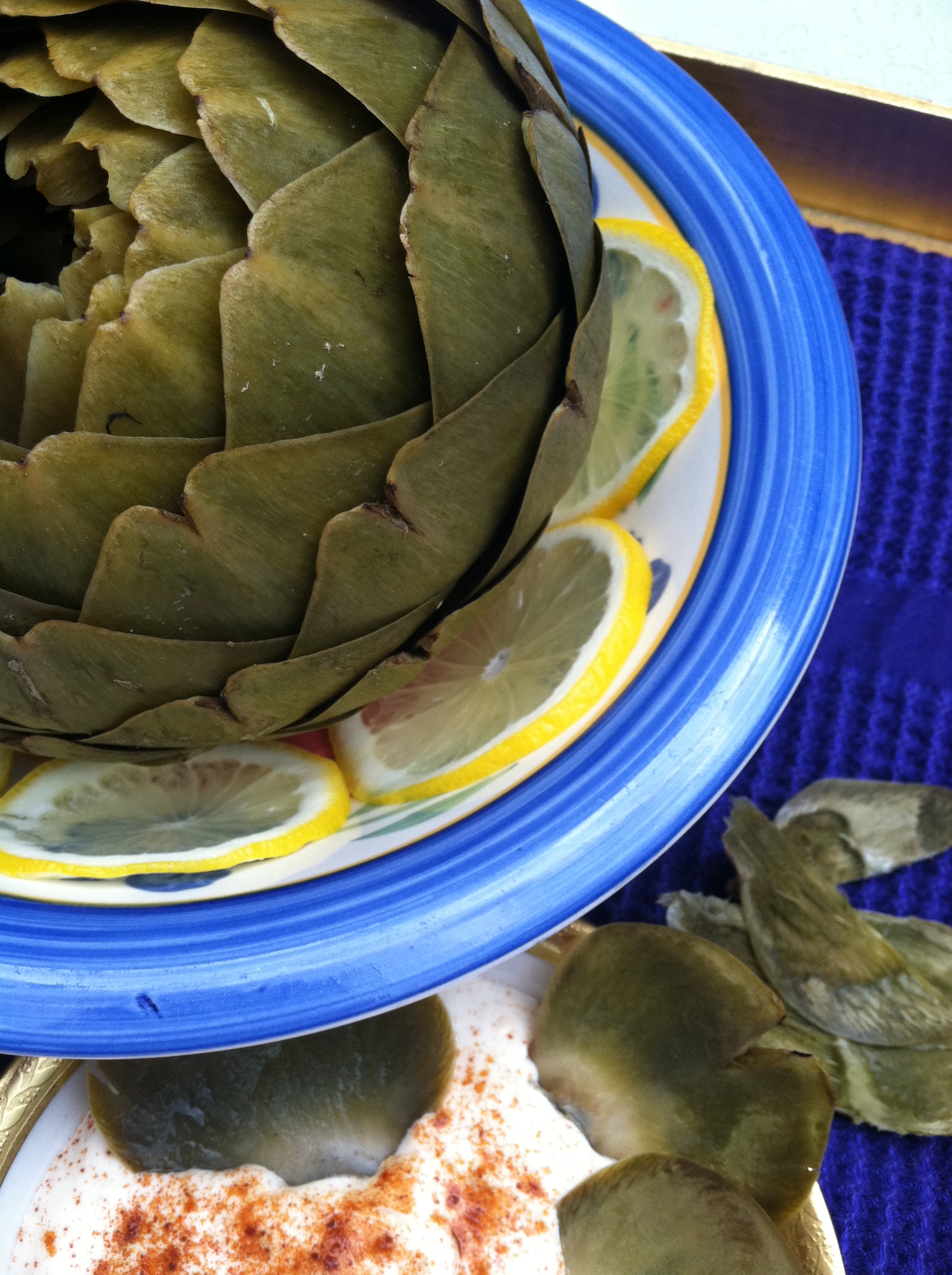
All I did with this artichoke is cut the stem so it would fit in the pot with the lid on it and steam. It had to be steamed for about an hour and 15 minutes. Once the water came to a boil, the heat was turned down to low. You will need to check the water level to be sure you don’t burn up a good pot.

If you find the non-hybrid type that have the small thorn on each leaf, you will need to use the kitchen shears and clip them off. After your cut a few, wipe the edges with a cut lemon to prevent the artichoke from turning black.

Any cut you make on a raw artichoke, swipe it with a piece of cut lemon to preserve the color and keep it from oxidizing.

You can tell the artichoke is done cooking when the leaves pull off easily and a knife is easily inserted into the base of the artichoke with no resistance. Do this from the bottom so as not to ruin the presentation.

There are a lot of things you can do with an artichoke but today, I am just steaming it and serving it with a couple of sauces.

We will eat it as an hors d’ oeuvre with aperitif before dinner. Serving like this is also an interesting way to put out a snack when guests and friends come visit. We usually gather in the front yard about an hour or so before dinner and friends join us for great conversations, drinks and sometimes an hors d’ oeuvre or two.

A word of caution, artichokes make cheap red wine taste great and good red wine taste awful. So if you are serving artichokes, serve a decent inexpensive red wine.

Please don’t go down as low as Trader Joe’s Two Buck Chuck. That is truly awful stuff. The only thing that makes that better is pouring it down the drain.

The sauces:

Yogurt Sour Cream Sauce

  • 1/4 cup plain Greek yogurt
  • 1/4 cup sour cream
  • 2 tablespoons mayonnaise
  • 1 teaspoon smooth Dijon mustard
  • 1 teaspoon fresh lemon juice
  • 1/8 teaspoon garlic powder
  • 1/8 teaspoon onion powder
  • Salt to taste
  • Sprinkle of sweet paprika for garnish

Mix it all together. Sprinkle sweet paprika lightly over the top.

Let is rest to allow the flavors to blend.

Dip artichoke leaves in sauce.

Lemon Butter Sauce

  • 1/2 cup butter
  • 1 lemon, zested and juiced

Melt the butter, add the juice of the lemon and 1/2 of the zest. Warm through.

Place a couple of slices of lemon in the bowl to serve. Dip artichoke leaves into sauce.

How do you eat a whole artichoke?

Starting at the bottom base, carefully pull a leaf off. It should separate easily. Dip in sauce if desired.

Place the inside of the leaf against your bottom teeth, lightly bite down and scrape the artichoke flesh off the leaf with your bottom teeth and discard the remaining leaf. You have to pull the leaf to effectively scrape it against your teeth.

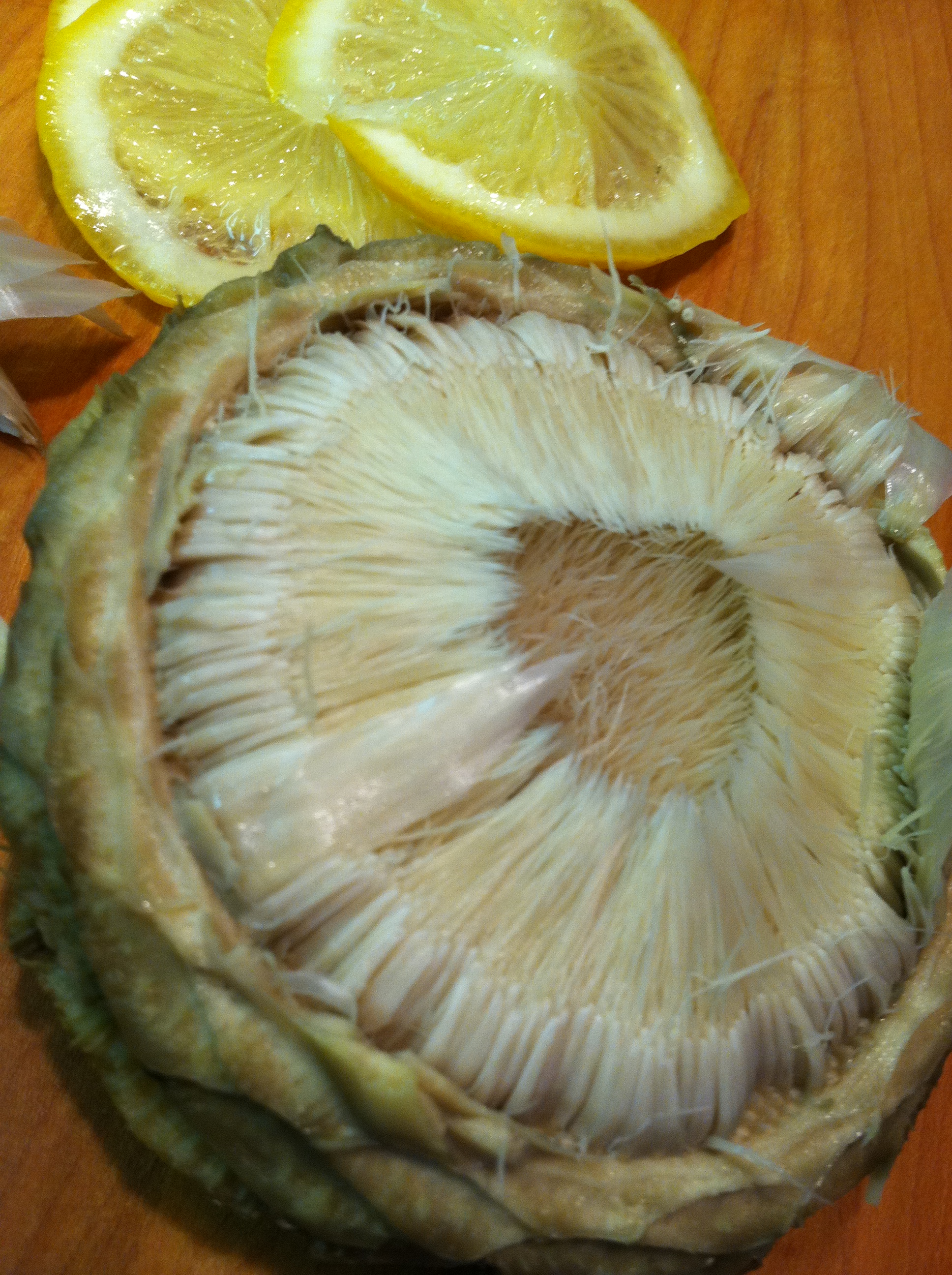
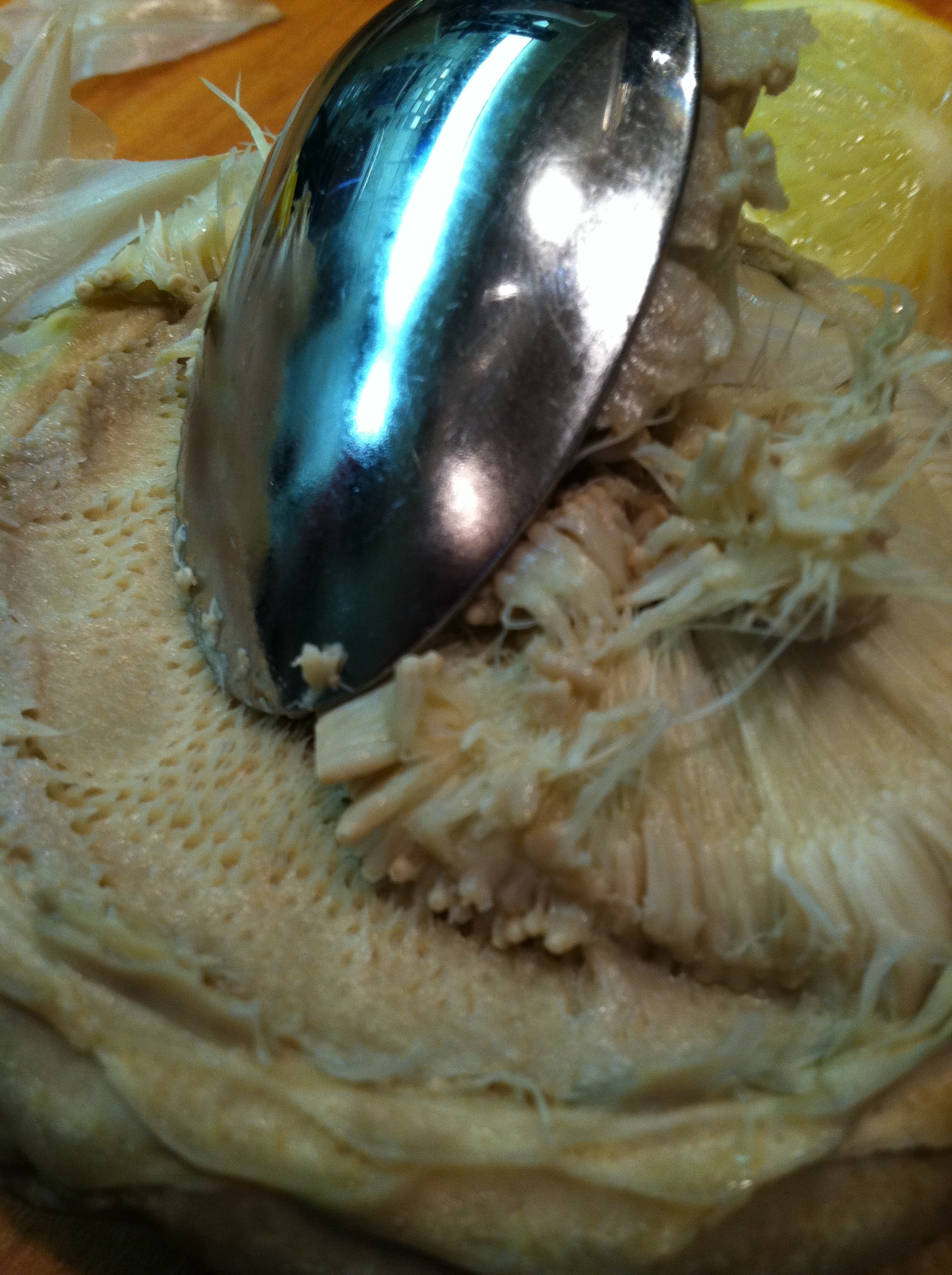
As you consume the leaves, the bottom will become visible. Once all the leaves have been consumed, you will find a “choke” in the very center. It is anchored by the bottom of the artichoke.

The "choke"
Notice how fuzzy it is; not leaf like at all

Scrape the choke away from the bottom; discard

The cleaned artichoke bottom

This is how it looks upside down

Cut artichoke bottom ready to use in salads, dips, etc.

You do not eat the choke because it is inedible and if you attempt to eat it, you will choke!

Scrape away the choke and eat the bottom. For this part, you will need a knife and fork.

You can always save it for slicing, mashing into Spinach Artichoke dip, salads or leave it whole and stuff it for a completely different dish.

If you have any leaves left over, scrape the flesh from the leaves with a spoon and make soup, salad dressings or use the artichoke scrapings in stuffing. There isn’t much shape to the scraping, use it like you would something mashed.

You can try making them the Roman way too. (Thanks, Barbara!)

Steamed Artichoke with Yogurt Sour Cream Dip and Crispy Kale Chips

Pickled Beets

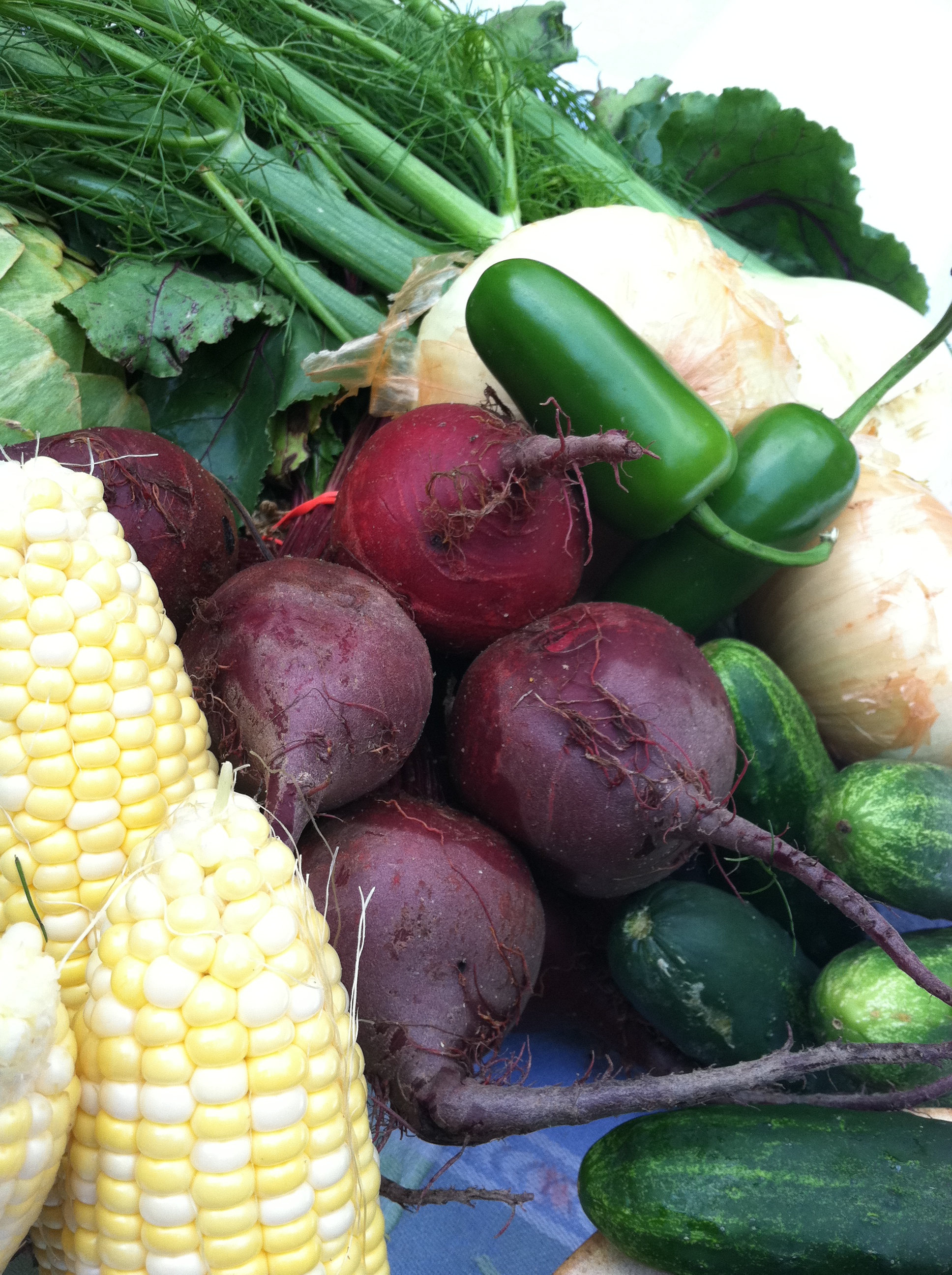
Pickled beets jumped out at me this weekend while at the farmers market. I brought home a beautiful bunch of beets with the greens, for just $2.50 this was a real steal.

I made a list of what I could do with them: Roasted beet salad with blood orange vinaigrette, Beet chutney, beets in butter with a splash of rice vinegar and in the end, pickled beets won.

I suppose I thought the bunch of beets was larger than it really was.

The first step in all the recipes is to cook them.

There are several ways, the best method and least messy is to steam them.

Here’s the thing about beets. They will “bleed” this lovely magenta color everywhere and leave a legacy of stains behind them.

Trick of the trade: Don’t cut, nick or peel them before cooking.

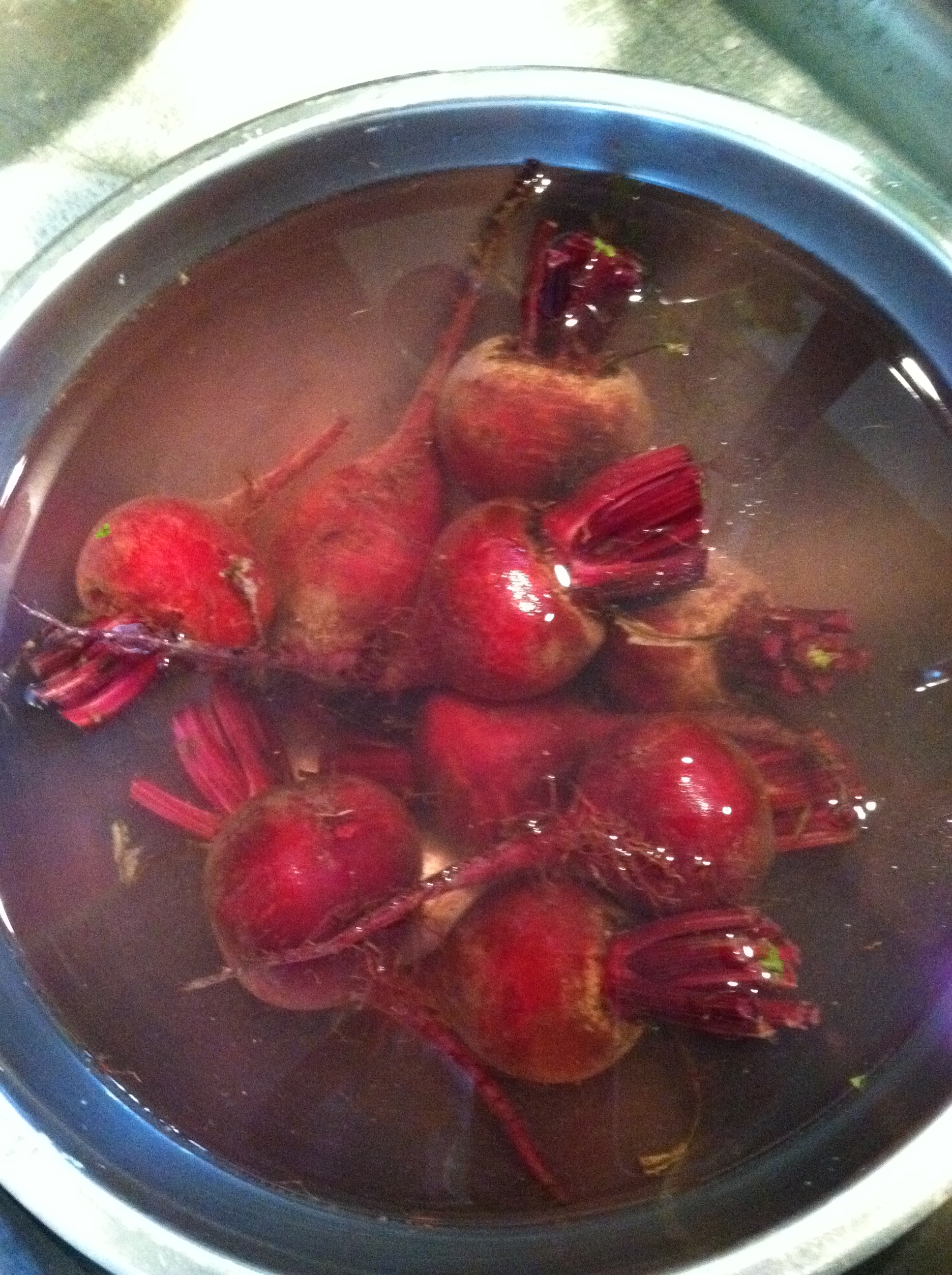
Trim leaving 1-2″ of stem; soak to remove soil and sand.
Do not peel or cut.

Trim the roots from the stems by cutting at least 1-2 inches of stem remaining on the root end. Leave the tap-root end in tact also, don’t trim it, just tuck it out-of-the-way.

Gently wash the beets to remove excess soil and sand. Don’t scrub them as they have a thin skin. Soaking for a few minutes is usually good.

Keep the greens. Set them aside in a large deep bowl of cold water. Remove any yellowish or ‘spotted’ leaves you wouldn’t want to eat.

Soak the leaves in cold water. Swish the leaves in the water gently. The sand will fall to the bottom of the bowl. Lift the leaves from the bowl without disturbing the bottom and repeat at least 4 times. You will be amazed how much sand and soil the leaves can hold.

Soak greens to remove dirt, and sand.
Change water 3-4 times

Lastly, rinse the leaves under running water, wrap in a towel, cover with plastic wrap or bag and store in the refrigerator until you want to use them in the next couple of days. That is another post.

How to use the beet greens is another post coming soon. The greens need to be cared for as soon as you remove the root ends so you don’t lose quality. If the greens look limp at first, they crisp up during the soaking process.

If you buy beets with greens and plan to use them later, separate the green tops and the root ends because the greens will pull nutrients, sugars and moisture from the roots during storage. (same with radishes, carrots, bulb onions etc.)

This recipe for pickled beets is simple and very flavorful. Some folks say they can eat the entire batch at once but that’s not recommended.

Steaming the beets takes the longest amount of time.

So here is how to make Pickled Beets:

Pickled Beets

  • Servings: 2 quarts
  • Difficulty: medium
  • Print

1 bunch of beets (8 medium size beets as close to the same size as possible)

Steam the beets by placing them in a steamer pot with a tight-fitting lid. Use good quality water to steam the beets. You will use 1/2 cup of this water in the pickling brine.

Steam the beets until tender

Steam the beets until easily pierced with a paring knife, just as you test a baked potato for doneness.

Do not pierce the beets often or all over as they will “bleed”. You want them to retain the color. Just test the biggest ones.

When the beets are done,  save the water in the bottom pot and place the beets in a big bowl of cold water. Once they are cool, underwater, using your hands, slip the skins off.The skins slip off very easily.

Set the peeled beets aside in another bowl.

Peeling underwater helps keep your hands from staining magenta.

Using a cutting board you can bleach later, trim the top and bottom, then slice the beets into thick slices and place them back into the bowl.

Make the brine and have the jars or containers you are going to store the finished beets in ready to fill.

Pickling brine

  • 3/4 cup apple cider vinegar
  • 3/4 cup water from steaming pot with beet drippings
  • 2 tablespoons sugar
  • 1/2 teaspoon kosher salt (or any non-iodized salt)
  • 3-4 black peppercorns
  • 2-3 whole cloves
  • 2 bay leaves
  • 1 cinnamon stick
  • 1 small sweet onion sliced

Bring the beet water and vinegar to a boil, add the remaining ingredients, including the onion and return to a boil. Boil for 1 minute.

Pour the hot mixture over the beets and gently stir with a rubber spatula to ensure all the beets are coated.

Pour the hot brine over beets, place in storage jars, cool. Serve cold.

Gently place the beets and all the brine into the storage jar. Allow to cool then refrigerate.

The pickled beets are ready to eat after 24 hours. One of my favorite parts are the onions that get pickled too. Slightly crunchy and  what a taste treat!

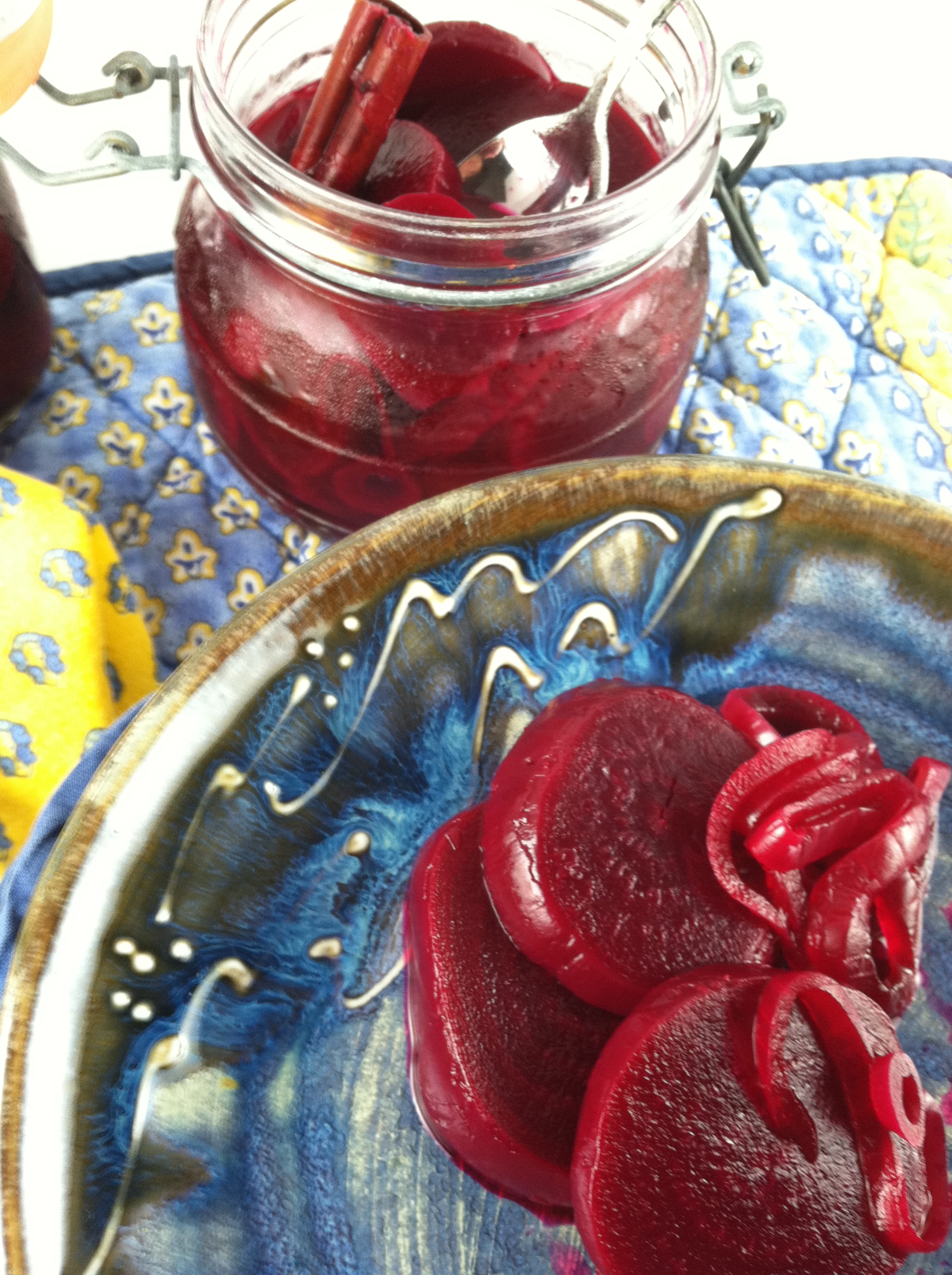
Pickled beets

Pickled Beets – I could eat the whole jar!

Serve very cold.